
 Google
 Yelp
 Facebook
 Twitter
 ChEnected
461687 Instructing Cells with Programmable Peptide-DNA Hybrids
Instructing Cells with Programmable Peptide-DNA Hybrids
Ronit Freeman1*, Nicholas Stephanopoulos1*, Samuel I. Stupp1
1. Simpson Querrey Institute for BioNanotechnology, Feinberg School of Medicine, Northwestern University, Chicago, IL 60611, US, Email: s-stupp@northwestern.edu
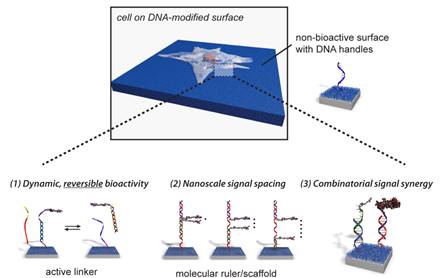 The native extracellular matrix is a space in which
signals can be displayed dynamically and reversibly, positioned with nanoscale
precision, and combined synergistically to control cell function. Artificial
forms of this matrix for tissue regeneration need to recapitulate these three
characteristics in a single molecular platform. Most efforts in this area have
effectively addressed only one of these three key phenomena, and focused mainly
on static cell adhesion or irreversible switching of bioactivity. Here we
describe a molecular system that can be programmed to control the dynamics,
spatial positioning, and combinatorial synergies of signals in extracellular
matrices. In this approach, a biological signal is immobilized to a surface
through DNA tethers, Figure 1. By engineering a series of tethers responsive to
different stimuli, we show that cells adhered and spread on the surface
reversibly. The DNA was also used as a molecular ruler to control the
distance-dependent synergy between two adhesion peptides. Finally, orthogonal
DNA tethers enabled the binding of both a peptide and a bioactive protein to
the surface in order to promote cell differentiation. This peptide/protein-DNA
(P-DNA) platform controls the way different signals are presented to cells and
their relative spacing and confers superior reversibility by employing a set of
bio-friendly stimuli. Multiple orthogonal DNA handles can be designed to allow
for the selective presentation of different signals, with the ability to
independently up- or down-regulate each over time. In principle, the anchoring
strand can be attached to any type of material, including three-dimensional
hydrogels, to better emulate the properties of the ECM.
Figure 1. Schematics of a DNA-modified surface used for the stimulus-responsive presentation of bio-active peptides and proteins in order to control cell adhesion, synergistic effects and differentiation.
See more of this Group/Topical: Materials Engineering and Sciences Division