
 Google
 Yelp
 Facebook
 Twitter
 ChEnected
462665 Systematic Investigation of Earth-Abundant Transition Metal Promoters for Pd-Catalyzed Methane Complete Combustion
Systematic Investigation of Earth-abundant Transition Metal Promoters for Pd-Catalyzed Methane Complete Combustion
Joshua J. Willis, Ian Andrew Naccarella, Helen Yan, Joseph Maalouf, Kester Wade, Matteo Cargnello
Department of Chemical Engineering and SUNCAT Center for Interface Science and Catalysis, Stanford University, Stanford, CA 94305, USA
There is a critical need for reducing emissions of methane, the second most prevalent greenhouse gas. Palladium is widely accepted the best metal catalyst. Still rates are unsatisfactory below 400˚C where new technologies for methane utilization (e.g. low-temperature combustion engines) are currently operating. Also, steam dramatically deactivates Pd-based catalysts through the formation of less active hydroxide phases. Thus, there is a critical need to utilize Pd to the best possible extent and improve its activity and stability. Earth-abundant transition metals (Mn, Fe, Co, Ni and Cu) as promoters are a promising route to optimizing Pd utilization and destabilizing the formation of Pd hydroxide.
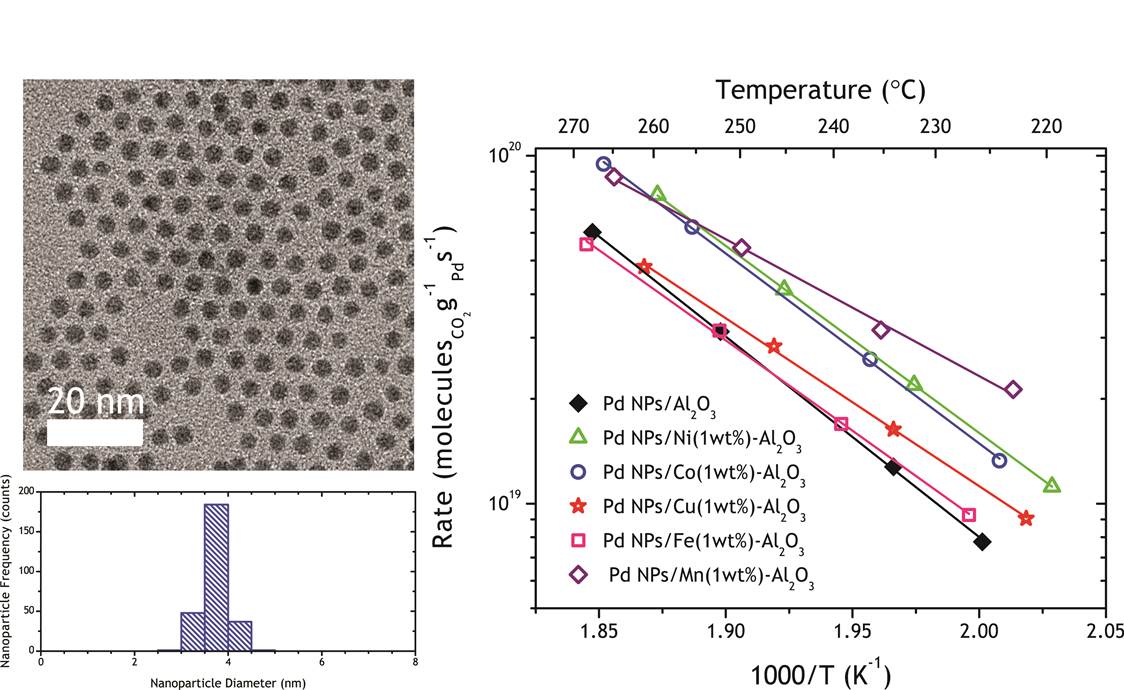 In order to perform systematic studies of promoting
effects in Pd-based catalysts, here we present the results of using highly
monodisperse palladium nanocrystals as the active phase. In this way, any variation
in catalytic activity can be directly attributed to the promoter structure and
properties. By deposition of the nanocrystals onto promoted γ-alumina
(M-Al2O3) and activation using a fast thermal annealing
process, a library of Pd/M-Al2O3 is obtained. By
controlling the Pd nanocrystal structure and size, promoter-activity
relationships can be drawn. Kinetic characterization demonstrates a unique
promoting effect for Pd-Mn systems for methane complete combustion, with
decrease activation energy and a three-fold increase in rates compared to the
corresponding Pd/M-Al2O3. Experiments in the
presence of steam also show pronounced effects of the promoters on the activity
of the Pd-only catalyst. Our work provides clear elements for improving the
activity of Pd-based combustion catalysts and in general a framework for
understanding promoter-activity relationships using highly uniform catalysts
under realistic reaction conditions.
See more of this Group/Topical: Catalysis and Reaction Engineering Division