
 Google
 Yelp
 Facebook
 Twitter
 ChEnected
462695 A Proliferation Switch of Fibroblasts in Alginate Microcapsules By in Situ Conjugation of RGD Peptides
Extracellular matrix (ECM) greatly affects proliferation, differentiation, and functions of cells. Chemical composition and structure of ECM dynamically changes during many physiological and pathological processes such as development of embryos, wound healing, and tumor growth. In order to mimic these dynamics, we newly developed clickable alginate microcapsules, which can introduce thiol-containing peptides by in situ conjugation between maleimide and thiol groups. In fact, encapsulated fibroblast cells started proliferation by in situ conjugation of CRGDS, while free RGDS did not show any effect. In tissue engineering, accurate and economic methods for induction of differentiation of stem cells are required. We expect that these microcapsules can be utilized for future cell differentiation process.
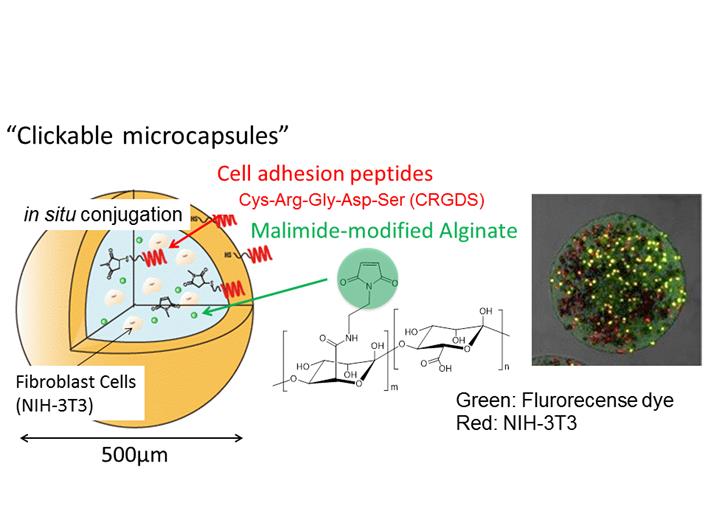
Fig 1. Schematic illustration of a clickable microcapsule. Malieimide-modified alginate microcapsules crosslinked with calcium ions can encapsulate NIH-3T3 fibroblast cells, which started proliferation by the stimuli of in situ conjugation of RGDS with maleimide residues of alginate matrix.
See more of this Group/Topical: Materials Engineering and Sciences Division