
 Google
 Yelp
 Facebook
 Twitter
 ChEnected
463261 Analysis of Upstream Creeping Reaction Zones in Catalytic Monolith Reactors
Analysis of Upstream Creeping Reaction Zones in Catalytic Monolith Reactors
Tian Gu and Vemuri Balakotaiah
Department of Chemical and Biomolecular Engineering, University of Houston, TX-77204
Abstract
Monolith reactors are widely used in catalytic after-treatment systems (e.g. TWC, DOC, LNT and SCR). One major challenge in exhaust after-treatment is reducing cold start emissions which accounts for a significant fraction of the total emissions. Recent developments in advanced combustion strategies such as low temperature combustion (LTC) make abating cold start emissions and meeting environmental regulations even more challenging.
During a cold start, ignition can occur at the front-end, in the middle or at the back-end of the reactor. After the reactor is ignited, it is desired that the reaction zone is maintained close to the inlet so that when small excursions in gas velocity, inlet temperature and concentrations do not quench the reactor. This can be achieved if front-end ignition is possible (which requires high precious metal loading and/or high inlet temperature and/or high adiabatic temperature rise). While front-end ignition is technologically possible, it may be economically impractical. In such cases, back-end ignition followed by a fast upstream creeping reaction zone provides a feasible way to reduce cold start emissions.
In this work, the upstream creeping reaction zone is investigated in detail using a modeling approach. The effects of various design parameters (e.g. solid thermal conductivity, heat capacity, etc.) and operating conditions (gas velocity, inlet temperature/concentrations) on the creep velocity are determined and summarized as a correlation. Analytical criteria for reaction zones to creep upstream are also presented. These criteria can provide guidance for both design and control of catalytic after-treatment systems.
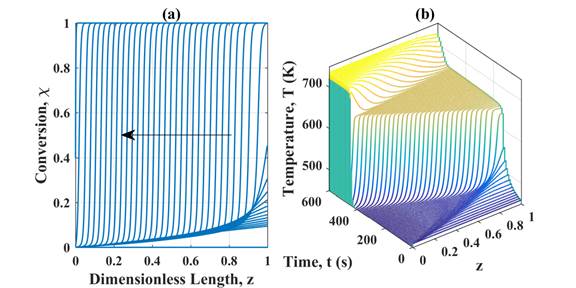
Fig.1 Snapshots of transient (a) conversion and (b) temperature profiles during
a cold start showing an upstream creeping reaction zone. Snapshots are taken
every 10s.
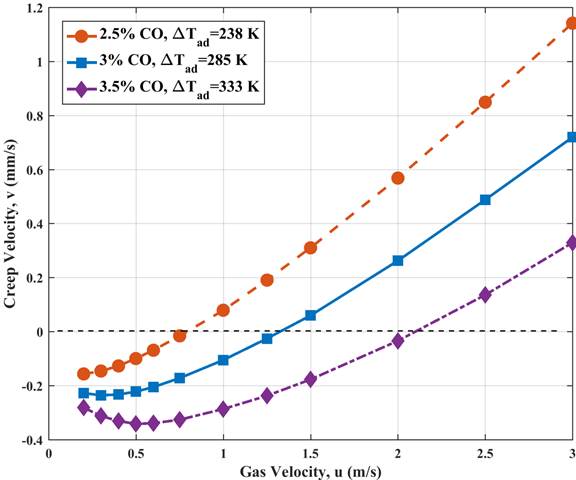
Fig.2 Creep velocity as a function of the gas velocity with different adiabatic temperature rise.
See more of this Group/Topical: Catalysis and Reaction Engineering Division