
 Google
 Yelp
 Facebook
 Twitter
 ChEnected
463504 Micro/Nano Lignocellulosic Fibrils (MNLCF) Aerogels from Coconut and Oil Palm Tree Residuals and Application for Environmental Remediation
The extensive utilization of oil palm and coir plantations worldwide has led to a substantial generation of residual biomass1. Therefore, an integrated utilization of related biomass streams is a necessity that, in fact, can become a source of valuable natural fibers. In addition, replanting operations and environmental issues can be avoided this way. The lignocellulose sources used in this study, include coir fibers and oil palm empty fruit bunches (EFB), both of which have high microfibril angle (~450) that imparts high breaking strain and low elastic modulus, making them useful for producing ropes, mats and fishing nets2,3. Coir and EFB fibers are cheap and a renewable resource but a vast supply is wasted due to a lack of better utilization. These fibers have high lignin content, approximately 43% and 36% dry weight in coir and EFB, respectively. Lignin is an undesirable component in paper manufacturing as it causes yellowing of the paper and hence, coir and EFB fibers do not find their use in high-volume papermaking. In fact, the current research on nanocellulose also focuses on producing lignin-free cellulose nanofibers which leaves a high carbon footprint on the environment4,5. Currently, lignin is utilized for their high calorific value which is a result of a cross-linked phenolic structure6. Recently, lignin has been shown to act as cementing material between cellulose nanofibers7. In addition, it has also been demonstrated that the porosity, hydrophilicity and the barrier properties of nanopapers or films of nanocellulose can be tuned via lignin content.
A high microfibril angle and a high lignin content, limits the applications of coir and EFB fibers. In the present study, we approach this problem by isolating micro/nano fibrils from the source fiber, thus foregoing effects related to the microfibril angle. We also target retaining the native lignin of coir and EFB by subjecting them to mild pulping conditions via hydrothermal treatment (see Table 1). A recently reported micro-emulsion method is used to facilitate defibrillation of the fibers8. The micro-emulsions swell and delaminate different structures of the fibers by disrupting intra-molecular hydrogen bonding. The micro/nano lignocellulosic fibrils (MNLCF) are obtained through microfluidization. A detailed characterization of the fiber defibrillation process is carried out via composition analysis, scanning electron microscopy (SEM), atomic force microscopy (AFM) and X-ray diffraction (XRD). The migration of lignin from cell wall to the defibrillated fibers is studied via confocal microscopy. The thermal properties of MNLCF is studied via thermogravimetric analyses (TGA) and differential scanning calorimetry (DSC). Our detailed analyses provide useful information to identify potential applications for the produced MNLCF. As a proof of concept, water-resistant and durable aerogels are synthesized from MNLCF via freeze drying (see Figure 1) and tested for adsorption of Zn(II), Pb(II) and Cd(II) salts.
Table 1: Chemical composition of fiber precursor before and after the treatment. All values are in %
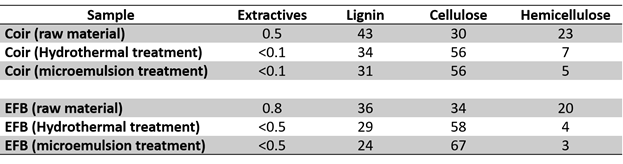
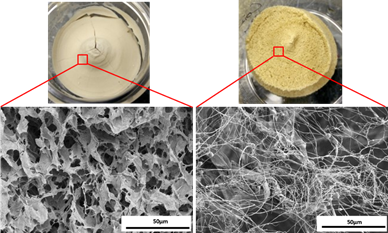
Figure 1: As-prepared aerogels from EFB (left) and coir (right) micro/nano lignocellulosic fibrils (MNLCF) along with their SEM images. The scale bar corresponds to 50µm
References:
1. Ferrer A, Vega A, Rodríguez A, Jiménez L. Acetosolv pulping for the fractionation of empty fruit bunches from palm oil industry. Bioresour Technol. 2013;132(November 2015):115-120. doi:10.1016/j.biortech.2012.12.189.
2. Khalil HPSA, Alwani MS, Omar AKM. Chemical composition, anatomy, lignin distribution, and cell wall structure of Malaysian plant waste fibers. BioResources. 2006;1(2):220-232. doi:10.15376/biores.1.2.220-232.
3. Satyanarayana KG, Kulkarni AG, Rohatgi PK. Structure and Properties of Coir Fibres. Proc Indian Acad Sci Ser Eng Sci. 1981;V 4 PT4(February):419-436. doi:10.1007/BF02896344.
4. Abraham E, Deepa B, Pothan L a., et al. Extraction of nanocellulose fibrils from lignocellulosic fibres: A novel approach. Carbohydr Polym. 2011;86(4):1468-1475. doi:10.1016/j.carbpol.2011.06.034.
5. Deepa B, Abraham E, Cordeiro N, et al. Utilization of various lignocellulosic biomass for the production of nanocellulose: a comparative study. Cellulose. 2015;22(2):1075-1090. doi:10.1007/s10570-015-0554-x.
6. Vanholme R, Demedts B, Morreel K, Ralph J, Boerjan W. Lignin Biosynthesis and Structure. Plant Physiol. 2010;153(3):895-905. doi:10.1104/pp.110.155119.
7. Rojo E, Peresin MS, Sampson WW, et al. Comprehensive elucidation of the effect of residual lignin on the physical, barrier, mechanical and surface properties of nanocellulose film. Green. 2015:1853-1866. doi:10.1039/c4gc02398f.
8. Carrillo CA, Laine J, Rojas OJ. Microemulsion Systems for Fiber Deconstruction into Cellulose Nano fi brils. Appl Mater Interfaces. 2014;6:22622-22627. doi:10.1021/am5067332 |.
See more of this Group/Topical: Forest and Plant Bioproducts Division - See also ICE