
 Google
 Yelp
 Facebook
 Twitter
 ChEnected
465023 Ab Inio Insights into the Electrochemical Double Layer
An ongoing challenge in computational electrochemistry is the accurate determination of electrochemical barriers due to the large cost associated with using adequately-sized cells to eliminate any artifacts contributing to the final result. A recent publication from our group provides a simple method to obtain these barriers more efficiently by employing a capacitor model.1 DFT calculations using this capacitor model have demonstrated, contrary to accepted knowledge, that the charge of a hydronium (H3O+) ion in the outer Helmholtz plane is not +1, but closer to +0.6. Thus, it is the goal of the current project to understand whether this is a physical phenomenon and the implications thereof on how we fundamentally treat electrochemical barriers.
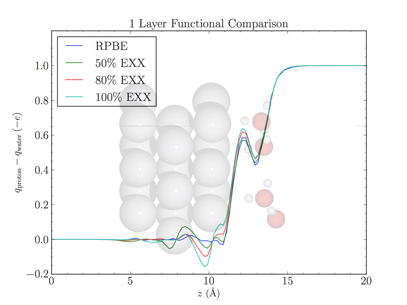
Figure 1. Cumulative charge difference between the protonated system (Pt slab + water + H) and the system with one fewer H (Pt slab + water) as a function of the z-coordinate of the unit cell, calculated with various functionals. Including various amounts of exact exchange only increases the electron density very slightly on the metal compared to GGA-level DFT. At the metal surface on the side of the solvent, there is a difference of 0.6 electrons, implying that the solvated H3O+ has a +0.6 charge instead of +1 in the first Helmholtz layer.
(1) Chan, K.; Norskov, J. K. Electrochemical Barriers Made Simple. J. Phys. Chem. Lett. 2015, 6 (14), 2663-2668.
See more of this Group/Topical: Engineering Sciences and Fundamentals