
 Google
 Yelp
 Facebook
 Twitter
 ChEnected
465066 Connected Nanoparticle Catalysts Having a Porous, Hollow Capsule Structure As Carbon-Free Electrocatalysts for Polymer Electrolyte Fuel Cells
We developed connected carbon-free platinum-iron (PtFe) nanoparticle catalysts with porous hollow capsule structure (Fig. 1) as oxygen-reduction-reaction (ORR) electrocatalysts for polymer electrolyte fuel cells (PEFCs).[1] This catalysts consist of a beaded network by connected PtFe nanoparticles with a crystallite size of 6~7 nm and a chemically-ordered (face centered tetragonal) superlattice structure. The beaded network is electrically conductive; thus, carbon-supports can be removed from catalyst layers in PEFCs. We have demonstrated that an MEA prepared using a carbon-free cathode of connected PtFe-nanoparticle catalysts was highly durable against start-up/shut-down operations because of the elimination of carbon-corrosion problems. Moreover, an ORR specific activity of a connected PtFe catalyst is about 9 times higher than that of a commercial Pt-nanoparticle catalyst supported on carbon black (Pt/C). Recent results will be explained.
[1] T. Tamaki, H. Kuroki, S. Ogura, T. Fuchigami, Y. Kitamoto, and T. Yamaguchi, Energy Environ. Sci., 8, 3545-3549 (2015)
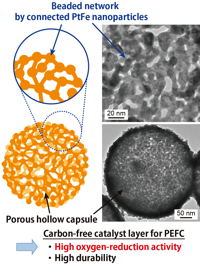
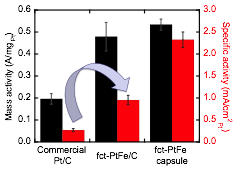
Fig. 1. Schematic illustration and TEM images of a carbon-free connected PtFe-nanoparticle catalyst with porous hollow capsule structure and its ORR activity compared with catalysts on carbon.
See more of this Group/Topical: Catalysis and Reaction Engineering Division