
 Google
 Yelp
 Facebook
 Twitter
 ChEnected
465515 Measurement and Correlation of Solubility and Diffusion Coefficient of Ethylene in Molten Propylene-Co-Polymers
Summary
Introduction
Experiments
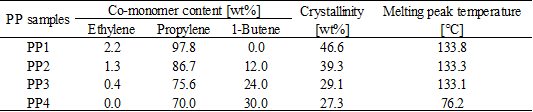
Table 1 The
Characteristics of PPs
Models
Solubility
and diffusion coefficients of ethylene in molten poly(propylene-ethylene-1-butene)co-polymers
(PPs) with different crystallinities were measured at
140 °C and 180 °C and up to 2.5 MPa. There was no
significant difference in solubility of ethylene in PPs at each temperature. Experimental
solubility was successfully correlated by the Sanchez-Lacombe equation of state.
On the other hand, the diffusion coefficient of ethylene in PPs was not
identical. The difference of diffusion coefficient was possibly caused by the
difference of specific volume of the PPs and/or of glass transition temperature
of the PPs. Diffusion coefficient was successfully correlated by the Kulkarni’s Free-Volume-Theory.
Propylene-co-polymer (co-PP) is widely used in the society due to its unique
mechanical and molding characteristics. In the industry, co-PP is usually
manufactured by the gas phase polymerization process which is progressed as
monomer molecules dissolve and diffuse into polymer and reach catalysts. Co-PP
is known as crystalline polymer having both crystalline and amorphous regions
in it and it has reported that monomer solution and diffusion only take place
in the amorphous region [1]. Therefore crystallinity
of co-PP strongly affects solubility and diffusivity of monomer in co-PP.
Furthermore, figuring out the relationship between crystallinity
and solubility and diffusivity of monomer is needed to optimize the
polymerization process. However, it is difficult to obtain phase equilibrium
data under a constant crystallinity since crystallinity has temperature and pressure dependences and
is changeable by thermal histories. Hence there have been reported only a few studies
that quantify the effect of crystallinity on
solubility and diffusivity of monomer in co-PPs with a wide range of crystallinity. In this work, solubility and diffusion
coefficient of ethylene in molten poly(propylene-ethylene-1-butene)co-polymers
(PPs) with different crystallinities were particularly
measured at 140 °C and 180 °C. The reason for the selection of temperature
above the melting point of PPs was to examine the affinity between ethylene and
PPs polymer chain without the effect of crystalline. In addition, solubility
and diffusion coefficient were correlated by the Sanchez-Lacombe equation of
state and the Kulkarni’s Free-Volume-Theory respectively.
Ethylene was used as monomer and four poly(propylene-ethylene-1-butene)-co-polymers
with different crystallinities were used as polymer
samples. Characteristics of polymer samples are listed in Table 1. Melting
point was determined by DSC measurement and set as using peak top temperature. Crystallinity was determined by density. Measurement of
solubility and diffusion coefficient was operated by the gravimetric method
using a Magnetic Suspension Balance (MSB) under 140 °C and 180 °C and up to 2.5
MPa with 0.5 MPa steps.
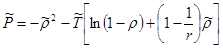
Solubility of ethylene in PPs was correlated by the Sanchez-Lacombe
equation of state (SL-EoS) [3, 4] shown in Equations
1 and 2.

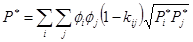
Where
kij
was a fitting parameter for correlation.
Results and Discussions
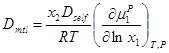
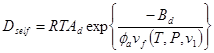
On the other hand, diffusion coefficient was correlated by the Kulkarni’s Free-Volume-Thoery (FVT)
[7] expressed in Equations 4, 5 and 6.

Figures 1 and 2 show the solubilities of ethylene
in PPs at 140 °C and 180 °C, respectively. The solubilities
increased with decreasing temperature and increasing pressure linearly. Solid
lines in Figures 1 and 2 denote the correlation by the SL-EoS.
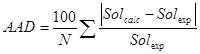
Experimental solubility of ethylene in PPs was successfully correlated with the
SL-EoS within the AAD defined by Equation 7 of 0.7%.
Moreover, solubility of ethylene in four different PP samples showed almost similar
values and the deviation of solubility in PP1 and PP4 defined by Equation 8 was
2.8% in 140 °C and 1.4% in 180 °C. Figure 3 shows the temperature dependence of
kij,
the binary interaction parameter in the SL-EoS in the
series of correlation. The maximum deviation of kij of PPs at both
temperatures was 9.6% in 140 °C, which changes solubility less than 3%. Hence, kij
can be treated as a constant for all PPs at each temperature.

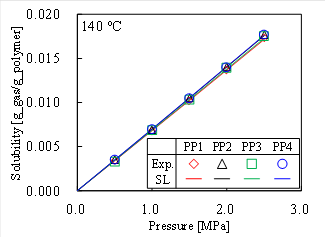
Figure
1 Solubility of ethylene in PPs at 140 °C
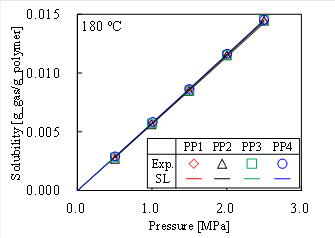
Figure
2 Solubility of ethylene in PPs at 180 °C
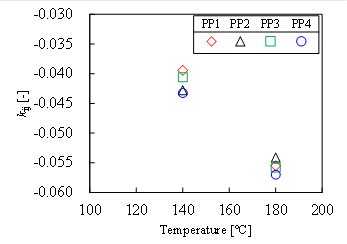
Figure
3 Temperature dependence of kij in
SL-EoS
Figures
4 and 5 show the diffusion coefficients of ethylene in PPs at 140 °C and 180 °C,
respectively. Diffusion coefficients of ethylene in PPs increased with
increasing temperature and concentration of ethylene. Solid lines in Figures 4
and 5 are the results of correlation by the FVT. Experimental diffusion
coefficients were successfully correlated with the FVT within the AAD defined
in Equation 9 of 4.0% at both temperatures. Additionally, the deviation of
diffusion coefficients of ethylene in PP1 and PP4 derived by Equation 10 was
about 22% in both temperatures. So it can be noticed that diffusion coefficients
of ethylene in PP4 is systematically larger than in PP1, while there wasn’t a
significant difference in the solubility.
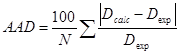

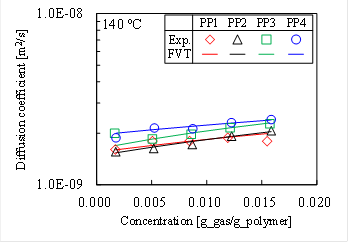
Figure 4 Diffusion
coefficient of ethylene in PPs at 140 °C
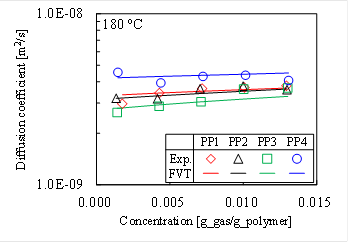
Figure
5 Diffusion coefficients of ethylene in
PPs at 180 °C
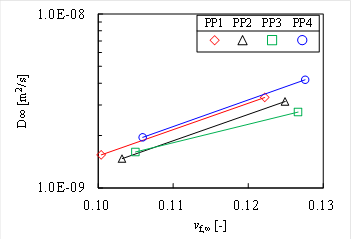
Figure
6 Diffusion coefficient vs free volume fraction of PPs at infinite dilusion
Conclusion
References
Symbols
Index
The solubilities and diffusion coefficients of ethylene in molten
PPs were measured at 140 °C and 180 °C and up to 2.5 MPa.
Both experimental solubilities and diffusion
coefficients were correlated by the SL-EoS and the
FVT, respectively. It can also be noted that the free volume fraction of PPs might
be the key parameters for relating the solubility and diffusion of ethylene in
polymers. Hence the PVT measurement of PPs would lead better understandings of
the relationship between the diffusion coefficients and the specific volumes of
PPs.
[1] A.S. Micheals and H. Bixler,
J. Polym. Sci., 50, 413 (1961). [2] I.C.
Sanchez and R.H. Lacombe, J. Phys. Chem.,
80, 2353 (1976). [3] I.C. Sanchez and R.H. Lacombe, Macromolecules, 11, 1145
(1978). [4] Y. Sato, M. Yurugi, T. Yamabiki, S. Takishima and H. Masuoka, J. Appl. Polym. Sci.,
79, 1134 (2001). [5]
Y. Sato, A. Tsuboi, A. Sorakubo,
S. Takishima, H. Masuoka,
T. Ishikawa, Fluid Phase Equilibria, 170,
49 (2000). [6] S.S. Kulkarni and S.A. Stern, Journal of Polymer Science: Polymer Physics
Edition, 21, 441 (1983). [7]
M.L. Williams, R.F. Landel, and J.D. Ferry, J. Am. Chem. Soc., 77, 3701 (1955).
P [MPa]:
pressure,
1: monomer, 2: polymer, s: standard state
See more of this Group/Topical: Engineering Sciences and Fundamentals