
 Google
 Yelp
 Facebook
 Twitter
 ChEnected
465607 Transformable Liquid-Metal Nanomedicine
TRANSFORMABLE LIQUID-METAL NANOMEDICINE
Yue Lu1,2, Quanyin Hu1,2, Yiliang Lin2, Frances S. Ligler1,2, Michael D. Dickey2 and Zhen Gu1,2,*
1 University of North Carolina at Chapel Hill, Chapel Hill, NC, 27599, USA;
2 North Carolina State University, Raleigh, NC, 27695, USA
Purpose
To date, numerous inorganic nanocarriers have been explored for drug delivery systems (DDSs). However, the clinical application of inorganic formulations has often been hindered by their toxicity and failure to biodegrade. We report here a novel liquid metal (eutectic alloy of gallium indium, designated EGaIn)-based nano-scale formulation for controlled drug delivery to achieve enhanced anticancer therapy.
Methods
To obtain liquid-metal based drug nanocarriers, an ¡°emulsion¡±-like ligand-mediated procedure is simply applied through ultrasonication at room temperature. During sonication, the thiolated ligands readily assemble onto the surface of the EGaIn, competing with the oxidation process and facilitating control of the particle size. The two ligands used here, thiolated (2-hydroxypropyl)-¦Â-cyclodextrin and thiolated hyaluronic acid, not only serve as capping agents during the formation of nano-scaled liquid-metal spheres, but also play roles of drug loading matrix and active targeting moiety, respectively. The final formulation (designated LM-NP/L) comprises three primary functional constituents: a cyclodextrin-based drug loading motif, the targeting ligand hyaluronic acid and an EGaIn core.
Results
The resulting nanoparticles loaded with Dox have an average diameter of 107 nm and demonstrate the capability to fuse and subsequently degrade under a mildly acidic condition, which facilitates release of Dox in acidic endosomes after cellular internalization. Equipped with hyaluronic acid, a tumour-targeting ligand, this formulation displays enhanced chemotherapeutic inhibition toward the xenograft tumour-bearing mice. This metal-based DDS with fusible and degradable behavior under physiological conditions provides a new strategy for engineering theranostic agents with low toxicity.
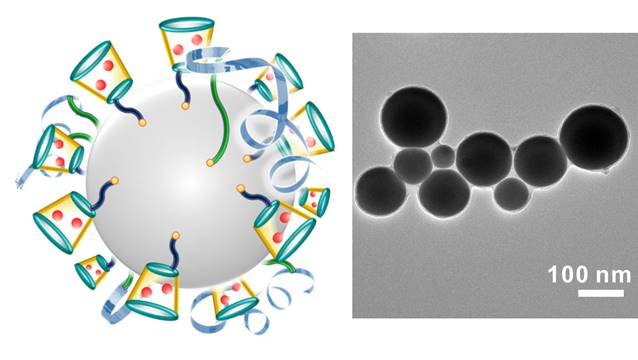
Figure 1. Schematic design and TEM image.
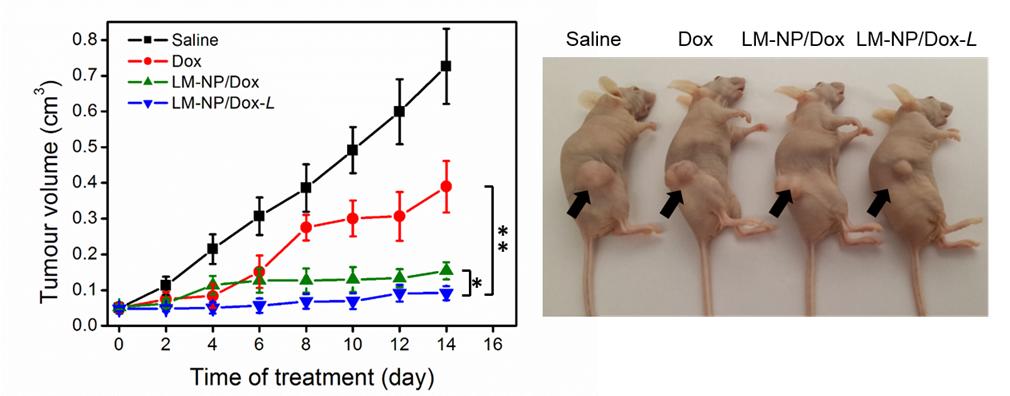
Figure 2. In vivo antitumour efficacy.
Conclusions
We have developed a new liquid metal-based drug delivery platform for anticancer therapy. The formulation can be easily formed and tailored via ligand-mediated self-assembly using facile ultrasonication. The resulting liquid-metal nanospheres are able to fuse for promoting drug release and eventually degrade under a mild acidic environment. After fusing, these nanospheres also display a contrast enhancing capability when imaged by X-ray, suggesting potential as a theranostic reagent. Systematic investigation of toxicology of LM-NP/L revealed no obvious toxicity at the treatment dose, favoring its biomedical applications.
Acknowledgements: NIH (CTSA, 1UL1TR001111) and NSF (CMMI-0954321, DMR-1121107).
References:
1. Yue Lu, Quanyin Hu, Yiliang Lin, Dennis B. Pacardo, Chao Wang, Wujin Sun, Frances S. Ligler, Michael D. Dickey and Zhen Gu (2015), ¡°Transformable Liquid-metal Nanomedicine,¡± Nature Communications, 6, 10066.
See more of this Group/Topical: Materials Engineering and Sciences Division