
 Google
 Yelp
 Facebook
 Twitter
 ChEnected
466588 Resolved Particle Fixed-Bed CFD with Microkinetics for Methanol Oxidation on Silver
Resolved Particle Fixed-bed CFD with Microkinetics for Methanol Oxidation on Silver
Behnam Partopour, Anthony G. Dixon
Department of Chemical Engineering, Worcester Polytechnic Institute,
Worcester, MA, USA, 01609
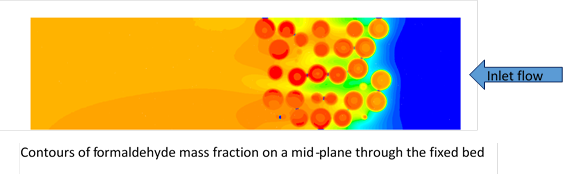
Formaldehyde is one of the highest volume chemicals with annual production of 46.4 million tons as of 2012. One of the major production processes for formaldehyde is methanol oxidation on silver. The reaction occurs at high temperature while carbon dioxide is produced as a dominant by-product. A microkinetics model was proposed and validated by Andreasen et al.1, to describe the reaction mechanism. The reaction parameters were highly affected by the temperature, species concentrations, and reactor configuration. Therefore, it is desirable to study the mechanism under realistic operating conditions. Recently, we have developed two approaches to couple the microkinetics model with computational fluid dynamics. Unlike the general approaches that couple CFD with microkinetics by setting the reaction as boundary condition for the fluid phase2, here we integrate the kinetics and transport by defining scalars inside the solid particles. The first method is using the reduced microkinetics with general rate expressions which are generated using the conventional reaction engineering assumptions. The second approach is to couple the detailed kinetics without any assumption about the elementary steps using splines regression with look-up tables.3 In this approach the microkinetics model is solved under the steady-state condition initially. Then the reaction rates are mapped into quadratic splines which are used for reaction rate evaluation during the CFD simulations. The simulations are carried out for a randomly packed bed of several hundreds of particles. It is observed that the reduced microkinetic model deviates from the original full microkinetic model under some extreme operating conditions. Moreover, diffusion limitations, axial and radial heat and transport profiles and their effects on the selectivity are studied. It is shown that the combustion is favorable at lower temperatures. Therefore, formaldehyde mass fraction increases along the tube while inside of the upstream particles (closer to the inlet) formaldehyde concentration decreases. It is also observed that when the oxygen mass fraction approaches zero inside the particles the overall reaction rate becomes zero. However, in the regions where methanol concentration becomes very low but oxygen and formaldehyde are present, combustion speeds up. These observations can be used to guide operation of the reactor to improve selectivity.
 |
References
1. Andreasen A., Lynggaard H, Stegelmann C, Stoltze P. A microkinetic model of the methanol oxidation over silver. Surf Sci. 2003;544(1):5-23.
2. Wehinger GD, Eppinger T, Kraume M. Detailed numerical simulations of catalytic fixed-bed reactors: Heterogeneous dry reforming of methane. Chem Eng Sci. 2015;122:197-209.
3. Partopour B, Dixon AG. Computationally efficient incorporation of microkinetics into resolved-particle CFD simulations of fixed-bed reactors. Comput Chem Eng. 2016;88:126-134.
See more of this Group/Topical: Catalysis and Reaction Engineering Division