
 Google
 Yelp
 Facebook
 Twitter
 ChEnected
466727 Student Activation and Interaction through Tutorials and Adequate Scheduling
Introduction
Activating students and interacting with them are hot topics in education. In this respect, blended learning, entailing the combination of a number of pedagogic approaches, irrespective of learning technology used, represents a valuable approach [1]. The idea of blended learning is founded upon the notion that every student has an individual way of processing new theories. By offering a broad range of educational tools, the chance for a student to successfully grasp a new concept drastically increases [2-5]. Currently, e-learning is being hyped as the ultimate form of blended learning. However, this form is not always easily accessible and similar outcomes might be obtained through another form of blended learning, e.g., tutorials. Moreover, a critical assessment and reorganization of the course schedule is expected to already significantly enhance the students’ motivation.
Kinetic Modelling and Simulation: starting situation
At Ghent University, Belgium, Kinetic Modelling and Simulation (KMS) is one of the core courses in the chemical engineering program. During this course, 20 to 30 students are confronted with a multidisciplinary field comprising mathematics, statistics, chemistry, engineering and informatics aiming at simulating and, hence, elucidating chemical kinetics. The KMS course spans a single semester, i.e., 12 weeks, and was constructed upon 5 different pillars: theory, examples, exercises, projects and feedback, see Figure 1. The theory, example and exercise sessions were given during the contact hours. In total, 8 ex cathedra theory sessions of 3 clock hours were scheduled in these 12 weeks to cover 5 topics: statistics (A), linear regression (B), non-linear regression (C), experimental design and model discrimination (D) and multi response regression (E). Exercises were only given on the topic of non-linear regression and were situated relatively far in time from the corresponding theory sessions, c.q., the theory on non-linear regression was given in weeks 4 and 5 while the corresponding exercises were held only in weeks 6, 7 and 9. During the latter weeks, the theory corresponding to other concepts such as experimental design was taught which did not promote the students’ learning process. Three projects were given on three different topics, i.e., linear regression, non-linear regression and experimental design aiming at model discrimination, after which students got overall feedback. At the end of the course, 4 to 5 PhD students presented their work as an example for different aspects in kinetic modelling.

Figure 1: Schedule of the course Kinetic Modelling and Simulation before reorganization
Although the course has been evaluated rather positively over the years, some issues were identified: (1) during the theory sessions, interaction was limited due to the rather abstract content, (2) students were ill-prepared for the exercise sessions, (3) not all concepts were put in practice through exercises and/or projects and (4) throughout the semester, the workload was concentrated at specific times.
Reorganizing of the course according to blended learning principles
Aiming at enhancing the students’ motivation and interaction with the teachers, a well-considered reorganization of the KMS course has been implemented, see Figure 2. Ex-cathedra theory blocks are, in this scheme, limited to 1.5 hours only and are followed by an equal amount of time for tutorials and hands-on trainings in which the students immediately process and apply the theory covered in the preceding time block. In addition, after a number of theory and tutorial sessions, a project assignment is given as a closure of that particular topic in which the student has to prove that he/she can apply the theory individually. After every project, which takes two weeks, students receive individual feedback. Compared to the previous schedule, the sequence of theory processing through ex-cathedra block, tutorials and projects is more continuous and, hence, contributes to a more blended learning environment. The work presented by the PhD students as kinetic modelling examples has been spread out more evenly at the end of the semester. Lastly, some additional topics have been introduced: contribution and reaction pathway analysis (F) and ‘reading and analyzing a scientific publication’ in regression analysis (G) which are well considered and relevant in the field of kinetic modelling.

Figure 2: Schedule of the course Kinetic Modelling and Simulation after reorganization
Feedback and grading
Every student receives feedback in various ways throughout the semester. Firstly, all 6 tutorial sessions are led by a number of assistants, i.e., one assistant per 6 to 7 students. Hence, during these tutorials, every student has a close interaction with an experienced assistant. In addition, after every project, each student has personal feedback, not only on their hard skills, i.e., the project report content, but also on their soft skills, i.e., writing, visualizing and summarizing. At the end of the semester, there is a common feedback session in which the students give direct feedback to the teacher and assistants.
The final grade for the KMS course is composed of two parts. One third is earned via the three projects made during the semester. The remaining two thirds are obtained viva voce. Typically, this examination comprises a theoretical question and a case study or a scientific publication analysis. A student acquires the credits for the course when they obtain a weighted score exceeding 50% (10 out of 20) with minimum score of 40% on both components individually.
Benefits and challenges
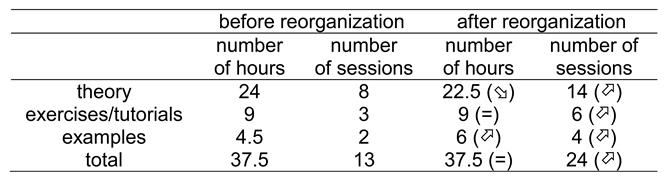
An overview of the number of contact hours and sessions is given in Table 1. Concerning theory, the contact hours decreased from 24 to 22.5 hours while the number of contact sessions almost doubled. This yielded more time for the students in which they can process the concepts taught. Surprisingly, the time spent on exercises/tutorials stayed identical while the number of sessions increased with 100%. Since these sessions are planned directly after the corresponding theory session, the tutorials are tailored specifically to this theory. Finally, more time was allocated for the PhD students to explain their work within the framework of kinetic modelling to the students. Although it could already be implied from a comparison of Figures 1 and 2, this reorganization did not result in a significant increase in workload for the teacher and assistants. Moreover, the total number of contact hours remained equal while the number of contact sessions doubled. However, having a more strict schedule, requires the teacher and assistants to have a more strict schedule.
Table 1: Number of contact hours and sessions of the course Kinetic Modelling and Simulation before and after reorganization
Conclusions
By critically assessing and reorganizing the schedule for the course Kinetic Modelling and Simulation according to blended learning principles, the student/teacher/assistant interaction has significantly increased, as reflected by the increase in number of contact sessions. This resulted in a significantly augmented student motivation. Although the amount of time spent by the teacher and assistants during the course stays equal, it requires more flexibility. The immediate follow-up of theoretical by the corresponding tutorial sessions allows for a more direct learning process of the students, remediating their previous ill-preparedness for the exercises. In addition, the workload has been spread out more evenly over the semester.
References
[1] M. Oliver, K. Trigwell, Can 'Blended Learning' Be Redeemed, E-Learning, 2 (2005).
[2] N. Hoic-Bozic, V. Mornar, I. Boticki, A Blended Learning Approach to Course Design and Implementation, Ieee T Educ, 52 (2009) 19-30.
[3] M.V. Lopez-Perez, M.C. Perez-Lopez, L. Rodriguez-Ariza, Blended learning in higher education: Students' perceptions and their relation to outcomes, Comput Educ, 56 (2011) 818-826.
[4] V. Woltering, A. Herrler, K. Spitzer, C. Spreckelsen, Blended learning positively affects students' satisfaction and the role of the tutor in the problem-based learning process: results of a mixed-method evaluation, Adv Health Sci Educ, 14 (2009) 725-738.
[5] J.H. Wu, R.D. Tennyson, T.L. Hsia, A study of student satisfaction in a blended e-learning system environment, Comput Educ, 55 (2010) 155-164.
See more of this Group/Topical: Education Division