467234 Diffusiophoresis of Colloidal Particles in the Limit of Very High Ionic Strength
Wednesday, November 16, 2016: 4:00 PM
Union Square 23 & 24 (Hilton San Francisco Union Square)
Dennis C. Prieve1, Stephanie M. Malone
1 and Mazen Kanj
2, (1)Chemical Engineering, Carnegie Mellon University, Pittsburgh, PA, (2)Saudi Aramco and KFUPM, Dhahran, Saudi Arabia
Diffusiophoresis is the deterministic migration of a
colloidal particle through an aqueous solution, driven by a gradient in
concentration of a solute which experiences a long-range interaction with the
colloidal particle. The prefix “diffusio-“
refers to the need for the range of interaction between particle and solute to
be large enough that any stress exerted along the particle surface by the
concentration gradient can result in flow of the fluid relative to the
particle.
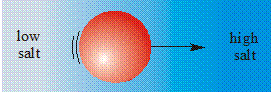 For
charged colloidal particles and electrolytes, the particle-solute interaction
is electrostatic and the range equals the Debye screening length, which is
inversely proportional to the square-root of ionic strength. In the limit
of very high ionic strengths, diffusiophoresis and electrophoresis are expected
to vanish.
We measured the rate of deposition of 320 nm anionic
latex particles onto the face of a Nuclepore membrane
having 100 nm pores, which separates a stirred solution having 4 M of NaCl from
another stirred solution having 0.4 M of NaCl plus 5wt% latex. The weight
of deposit grew linearly with time over the 20 minutes of the experiment and
corresponds to a particle speed of about 3 micron/sec. A diffusion
potential of 7 mV was also measured with the high-salt side being more positive.
The observed dependence of the deposition speed and
diffusion potential on the ratio of salt concentrations (see Fig. 1) is
consistent with a mechanism in which the negatively charged latex particles
undergo electrophoresis in the electric field induced by the salt
gradient. Given that the Debye length is only 0.15 nm (less than one
water molecule) at 4 M, it is astonishing that the particle moves at all.
Indeed the measured electrophoretic mobility of the latex decreases monotonically
to zero at about 5 M of NaCl (see Fig. 2).
One likely reason for our astonishment is that the
equation used for calculating Debye length for a given salt concentration (as
well as nearly all the models for electrophoresis and diffusiophoresis) is
based on the assumption that the electrolyte solutions are thermodynamically
ideal. But at these high salt concentration, steric repulsion between
ions of finite size makes the solution highly nonideal.
The observed persistence of diffusiophoretic transport
of particles in high salinity gradients bodes well for the application of
functionalized nanoparticles in enhanced oil recovery during which medium-salinity
flood waters contact connate brines in reservoirs.*
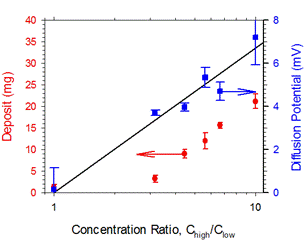
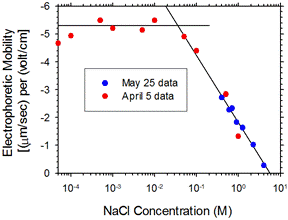
Fig. 1
Fig. 2
Extended Abstract: File Not Uploaded

 Google
 Yelp
 Facebook
 Twitter
 ChEnected