
 Google
 Yelp
 Facebook
 Twitter
 ChEnected
467244 Electric-Field-Assisted Protein Crystallization in Continuous Flow
The competitive environment in global market for biopharmaceuticals calls for shorter development times, improved manufacturing flexibility, reduction of batch-to-batch variability and reduction of the footprint of production facilities. A key method to potentially achieve these improvements is to switch from traditional batch-wise manufacturing to continuous manufacturing1, which offers several potential advantages such as a reduction in the number of required processing steps, simplified scale-up, and the ability to implement more effective process control strategies.2 The separation of a protein from a mother liquor with impurities is a typical biopharmaceutical process. Compared to traditional packed-bed chromatography, crystallization is an important alternative, yielding high purities in a single processing step that can operate over a range of scales and throughputs. Unfortunately, the design and control of crystallization processes involving large biomolecules such as proteins remains notoriously difficult.
The transition of batch-wise to continuous manufacturing offers opportunities to develop new concepts for continuous protein crystallization.3 Usually, the kinetics of protein crystallization are optimized by manipulating relevant global variables such as concentration, temperature, and solvent composition. However, studies on the use of local variables to manipulate protein crystallization, such as electric fields, have also been reported4. All studies of the mechanism of electric-field-assisted crystallization have been conducted batch-wise and mainly with the objective of producing high-quality material for crystallography or biomedical analysis. The use of low-voltage AC electric fields for protein nucleation in a continuous flow setting for manufacturing has, to the best of our knowledge, not been addressed. Consequently, insights into the mechanism and guidelines for design of continuous electric-field-assisted protein crystallization are lacking.
The objective of this work is to investigate different electrode structures that could be implemented in a continuous flow device to control protein nucleation both spatially and dynamically. The long-term objective is to develop guidelines for the optimal design of a cell with microelectrodes to enable electric-field-assisted protein crystallization in continuous flow. To investigate the interaction of different types of electrodes and field properties on protein crystallization, microelectrode chambers (MEC) have been fabricated and tested. ITO coated glasses are used as electrodes and treated with standard lithographic techniques to obtain specific patterns (Figure 1). Two different types of electrodes have been tested, 1) parallel plate electrodes (Figure 1a-h) in which a potential difference is created in vertical direction, and 2) coplanar electrodes5 in which a potential difference in horizontal direction is created (Figure 1i-j). Lysozyme with a fluorescent label is used as the model protein in this study. In a typical experiment, supersaturated lysozyme solution is mixed with precipitant and injected into the MECs and observed under a microscope. Results demonstrate that under the applied electric field, the induction time for nucleation is reduced with an average induction time of around 20 hours for some electrode patterns. Furthermore, most of the protein crystals are found on the ITO electrode, which is probably due to the effect of local electric field minima. In addition, the number and quality of crystals are improved when using electric fields, especially compared with a reference case using non-conductive glass chambers.
In conclusion, electric fields can induce faster protein crystallization with higher crystal quantity and better quality. These findings can be used as guidelines for fabricating MECs for continuous protein crystallization by aligning the electrodes in flow channels. The advantage of the tested coplanar electrodes over parallel electrodes is that the height of the flow channels can be varied independently to optimize hydrodynamics whereas the height of channels with parallel electrodes also influences the electric field properties.
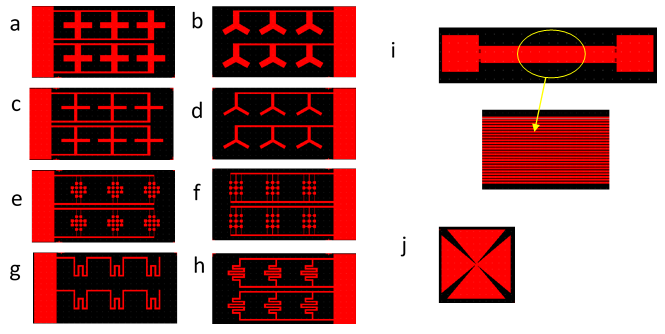
Figure 1. Various electrode structures fabricated with lithographic methods to construct MECs: (a-h) parallel electrode; (i, j) coplanar electrodes.
References
1. Mascia, S., Heider, P. L., Zhang, H. T., Lakerveld, R., Benyahia, B., Barton, P. I., Braatz, R. D., Cooney, C. L., Evans, J. M. B., Jamison, T. F., Jensen, K. F., Myerson, A. S. and Trout, B. L. Angewandte Chemie-International Edition, 2013, 52 (47), 12359-12363.
2. Lakerveld, R., Benyahia, B., Heider, P. L., Zhang, H., Wolfe, A., Testa, C. J., Ogden, S., Hersey, D. R., Mascia, S., Evans, J. M. B., Braatz, R. D. and Barton, P, I., Org. Process Res. Dev., 2015, 19, 1088-1100.
3. Neugebauer, P. and Khinast, J. G., Crystal Growth & Design, 2015, 15, 1089-1095.
4. Taleb, M., Didierjean, C., Jelsch, C., Mangeot, J. P., Capelle, B. and Aubry, A., Journal of Crystal Growth, 1999, 200, 575-582.
5. Hou, D. and Chang, H.-C., Applied Physics Letters, 2008, 92, 223902.
See more of this Group/Topical: Separations Division