
 Google
 Yelp
 Facebook
 Twitter
 ChEnected
467253 Novel Fe-Promoted MgAl2O4 Support Material for Control of Carbon Deposition during Reforming Reactions
Introduction
The role of the support in syngas production from methane has been widely investigated for various reforming technologies, like steam reforming (MSR), dry reforming (DRM), partial oxidation of methane (POM) and autothermal reforming (ARM) [1]. Inert supports, e.g. SiO2, although ensuring active metal dispersion, will result in quick deactivation due to carbon deposition, since both CH4 and CO2 are activated on the same active site (mono-functional mechanism) [2-4]. A bi-functional mechanism exist on acidic/basic supports (Al2O3, La2O3, MgO etc.), where CH4 is activated on active metals and CO2 on the support, thus enhancing the oxidation of deposited carbon [5-7].
To improve the latter mechanism, the synthesis of supported reforming catalysts should be adjusted in such a way that the support inhibits carbon formation by actively participating in the reforming reaction scheme. This should include (1) high temperature resistance, (2) basicity which will enhance the adsorption of CO2 and (3) good redox properties, in particular oxygen storage capacity [8, 9].
MgAl2O4 was widely investigated in literature as a suitable support material for reforming reactions due to its low cost. The addition of MgO to Al2O3 prevents interaction between active metals and alumina forming inactive spinel phases. Guo and co-workers [10] compared Ni/γ-Al2O3, Ni/MgO-γ-Al2O3 and Ni/MgAl2O4 during methane dry reforming. They found that Ni/MgAl2O4 exhibited higher activity and better stability compared to the other samples. The MgAl2O4 spinel can effectively suppress the phase transformation to form NiAl2O4 and stabilizes Ni crystallites. In order to lower significantly the carbon deposition during DRM conditions at high temperature (1023 K), the present study proposes a MgFeAlOx support, where Fe is incorporated in the magnesium aluminate lattice, as a cheaper alternative oxygen storage material.
Results
A series of Mg(a%)FeAlOx support materials (where α =0, 2.5, 5 ,7.5 ,10 and 20 wt%) were prepared by one-pot synthesis, using an aqueous solution of the corresponding nitrates and calcined at high temperature (1073 K). Supported 8wt.%Ni catalysts were prepared by incipient wetness impregnation on the Mg(α%Fe)AlOx materials, resulting in Ni/Mg(αFe)AlOx and were investigated during methane dry reforming at 1023 K and 121.3 kPa.
The evolution of the support and the catalyst structure during H2-TPR and CO2-TPO was examined using time-resolved in-situ XRD and operando-XAS. The XANES region of the support MgFeAlOx showed reduction through a shift of edge energy position towards lower values. The reduction remained partial as complete reduction to reference Fe+2 and Fe0 was not observed. This could indicate spinel reduction from MgFe+3AlOx to MgFe+2AlOx without complete segregation of iron from the support [11], while it can be re-oxidized to MgFe+3AlOx under CO2 flow. This redox ability of the support, with iron incorporated in the spinel lattice, is beneficial for suppressing the carbon deposition during reforming reactions. The in-situ XRD during H2-TPR of the catalyst, Ni/Mg(αFe)AlOx, showed the formation of Fe-Ni alloy, via Fe delivery from the support material to the catalyst surface. The presence of Ni enhanced the reducibility of iron to Fe0, indicating that part of Fe could be segregated from the support.
Figure 1 displays the space time yield, STY, of the products for the best candidate of Fe-promoted samples along with the non-promoted catalyst during a stability test (TOS of 12 h). The amount of deposited carbon was determined by O2-TPO.
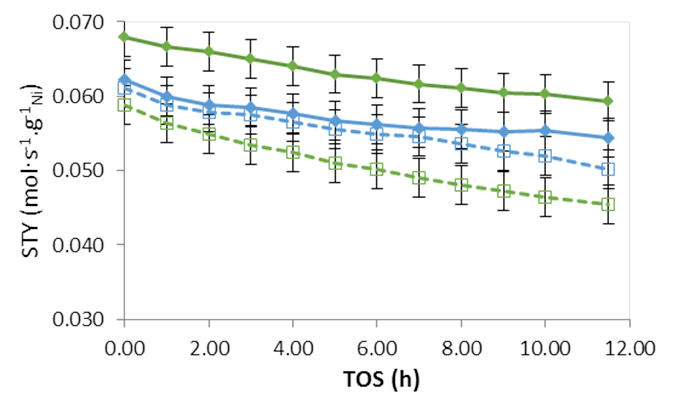
Figure 1: Stability tests during DRM after 12h time-on-stream (TOS) at 1023 K (total pressure of 121.3 kPa and CH4/CO2=1/1).♦,♦: STYCO (solid line); □, □: STYH2 (dashed line). Blue line: Ni/Mg(0Fe)AlOx where XCH4 from 72% to 60%, green line: Ni/Mg(2.5Fe)AlOx where XCH4 from 75% to 62%. Error bars were calculated after three independent experiments representing standard deviation (66% probability confidence interval).
Among the different supports, Ni/Mg(2.5Fe)AlOx has an optimal composition as it results in more syngas production with a ratio of CO/H2 equal to 1.2, due to reverse water gas shift reaction, while further increase of Fe content leads to catalyst activity decrease. The Fe addition in the support material increases the oxygen mobility through the support lattice, suppressing carbon formation during DRM. While 1.12 mol of carbon was deposited on Ni/Mg(0Fe)AlOx after 12h, no carbon was detected on samples with Fe incorporated in the support.
The novel Fe-promoted MgAl2O4 material could be used as a support for reforming reactions, replacing conventional oxygen storage materials (i.e CeO2) due to its low price. The difference in carbon deposition between Ni/Mg(0Fe)AlOx and Ni/Mg(2.5Fe)AlOx indicates the beneficial effect of Fe incorporation into the magnesium aluminate spinel lattice.
Acknowledgments
This work was supported by the FAST industrialization by Catalyst Research and Development (FASTCARD) project, which is a Large Scale Collaborative Project supported by the European Commission in the 7th Framework Programme (GA no 604277), by the “Long Term Structural Methusalem Funding by the Flemish Government”, the Interuniversity Attraction Poles Programme, IAP7/5, Belgian State – Belgian Science Policy, and the Fund for Scientific Research Flanders (FWO; project 004613N). XAS experiments were performed on the ROCK beam line, at the SOLEIL Synchrotron, France (proposal number 20150256). The authors acknowledge the SOLEIL staff for smoothly running the facility, support from Prof. C. Detavernier with the in situ XRD equipment (Department of Solid State Sciences, Ghent University) and from Dr. Vitaliy Bliznuk (Department of Materials Science and Engineering, Ghent University) for the HRTEM measurements.
References
1. Littlewood, P., X. Xie, M. Bernicke, A. Thomas, and R. Schomäcker, Ni0.05Mn0.95O catalysts for the dry reforming of methane. Catal. Today, 2015. 242, Part A(0): p. 111-118.
2. Kroll, V.C.H., H.M. Swaan, S. Lacombe, and C. Mirodatos, Methane Reforming Reaction with Carbon Dioxide over Ni/SiO2Catalyst: II. A Mechanistic Study. Journal of Catalysis, 1996. 164(2): p. 387-398.
3. Bitter, J.H., K. Seshan, and J.A. Lercher, Mono and Bifunctional Pathways of CO2/CH4 reforming over Pt and Rh Based Catalysts. J. Catal., 1998. 176(1): p. 93-101.
4. Ferreira-Aparicio, P., I. Rodrı́guez-Ramos, J.A. Anderson, and A. Guerrero-Ruiz, Mechanistic aspects of the dry reforming of methane over ruthenium catalysts. Appl. Catal., A, 2000. 202(2): p. 183-196.
5. Tsipouriari, V.A., A.M. Efstathiou, and X.E. Verykios, Transient Kinetic Study of the Oxidation and Hydrogenation of Carbon Species Formed during CH4/He, CO2/He, and CH4/CO2 reactions over Rh/Al2O3 Catalyst. J. Catal., 1996. 161(1): p. 31-42.
6. Zhang, Z. and X.E. Verykios, Carbon dioxide reforming of methane to synthesis gas over Ni/La2O3 catalysts. Appl. Catal. A 1996. 138(1): p. 109-133.
7. Pakhare, D. and J. Spivey, A review of dry (CO2) reforming of methane over noble metal catalysts. Chem. Soc. Rev., 2014. 43(22): p. 7813-7837.
8. Hecht, E.S., G.K. Gupta, H. Zhu, A.M. Dean, R.J. Kee, L. Maier, and O. Deutschmann, Methane reforming kinetics within a Ni–YSZ SOFC anode support. Appl. Catal., A, 2005. 295(1): p. 40-51.
9. Theofanidis, S.A., V.V. Galvita, H. Poelman, and G.B. Marin, Enhanced Carbon-Resistant Dry Reforming Fe-Ni Catalyst: Role of Fe. ACS Catal., 2015: p. 3028-3039.
10. Guo, J., H. Lou, H. Zhao, D. Chai, and X. Zheng, Dry reforming of methane over nickel catalysts supported on magnesium aluminate spinels. Appl. Catal. A 2004. 273(1–2): p. 75-82.
11. Dharanipragada, N.V.R.A., L.C. Buelens, H. Poelman, E. De Grave, V.V. Galvita, and G.B. Marin, Mg-Fe-Al-O for advanced CO2 to CO conversion: carbon monoxide yield vs. oxygen storage capacity. J. Mater. Chem. A, 2015. 3(31): p. 16251-16262.
See more of this Group/Topical: Catalysis and Reaction Engineering Division