
 Google
 Yelp
 Facebook
 Twitter
 ChEnected
467732 Effect of Fast Cycling on the Formation of HC Intermediates and NOx Conversion Using H2, Propene or Propane As Reductants
Effect of Fast Cycling on the Formation of HC Intermediates and NOx Conversion Using H2, Propene or Propane as Reductants
Allen Wei-Lun Ting, MengMeng Li, Michael P. Harold and Vemuri Balakotaiah
Department of Chemical & Biomolecular Engineering, University of Houston, Houston, TX 77204, USA
Abstract
A combined experimental and modeling study of fast cycling NOx storage and reduction for emissions control of lean burn gasoline and diesel vehicles is conducted to provide mechanistic insight. Experiments reveal notable NOx conversion enhancement for cycle times less than 10 seconds (fast cycling) compared to long cycle times of a minute (Fig. 1, Perng et al. Catalysis Today 231 (2014) 125–134 [HMP1] [TA2] ).
The mechanism of the fast cycling has been analyzed through both experiments and simulations with H2, propene, or propane as the reductant and ceria-free and ceria-containing NOx storage catalyst (Pt/BaO/Al2O3). For H2, more frequent storage and regeneration under fast cycling increases the storage capacity available proportionally when storage and reaction is capacity limited, with negligible effect when kinetically limited. The mechanism explains the increase in NOx conversion over a wide temperature range and corresponding decrease in the NH3 selectivity. The cycle-averaged catalyst temperature under fast cycling increases because of the combined effect of dispersion effect between lean and rich feed and the enhancement of O2 storage ability by ceria.
The “Di-Air” system proposed by Toyota researchers shows an overall increase in NOx conversion when using propene as the reductant under fast cycling[HMP3] [TA4] (Bisaiji et al., SAE 2011-01-2089). Modeling results show that fast cycling enhances the formation of a thermally-stable HC intermediates from propene and NO. This results in a substantial increase the conversion at high temperature (Fig. 2). However, using propane as the reductant shows a negative effect. Modeling results predict this inverse behavior by treating the dehydrogenation reaction from propane to propene to be the rate limiting step to reduce NOx.
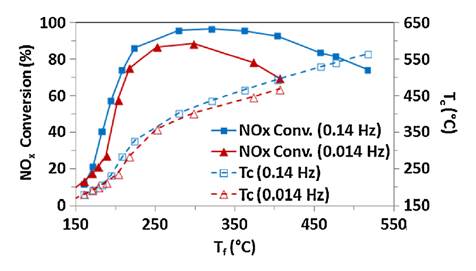
Fig. 1 Cycle averaged NOx conversion and catalyst temperature vs. feed temperature for two different frequencies. Feed: 700 ppm NO 5% O2, rich phase contain 1.75% C3H6.
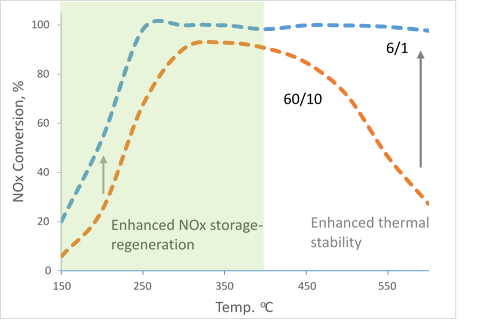
Fig. 2 Simulated isothermal cycle averaged NOx conversion vs. catalyst temperature for two different frequencies. Feed: 700 ppm NO 5% O2, rich phase contain 1.75% C3H6.
See more of this Group/Topical: Catalysis and Reaction Engineering Division