
 Google
 Yelp
 Facebook
 Twitter
 ChEnected
467828 Catalytic Conversion of 5-Hydroxymethylfurfural into Tetrahydrofuran–Dimethanol in Aqueous Media Using a Continuous-Flow Reactor
AIChE meeting 2016
Catalytic Conversion of 5-Hydroxymethylfurfural into tetrahydrofuran–dimethanol in aqueous media using a continuous-flow reactor
Sérgio Lima, Klaus Hellgardt, David Chadwick
Chemical Engineering Department, Imperial College London , London SW7 2AZ, United Kingdom
During the coming decades, the world is being challenged to reach its goals to replace a major part of its use of oil based feedstock for the production of new commodity chemicals and fuels. In this context, a particular attention is now given to the introduction of renewable carbon (e.g. biomass) in the chemical industry. Among the large variety of biomass available on earth, lignocellulosic biomass, a non-edible resource, has the potential to provide a direct access to valuable chemicals, ideally with similar or improved properties as compared to fossil-derived chemicals. Its high oxygen content, low accessibility to (bio)catalysts and its polyfunctionality makes the transposition of current catalytic processes to lignocellulosic biomass rather challenging. Tetrahydrofuran–dimethanol (THFDM) is a key derivative for the production of a wide range of non-petroleum-derived chemicals. In particular it can be used for the production of 1,6-hexanediol (1,6-HD; Scheme 1). 1,6-HD can be used to produce caprolactam, the monomer for nylon-6, a widely used synthetic polymer and is extensively used in the production of polyesters for polyurethane elastomers, coatings, adhesives, and polymeric plasticizers.[1,2]
In this work we wish to report on the heterogeneous catalysed continuous synthesis of tetrahydrofuran–dimethanol (THFDM) from 5-hydroxymethylfurfural (5-HMF) in water using a continuous-flow reactor. Raney-Cu and Raney-Ni were found to be effective catalysts for this reaction, using water as solvent in a two-steps process. The highest yield of THFDM (higher than 90 %) was achieved by first hydrogenation of 5-HMF to 2,5-furandimethanol (FURDM) in the presence of Raney-Cu follow by hydrogenation of FURDM to THFDM under 90 bar H2 at 90 ºC. Results indicate that large-scale production of low-cost platform and commodity chemicals for the polymer industries from carbohydrate biomass can be achieved in continuous flow processes.
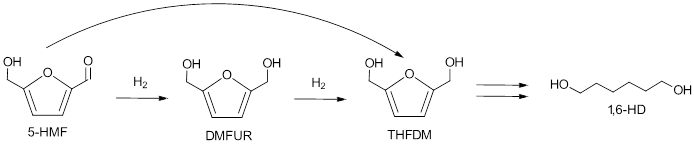
Scheme 1
1. Buntara T., Noel S., Phua P. H., Cabrera I. M., de Vries J. G., Heeres H. J., Angew. Chem. Int. Ed. 2011, 50, 7083-7087.
2. Figueiredo F. C. A., Jorda E., Carvalho W. A., Appl. Catal. A 2008, 351, 259-266.
See more of this Group/Topical: Sustainable Engineering Forum