
 Google
 Yelp
 Facebook
 Twitter
 ChEnected
468953 Process Intensification of Ethanol Dehydration Under Liquid Phase Conditions
Replacement of petroleum-derived chemicals with renewable alternatives has potential to improve the sustainability of the chemical industries, mitigate global CO2 emissions, and provide a bridge to an economy featuring cost-effective biofuels. Because most of the needed infrastructure is already in place, chemical upgrading of inexpensive fermentation products is especially attractive. Specifically, acid-catalyzed dehydration of ethanol to produce ethylene is a commercial process which has been demonstrated using a variety of acidic catalysts. One common upgrading catalyst is ZSM-5 zeolite, a three dimensional silica-alumina microporous framework made of internal channels with Brønsted acid sites. ZSM-5 catalyzed ethanol dehydration is highly selective for the desired ethylene product at lower operating temperatures relative to Syndol®, the catalyst currently used commercially for ethanol dehydration. In this work, we have examined continuous ethanol dehydration in the liquid phase, exploring a region of thermodynamic phase space that has received scant attention compared to the vapor phase.
Operating under liquid phase conditions has many potential benefits, including manipulation of product distribution, reduced separations burden, increased process intensity, decreased coke formation rates, and superior heat management for the highly endothermic reaction. As seen in Figure 1, the favored is butanol, a potential drop-in biofuel which is more than twice as valuable as ethylene according to current commodity prices. On the other hand, ethanol conversion does not suffer under liquid phase conditions compared to the vapor phase. Because the density of liquid reaction mixture is more than 100-times greater than the vapor phase at reaction temperatures, the result is an improvement in process intensity – that is moles of ethylene produced by gram of catalyst – or nearly 2 orders of magnitude. In terms of coke formation, operation under liquid phase conditions shows a clear reduction in catalyst coking. Finally, engineering calculations show superior heat transfer to the scaled-up liquid-phase reactor compared to the vapor-phase reactor. Based on this analysis, we conclude that liquid-phase ethanol upgrading has commercial promise and that liquid-phase reactions in general deserve increased attention.
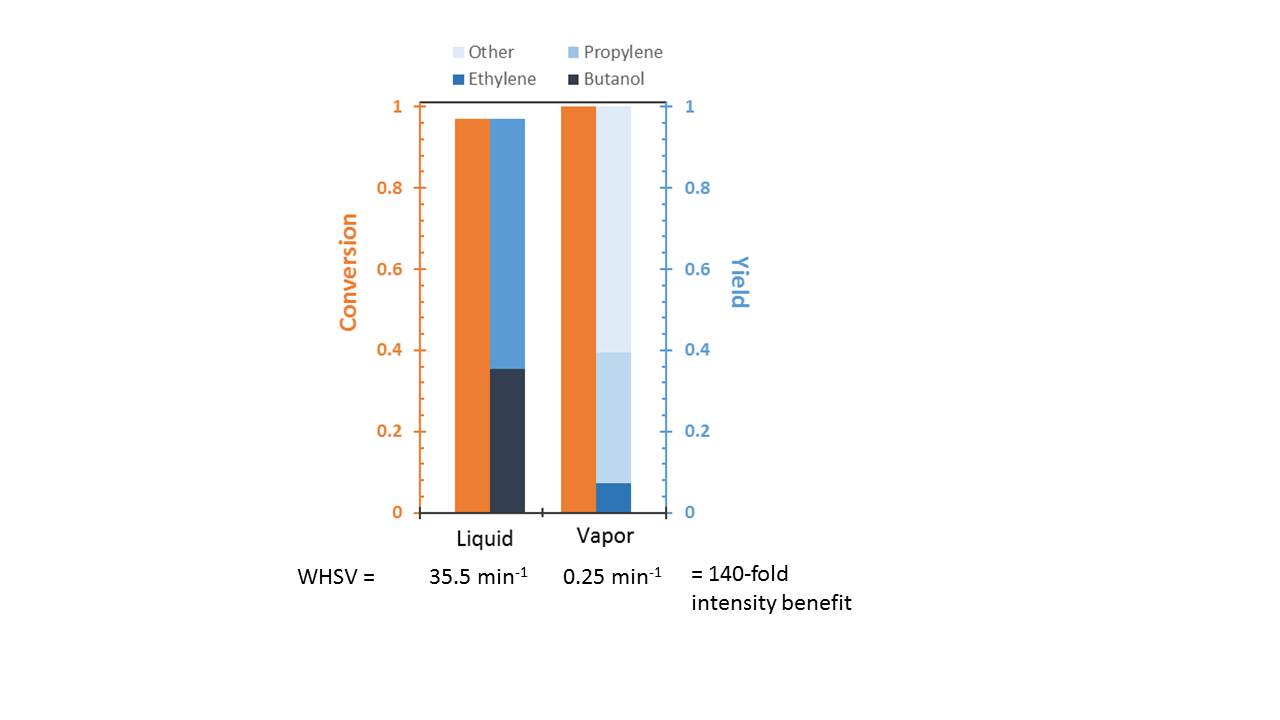
Figure 1: Product selectivity from ethanol dehydration operated under liquid phase conditions at 390OC
See more of this Group/Topical: Catalysis and Reaction Engineering Division