
 Google
 Yelp
 Facebook
 Twitter
 ChEnected
469250 Melt Rheology of Cellulose Ethers Designed for Hot Melt Extrusion
Melt Rheology of Cellulose Ethers Designed for Hot Melt Extrusion
Authors: Tirtha Chatterjee, Kevin O’Donnell, Yongfu Li, Uma Shrestha, Robert L. Sammler, Shrikant Khot
Formulation of new drug entities is increasingly challenging due to poor solubility of the drug and limited polymers that can produce amorphous solid dispersions (ASDs). One of the leading technologies to manufacture ASDs is hot melt extrusion (HME) in which the solid or melted drug is mixed with a molten polymeric carrier. In order to be processed, the polymeric carrier must have adequate melt rheology at temperatures acceptable for pharmaceutical applications. The AFFINISOL™ cellulosic polymer family has been engineered to have a melt viscosity that enables their use as excipients in HME.
In order to design a successful HME process the formulator must understand the excipient melt rheology as a function of operating conditions. In the present study, the melt rheology of AFFINISOL™ HPMC HME (hydroxypropyl methylcellulose) and HPMCAS HME (hydroxypropyl methylcellulose acetate succinate) is presented. Traditionally the melt rheology is characterized using a rotational rheometer, however, this was found to be inadequate for this family of polymers. To overcome this challenge an alternative method was adapted allowing rheological analysis directly in line with a twin screw extruder. This enables analysis under conditions identical to those a formulator would experience. Melt viscosity of the cellulose ethers was found to be dependent upon temperature and shear rate with all polymers exhibiting a power law shear thinning behavior. The rheology of select formulations containing model active pharmaceutical ingredients will also be presented.
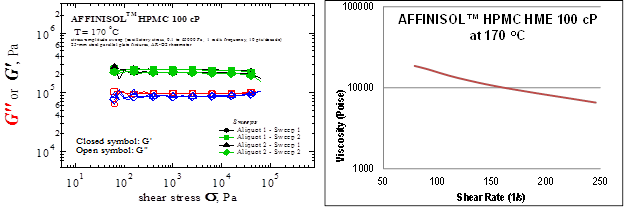
Figure 1: (Left) Rotational rheology of AFFINISOL™ HPMC HME at 170 °C exhibiting solid like behavior despite ability to extrude at temperatures well below this and (Right) alternative in-line method demonstrating melt viscosity as a function of shear rate at 170 °C.
See more of this Group/Topical: Pharmaceutical Discovery, Development and Manufacturing Forum