
 Google
 Yelp
 Facebook
 Twitter
 ChEnected
471666 Using Ultrafiltration to Concentrate Detergent-Solubilized Membrane Proteins without Concentrating Detergents
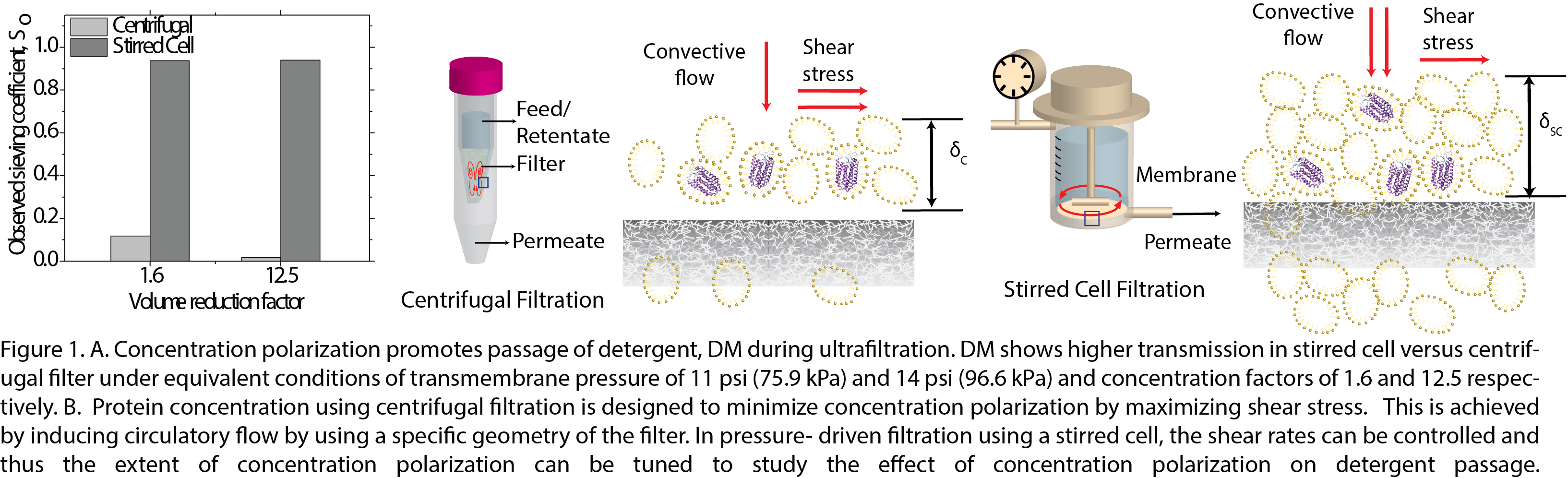
Membrane proteins (MPs) carry out various physiological functions in living organisms and as such are important targets for pharmaceutical products and for the design of novel sensors and synthetic membranes (Kim et al. 2012; Kowalczyk et al. ; Shen et al. 2014). The challenge with using MPs for such applications lies in purifying high concentrations of functional MPs. The hydrophobic exterior of MPs necessitates their stabilization in detergent micelles. Due to low yields obtained, MPs often need to be concentrated for subsequent biophysical characterization or use in applications. The widely-used ultrafiltration-based concentration of MPs in commercial filters often leads to a concomitant increase in concentration of empty detergent micelles. The resulting high detergent concentrations can destabilize MPs, interfere with subsequent structural and biophysical characterization of MPs, and present challenges in applications. We present a detailed analysis of the hydrodynamic conditions that selectively promote detergent passage during MP ultrafiltration. We studied two different classes of transporter MPs, the bacterial water channel protein, Aquaporin Z (AqpZ) and the archaeal light-driven chloride pump, Halorhodopsin (pHR) in nonionic detergents, octyl–β-D glucoside (OG) and decyl-β-D maltoside (DM) respectively. The observed sieving coefficient (So)- the ratio of detergent concentration in permeate to that in retentate, was evaluated in the stirred cell and centrifugal systems. The sieving coefficient for detergent for both pure detergent and MP-detergent systems was much greater in the stirred cell than in the commercial filters (Figure 1A). Thus, almost complete transmission of detergent can be achieved by operating under conditions that encourage concentration polarization (CP). This contradicts current approaches in soluble protein concentration systems, including centrifugal filters, which are designed to maximize flux by minimizing CP (Figure 1B). Thus a rethinking of the design of ultrafiltration-based systems of MP concentration to promote CP may be required for downstream processing of MPs.
References
See more of this Group/Topical: Separations Division