
 Google
 Yelp
 Facebook
 Twitter
 ChEnected
472149 Delivery Materials to Induce RNAi in Bone Marrow to Control Hematopoietic Stem Cell Trafficking
Delivery Materials to Induce RNAi in Bone Marrow to Control Hematopoietic Stem Cell Trafficking
Michael J. Mitchell1, Robert Langer1
1Department of Chemical Engineering, Koch Institute for Integrative Cancer Research, MIT, Cambridge, MA 02139
 Introduction: Hematopoietic
stem cell (HSC) transplantations (HSCT) are essential for restoring a patientÕs
immune system destroyed by radiation or chemotherapy. However, HSCT remains a
dangerous procedure for patients with life-threatening diseases, with a major
complication being harvesting HSCs from blood to restore the recipientÕs immune
system. Here, we developed a nanoparticle (NP) platform to induce RNAi in bone
marrow (BM) in vivo to increase HSCs in
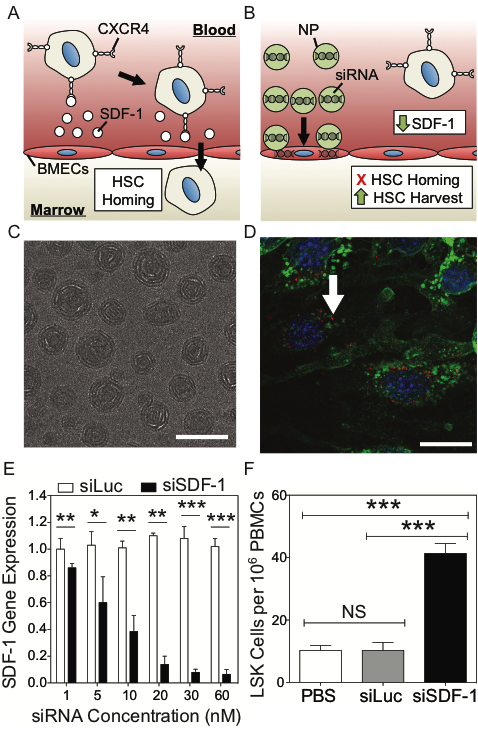
blood for harvesting and transplantation (Fig 1A,B).
Methods: siRNA targeting stromal-derived factor-1 (SDF-1) and luciferase (Luc) were encapsulated in NPs consisting of lipids and modified polyethylenimine via rapid microfluidic mixing. NPs were characterized using DLS, SEM, and cryo-TEM. BM endothelial cells (BMECs) were treated with NPs at siRNA dosages of 1-60 nM in vitro. C57/BL6 mice were treated with NPs at a siRNA dosage of 1.0 mg/kg to determine in vivo SDF-1 knockdown. HSCs were harvested from blood 1-week after initial NP treatment and characterized via flow cytometry as Lin-Sca-1-c-Kit+ (LSK) cells.
Figure 1: (A) HSC homing into marrow via SDF-1. (B) SDF-1 knockdown via in vivo NP-mediated RNAi reduces homing and increase HSCs within blood. (C) Cryo-TEM micrograph of lipid-polymer NPs encapsulated with siRNA. Scale bar: 100 nm. (D) NP-mediated siRNA (red) uptake in BMECs. Scale bar: 10 μm (E) NP-mediated SDF-1 knockdown in BMECs. (F) Lin-Sca-1-c-Kit+ (LSK) HSCs isolated from blood per 106 peripheral blood mononuclear cells (PBMCs) 1-week post-SDF-1 knockdown. *P<0.05. **P<0.01. ***P<0.001. NS: not significant.
Results and Discussion: 60 nm polymer-lipid NPs containing siSDF-1 were formulated via microfluidic mixing (Fig 1C). NPs containing fluorescent siRNA were uptaken by BMECs as per confocal micrographs (Fig 1D). NPs containing siSDF-1 induced potent gene knockdown in BMECs, compared to siLuc controls (Fig 1E). In vivo, silencing of SDF-1 induced a nearly 300% increase in the number of HSCs harvested from blood, compared to controls (Fig 1F).
Conclusions: We have developed a NP platform that, potentially for the first time, induces potent gene knockdown in the bone marrow microenvironment in vivo. Clinically, this platform can be used to silence BM factors to increase the number of HSCs in blood available for harvesting and subsequent transplantation.
See more of this Group/Topical: Materials Engineering and Sciences Division