
 Google
 Yelp
 Facebook
 Twitter
 ChEnected
474244 Ring-Opening Polymerization for 100% Renewables-Based Polyethylene Furanoate (PEF) for the "Green Bottle"
Along the shift of our societies from fossil-fuel based economies towards more sustainable civilizations, ring-opening polymerization (ROP) can be an alternative process to synthesize a novel class of renewable resource-based polymers. Furanic polyesters like polyethylene furanoate (PEF) have been ranked among the top potential chemicals by the US-DOE and may replace one of the world’s dominant fossil-based plastics, polyethylene terephthalate (PET). Recent efforts and first commercial scale production by Dutch company Avantium and other research groups were invariably based on polycondensation, which is burdened with the necessary removal of condensation byproducts to reach high conversions and molecular weights, and thus typically requires reaction times in the order of days [1,2]. Cyclic monomers do not have endgroups and thus render byproduct removal unnecessary, which enables ROP as a living chain-growth mechanism to deliver high conversion to PEF within minutes. We present ROP as an alternative process to reach sufficiently high molecular weight PEF for commercial applications such as bottles, textiles, medical grafts, etc. [3,5].
Cyclic PEF monomers (cyOEF) can be derived from 100% renewables-based building blocks furandicarboxylic acid and ethylene glycol via different synthesis routes that have successfully been applied to PET, which all exploit the shift of the ring-chain-equilibrium to cyclics in dilution [4]. Synthesis pathways such as depolymerization of short PEF oligomers in 2-Methylnaphthalene have yielded >80% cyOEF with a ring-size distribution from dimer to heptamer within 4 hours, as part of other projects in our group. Maximization of material turnover as well as minimization of waste is possible by full recycling of unconverted linears and solvents [5]. Purification of cyOEF from residual linears via silica gel adsorption to yield >99% cycles is essential for ROP to deliver 1) sufficiently high molecular weights, 2) reproducible reaction control and 3) colorless products. The search for better and “greener” solvents is ongoing, aided by solubility predictions from COSMO-RS that show several aromatics and polyethers to possess promising solvent power and selectivities.
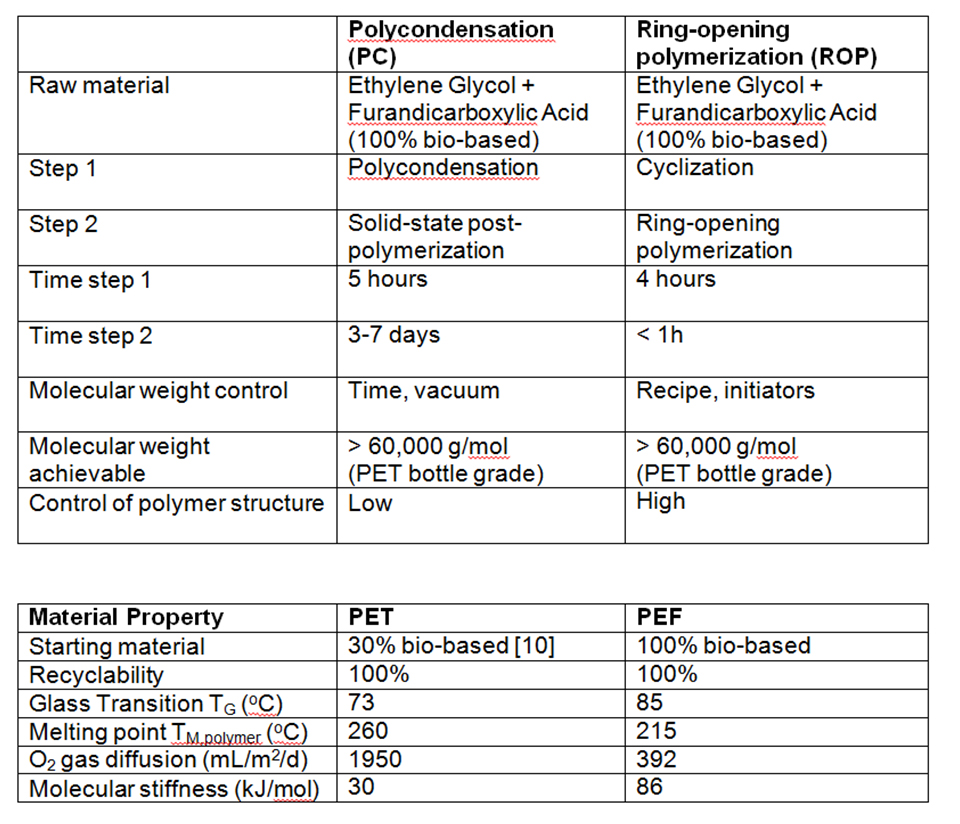
PEF applicable to typical commercial applications of PET can then be produced from high purity cyOEF. cyOEF were subjected to catalytic ROP to form PEF chains in yields of >95% and molecular weights equivalent to a PET bottle (~60’000 g/mol). Since absolute molecular weight determination is essential for such process development, all our samples were all analyzed with size exclusion chromatography (SEC) multi-angle light scattering (MALS) as well as diffusion (DOSY) NMR. The latter was developed especially for PEF, as it offers advantages over SEC-MALS such as reduced solvent use, analysis time <2 min and is less prone to hardware failure, while allowing for simultaneous absolute molecular weight and conversion analysis due to the different chemical shifts of cyOEF and PEF [6]. The reaction is usually complete after less than 20 min, which, even combined with cyOEF synthesis time, outperforms commonly applied solid-state polycondensation by about a factor of 20. Since the cyclic raw material exhibits a distribution of ring sizes, the individual species show melting points ranging from 270oC to 370oC and different reactivity. Successful conversion of each observed cyclic species from dimer to heptamer was achieved well below their melting point using 250-280oC with tin-catalysts such as FDA-approved tin octoate, the application of which could facilitate the entry to the FDA-regulated food packaging market. Lower temperatures are actually beneficial and allow for higher achievable molecular weights, due to the more limited impact of degrading side-reactions. This degradation became dominant usually after 20 min after reaching >95% conversion. Maximum achievable molecular weights also increased with monomer purity, as linear impurities reduce molecular weight through the introduction of additional end-groups. After having obtained PEF from ROP with favorable molecular properties, the material properties essential for bottle manufacture were analyzed. The higher glass transition temperature (85oC vs. 73oC) and lower melting point compared with PET (215oC vs. 260oC) indicate higher thermal stability and easier processing of the final bottles. An at least 5x higher oxygen diffusion barrier complements the advantageous properties of PEF, which can be explained with a higher molecular rotational energy barrier as derived from molecular dynamics simulations that we have recently performed.
While the scale-up to larger (kilogram) volumes and processing towards actual bottles is ongoing, the advantageous synthesis of PEF via ROP opens a new and promising pathway not only towards the highly anticipated “green bottle”, but also enables advanced molecular architecture control of furan based polyesters through a “living” polymerization, e.g. for branching and block copolymers, which is infeasible with the current process based on PC-SSP.
References
[1]
M Gomes, A Gandini, AJD
Silvestre, B Reis, J. Polym.
Sci. A: Polym. Chem. 2011, 49, 3759-3768
[2] L Sipos, E De Jong, MA Dam, JM Gruter, ACS Symposium Series 2012,
1105, P Smith(Ed.), 1-11
[3] D Pfister, G Storti, F
Tancini, LI Costa, M Morbidelli, Macromol Chem Phys 2015, 216, 2141-2146
[4] R R Burch, SR Lustig, M Spinu, Macromolecules 2000, 33, 5053-5064
[5] JG Rosenboom, P Fleckenstein, G Storti, M Morbidelli, 2016, in preparation
[6] W Li, H Chung, C Daeffler, JA Johnson, RH Grubbs, Macromolecules 2012, 9595-9603
FIGURE 1
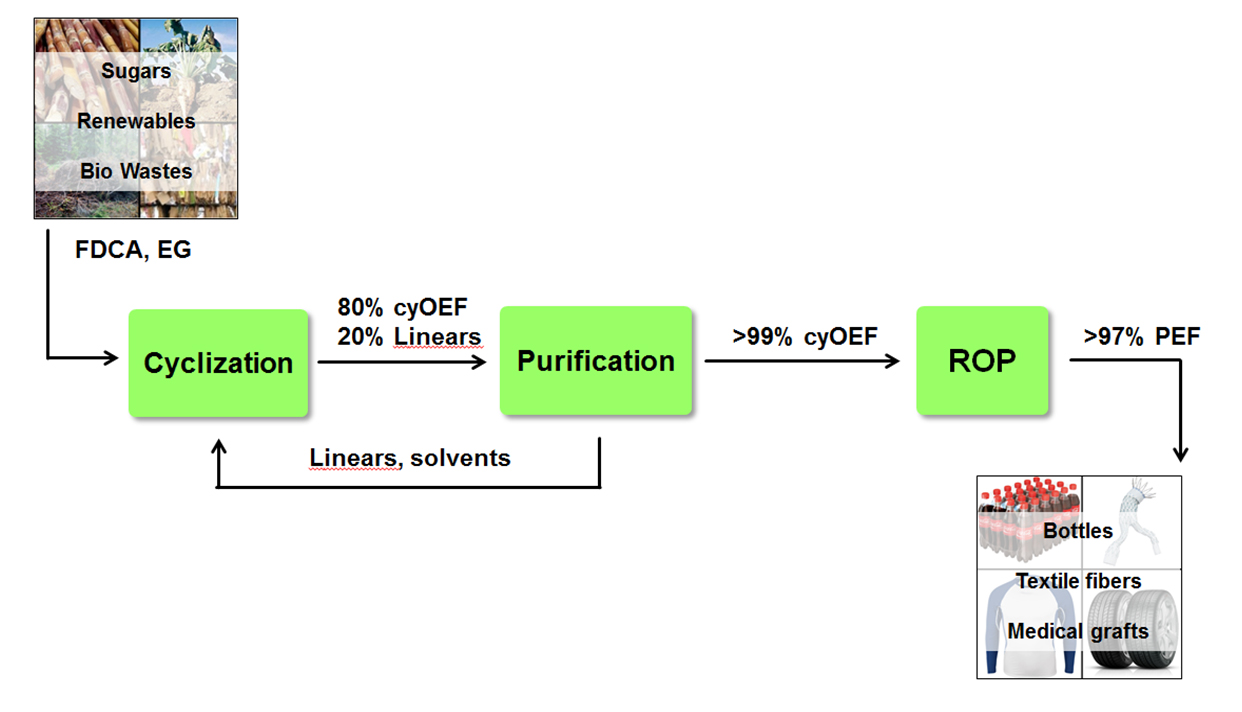
FIGURE 2
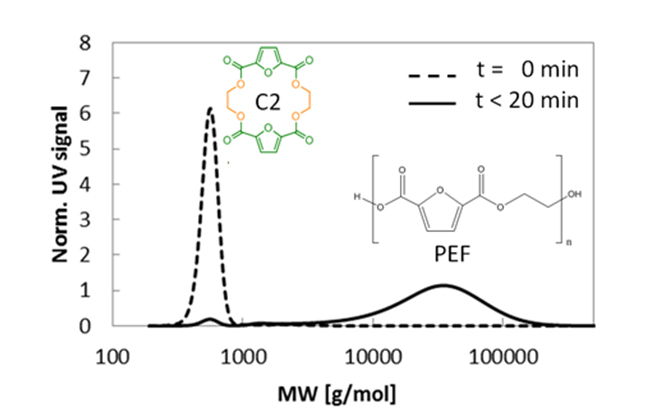
FIGURE 3
See more of this Group/Topical: Materials Engineering and Sciences Division