474277 Catalytic Process for Levoglucosan Conversion into Distillate Range Molecules
Thursday, November 17, 2016: 8:30 AM
Taylor (Hilton San Francisco Union Square)
Mrunmayi D. Kumbhalkar1, Daniel J. McClelland1, Nathaniel Eagan1, J. Scott Buchanan2, George W. Huber1 and James Dumesic1, (1)Department of Chemical and Biological Engineering, University of Wisconsin-Madison, Madison, WI, (2)ExxonMobil, Annandale, NJ
Pyrolysis
oils are low quality fuels which cannot be used in conventional gasoline or
diesel engines largely due to their high oxygen contents. Upgrading strategies
for deoxygenation of pyrolysis oils are imperative for use in transportation fuels.
In this presentation, we describe a multi-step catalytic process for conversion
of levoglucosan (LGA), a major anhydrosugar present in pyrolysis oil, to
monofunctional compounds, which can subsequently be coupled to obtain distillate
range molecules.
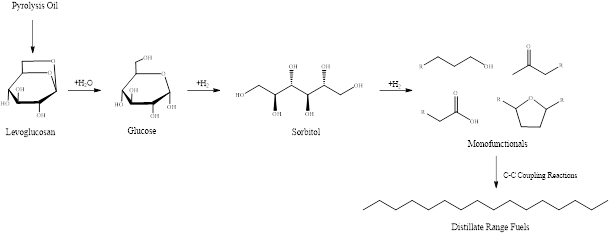
Figure 1. Pathway
to convert levoglucosan to distillate range fuelsSugar
syrups produced via the pyrolysis of red oak pyrolysis oil are rich in LGA.
Firstly, LGA in this sugar syrup is hydrolyzed to glucose. Following hydrolysis,
glucose is converted to sorbitol with high yield by hydrogenation over Ru/C. Monofunctional
intermediates are produced in the aqueous-phase hydrodeoxygenation (APHDO) of
sorbitol with carbon yields up to 55%. These monofunctional species consist
mainly of alcohols (71%) and heterocyclic species (24%). The majority of these
species (52%) are C
5 or C
6 compounds, and only small
amounts of ketones and acids are formed. The monofunctional intermediates are
then converted into distillate range molecules by dehydration-oligomerization. The
sorbitol APHDO effluent is fed to a flow-through reactor packed with a solid
acid catalyst, SiO
2/Al
2O
3, to convert the
monofunctional stream to olefins. Nearly 75% yield to mono-alkenes and dienes is
obtained, based on the total carbon in the monofunctionals. Dienes originate
from ring opening of heterocyclic compounds. C
2-C
6
olefins thus obtained can be oligomerized over acid catalysts to produce distillate
range hydrocarbons.
Extended Abstract: File Not Uploaded

 Google
 Yelp
 Facebook
 Twitter
 ChEnected