
 Google
 Yelp
 Facebook
 Twitter
 ChEnected
474467 Monte Carlo method to calculate the lifetime efficiency of a solar reactor for reduction of zinc oxyde
Monte Carlo method to calculate
the lifetime efficiency of a solar reactor for reduction of zinc oxyde
O. Farges, J.J. B´ezian, and M. El Hafi
Universit´e F´ed´erale de Toulouse Midi-Pyr´en´ees, Mines Albi, UMR CNRS 5302, Centre Rapsodee, Campus Jarlard,
f-81013 Albi ct cedex 09, France
Concentrated solar plant are ommonly used to produce electricity through ther- modynamic cycles (Gemasolar Power Plant, Ivanpah Solar Power Plant, ...) and can also be seen as an alternative to fossil fuel-based methods for H2 generation [5]. High temperature solar thermochemical processes make use of concentrated solar energy to realize metal oxydes reduction. These processes can be considered as a solar energy storage : products may be stored and transported (H2 in this case). Among all metal oxydes reduction, the zinc oxyde to zinc (ZnO/Zn) redox reactions are particularly attractive as the first part of a two step water splitting cycle (eqs. (1a) and (1b)).
As presented on fig. 1, a thermochemical reactor R, placed at the top of a solar tower receives concentrated solar energy emited from the sun S and reflected by heliostats H. Thus, the reactor, feeded with zinc oxyde, reaches high temperature, ie above 1400 K, to achieve reduction of zinc oxyde and to procude zinc Zn.

In order to evaluate the performance of a thermochemical solar plant and to allow an optimally design of both the reactor and the whole facility (heliostat field,
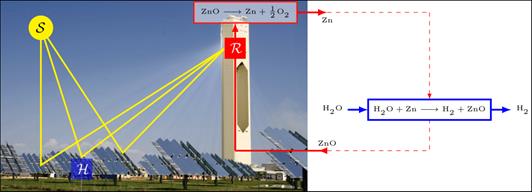
Figure 1: H2 solar production process
tower), numerical modelling of this process is required. We present here a Monte Carlo algorithm that allows the estimation of the solar plant annual productivity which is a non-linear problem. This non-linearity is due to the coupling between photon transport and the metal oxyde reduction reaction. The widespread opinion is currently that “Monte Carlo methods are not generally effective for nonlinear problems mainly because expectations are linear in character”[3]. This difficulty has been overcome by Dauchet who proposed a methodology in his Phd thesis [1].
To evaluate the quantity of interest, ie the annual solar-to-chemical conversion rate (ηr ), this Monte Carlo algorithm firstly computes the instantaneous power re- ceived at the entrance of the reactor at an instant i, (Pth(X |i)). A Monte Carlo algorithm previously presented in [2] is used as a first step of the proposed algo- rithm to evaluate this quantity. The random variable Pth(X |i) is the contribution of optical paths X |i to the thermal power collected at instant i. Then, (Pth(X |i)), the expectation of this random variable, is the instantaneous thermal power col- lected at moment i. A part of the power received by the reactor, the instantaneous useful power Pu = f (Pth(X |i)), represents the efficient energy used to achieve redox reactions with an instanteneaous reaction rate described by a zero-order Arrhenius-type law, strongly non-linear. Integration over time of the instanta- neous conversion rate leads to the lifetime conversion rate (ηr ((Pth(X |i))))i as presented eq. (2).

To treat this non-linearity, the Monte Carlo algorithm is based on a Taylor expansion of (ηr ) around Pth0 > Pth (X ). Independent and equally distributed optical-path random variables Xj |I are introduced and the infinite power series is statistically formulated thanks to the discrete random variable J whose realization
j is the order of Taylor expansion. The Taylor expansion is stopped through a Bernoulli process in order to decide whether the algorithm stops or continues without introducing a statistical bias.
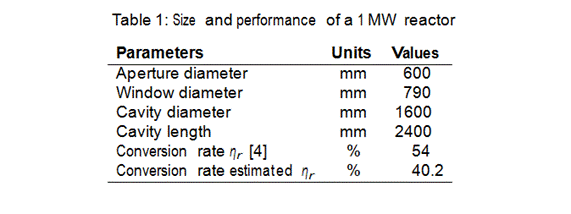
Simulations are performed for the 1 MW reactor presented in [4]. A simplified model of thermal losses is applied and a comparison of the nominal performance between results obtained with the Monte Carlo algorithm and experimental results presented in [4] are presented in table 1. The difference between the measured and calculated results are due to the simplified thermal losses model as well as uncertainties of the measurements.
We have shown in this work that we are able to calculate the efficiency by a Monte Carlo Method, of a solar chemical reactor involving non-linearities between the heat source and the products of the reaction. A futur work could be the improvement of the heat loss model.
References
[1] J. Dauchet. Analyse radiative des photobioracteurs. PhD thesis, 2012.
[2] O. Farges, J. B´ezian, H. Bru, M. E. Hafi, R. Fournier, and C. Spiesser. Life- time integration using monte carlo methods when optimizing the design of concentrated solar power plants. Solar Energy, 113(0):57 – 62, 2015.
[3] M. H. Kalos and P. A. Whitlock. Monte Carlo Methods. John Wiley & Sons,
2008.
[4] L. Schunk, W. Lipin´ski, and A. Steinfeld. Heat transfer model of a solar receiver-reactor for the thermal dissociation of zno-experimental validation at
10 kw and scale-up to 1 mw. Chemical Engineering Journal, 150(23):502 – 508,
2009.
[5] A. Steinfeld. Solar thermochemical production of hydrogen--a review. Solar
Energy, 78(5):603-615, 2005.
See more of this Group/Topical: 2016 International Congress on Energy