Measurement and Control of Slip-Flow Boundary
Conditions at Solid-Gas Interfaces
Dongjin SeoDepartment of Chemical EngineeringUC Santa Barbara, Santa Barbara, Californiadongjin_seo@ucsb.edu
In
traditional Chemical Engineering applications one usually assumes that the
no-slip boundary condition for flow applies at the solid-gas interface.
However, it has been known since the time of Maxwell that, even for moderate
Knudsen numbers, partial slip could occur, of order the mean free path of
gases. With the growing number of applications for micro- and nano-scale
devices and flow systems, it is interesting to quantify more precisely the flow
boundary condition.
In
this work I describe unambiguous measurements where I show that partial slip
does occur, that the slip length is a function of both the gas and solid, and
that the solid can be altered in-situ to change the slip length. In-situ
changes in slip length could in principal be used to control flow in a variety
of important applications.
The
main theme of this presentation is the effect of solid surface properties on
the flow boundary condition. The effect of water films, organic films, electric
fields and the gas species was studied. Water films had a large, but complex
effect. On bare hydrophobilic glass, the tangential momentum accommodation
coefficient (TMAC) for nitrogen on hydroxyl-terminated silica changed from 0.25
to 0.88 when the humidity changed from 0 to 98 %. On hydrophobized glass, TMAC
changed from 0.20 to 0.56 in the same range. The effect of humidity was
interpreted with the formation of water film, verified with a quartz crystal
microbalance. TMAC on octadecyltrichlorosilane-coated glass surfaces was
examined for five different gases (helium, nitrogen, argon, carbon dioxide,
hexafluoride sulfur). A lower TMAC occurred for greater molar mass.
I
also developed methods for controlling the flow boundary condition using
external stimuli – temperature and electric fields. Using Atomic Force
Miscroscopy (AFM), each of these stimuli altered the roughness of the film, so
control of the boundary condition was attributed to surface roughness
change. The temperature was used to change the roughness of an
octadecyltrichlorosilane film on glass, and the electrical field was used to
change the roughness of a 16-mercaptohexadecanethiol film on gold. Considering
collisions of simple spheres that conserved momentum and kinetic energy, a
surface with periodic triangular grooves had higher TMAC with steeper slopes.
A
novel method of measuring gas pressure using an AFM cantilever was
presented. The frequency spectrum of the cantilever vibration in the gas
was measured, which was then fit to a continuum description that depends on the
density. Use of the continuum approximation restricts calculation of the
pressure to the continuum regime. In the range 0.1 to 2.2 atm, the gauge
deviated by less than 5 % compared to a commercial gauge. Research
Interests:
Colloids and surface science
is my expertise and tool. With this, I am planning on extending my research
toward energy engineering and biomedical engineering. I like to propose two
research projects for the immediate years that follows. The first project, a
novel gas separation technology, is intended for the submission to National
Science Foundation (CBET division). This project is intended to prove a new
separation principle and separate carbon dioxide from natural gas in the
future. The second project, deep drug deliver to lung with aerosol surface
modification, was prepared for National Institute of Health R21 funding. This
simple modification to aerosol medication would deliver more active ingredient
toward alveoli, reducing overdose and cost.
Separation
of Gas Mixtures via Differences in Flow Boundary Conditions
The
objective of the proposed work is to verify the principle of a novel gas separation
method based on difference in flow boundary conditions. The principle to be
proved is that different gas species intrinsically have different boundary
conditions when their mean free paths are comparable to the characteristic
length of the separation system. This will further extended toward the
preparation of the prototype gas separation device, which is clean and easy to
operate consuming low energy. The
specific aims of this project is to 1) implement simple computational
simulation and calculations 2) devise a prototype device for continuous
process, and 3) build a control system for a batch process. The simulation part
will be done with the collaboration with graduate students studying
computational fluid dynamics (CFD). The rest will be achieve with glass
capillary system coated with surface molecules for passivation and protection.
This system would prove the principle found in the previous work can be also
applied in tubular systems. For these aims, the following activities will be
implemented. Computational
Fluid Dynamics: For both methods mentioned above, I will investigate the
feasibility of volumetric flow and velocity difference with computer simulation
getting help from a graduate student involved in CFD. A simple model would be
set up to see the difference velocity of several spheres with different
boundary conditions flowing through a cylinder. Devising
adequate cylindrical geometry: An experimental equipment would be built. I
propose 100 ~ 1000 nm glass capillaries. The interior of the capillaries would
be coated with octadecyltrichlorosilane for protection and smoothness. The
outlet would be connected to gas chromatography to detect the effluent of
different gases Continuous
separation experiment: To test this method, a chamber would be built for a
binary mixture with oxygen and carbon monoxide. I chose these species because
detection equipment is very precise and requires low concentration. Then their
concentration would be measure at the outlet. The
success of this project would provide clean separation technology with low
energy consumption and high throughput without having severe operation
conditions. The process will integrate the science and engineering in different
fields, surface science, process control, fluid mechanics, and computational
calculation, into one field. This will lead to several patents further utilized
in commercial separation units.
Roughening of Aerosol for Deep
Lung Delivery
1.
Background
Chronic
Obstructive Pulmonary Diseases (COPDs) are the third leading cause of mortality
in the United States and about 15 million adults have reported they have
COPD. Another lung disease, asthma, is even more common for both adults and
children; in the United States: one out of 12 adults and one out of 11 children
have asthma. Delivery of drugs to treat COPD, asthma, and other pulmonary
diseases is achieved through aerosolized (small liquid droplet) medications,
primarily delivered via inhalers. These inhalers are used to spray drugs into
the lungs via the mouth, which naturally results in unnecessary deposition
close to the entrance of lung, rather than deeper into the lung where delivery
is required. A longer average travel distance of aerosol particles is therefore
desired for better treatment.
2.
Specific Aims:
The
aim of this work
is to enhance the travel distance of inhalant aerosol medication inside the
lungs by increasing the resistance to droplet motion towards airway surfaces
(See Fig. 1). By opposing motion toward the airway surfaces, deposition
on the walls is delayed, and the droplets are able to travel to the distal
portions of the lungs.
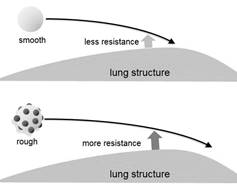 | Fig. 1. A stronger lubrication force on rough particles delays approach of particles to lung surfaces, thereby extending travel into the deep lung. |
Until
recently, many chemical engineers assumed the boundary condition for the flow
of gases was fixed. But recent research by our group has shown that very
slight (nanoscale) roughening of surfaces can be used to increase the
resistance to a particle approaching a solid in air. The required
increase in resistance to motion towards airway surfaces will be achieved
through deliberate roughening of the surface of the aerosol droplet through the
addition of surfactant. Whether the aerosol particles attempt to make contact
with lung passage walls due to gravity, or due to airway curvature, the
additional resistance will always push the droplets away from the wall. This
allows each droplet to utilize momentum parallel to lung surface, and thereby
travel deeper into the lungs.
The
specific aims are to test the following hypotheses: 1)The addition of
surfactants increases the lubrication force acting on particles approaching a
wall. 2) These surfactants adsorb to the aerosol – gas (inhaled air) interface,
and increase its roughness. 3) An increased lubrication force increases the
distance that a droplet travels in a numerical model.4) An increased
lubrication force increases the distance that a droplet travels in an
experimental model system. 5) Optimum concentrations of surfactants exist and
vary by the kind of surfactant and medication.
Successful
completion of this project will provide a relatively simple, inexpensive, and
safe way to enhance delivery of aerosol-based drugs into the entire lung. Most
importantly, the increased delivery distance will help to obtain a more even
distribution of the drug, which may allow lower doses, and fewer side
effects. Since this enhancement would come by simply adding appropriate
FDA-approved surfactants to existing aerosol delivery systems, this additive
technology is more likely to be adopted. The major impact of adoption
would be better therapeutic outcomes for both sufferers of pulmonary diseases,
and recipients of systematic drugs. Teaching
Interests:
I am very
interested in interaction with chemical engineering students and helping them
become more prepared engineers after graduation. With such interest, I am
willing and able to teach general chemical engineering topics in any level, as
well as special topics such as surface and colloid chemistry, atomic force
microscope (AFM), refinery and chemical plant processes. My diverse research
experiences scope through different areas of chemical engineering, physics,
mechanical engineering, and material science. In addition to this research
activities, my practical experience in a downstream oil company I worked for
four years provided me with not only the basic principles of chemical
engineering, but also the practical integration of knowledge that is needed for
chemical engineers. Teaching
Philosophy
My basic
teaching philosophy consist of 1) teaching students correct principles and
knowledge, 2) encouraging them to utilize the knowledge, 3) getting them
involved in teaching, and 4) following up. I believe these principle are needed
for students in any fields to learn. As with other teachers, I will lecture
with much preparation focusing on how to have them involved during lectures. I
will make sure they understand through homework and projects they have to work
together and teach together. In my belief, they have to at least attempt to
speak or write out what they have learned to their colleagues in their own
language. Otherwise, very little can be left with them. Therefore problems and
projects will be oriented toward teaching each other. My teaching method will
be also tested with exams that require not only calculations but also require
interpretation of the calculated results. I have seen from much experience that
the students like to produce results. I will help them make one step further by
letting them think for physical meaning for the result and the application
thereof. This application of knowledge is also important. I will assign a group
project with which they can think of the solution to a problem with the
knowledge from the courses. I will follow up on their progress by encouraging
them to come to office hours to make individual contacts. This way, I can
follow up on their progress. This principle will be also true to graduate
students. I will brainstorm with them every week to see if they and I can
prepare for the next projects they are on by combining results from different
projects. Specific
Topics of Interest
Among many
classes, I like to teach colloids and surface science along with AFM. I like to
involve AFM, because it demonstrates the surface forces with visual images.
With the advance of nanotechnology and polymer science, the small forces or
relatively insignificant properties became important in understanding physical
phenomena and chemical engineering processes. I believe chemical engineering
students have to see the importance in these features and be able to manipulate
the variables to obtain desired results. If this course is not opened, I am
happy to prepare the course.Another course
I am very interested in is Unit Operation Laboratory (UO Lab). I loved teaching
UO Lab as a graduate student because it gave me more chance of talking to
students and finding out not only their knowledge but also their interest in
future as engineers. However, the room for improvement I saw among students
gave me strong desire to teach this class. I would like to lead this class with
evocation of discussion and analysis of the activity and data. One thing I
noticed was student tend to focus on the results, and not the meaning. I like
to teach them how to produce meaningful conclusion out of data. Teaching
Experiences
Please refer to
my curriculum vitae as well. I have actively engaged in the interaction with
undergraduate students by 1) helping them for undergraduate research, 2)
lecturing for different classes, and 3) teaching at experimental laboratory
classes. These experiences prepared me as an effective teacher. My goal in
teaching is helping them independent and I saw such progress in them. I have
taught junior, senior, and graduate-level classes as well as lab classes. I
also supervised three different undergraduate research projects. In all of
them, I had a chance to see them grow toward understanding the problem, finding
solution, and being autonomous.
Outreach Effort
I
want to direct my outreach effort mostly toward, but not limited to, K6 to K12
students. Youths, especially girls, around this age lose their interest in
science, technology, engineering and mathematics
(STEM)
area, and especially when they do not make connection between STEM knowledge
and the real life. (Ref. 1) Therefore it is important to let them realize that
we are living in a world utilizing knowledge from STEM area. I like to make
such connection using colloid and surface science.
For
younger students from K6 to K9, I like let them know daily-life products,
shampoo, make-ups, cleaning agents, and even diapers, not only work, but also
are better with surface science. This demonstration or a set of simple 5 – 10
minute experiments would be presented during a field trip or as one of outreach
experiences for school breaks. During this presentation, each student will be
given materials and experience on their own hands how surface science is
related to their daily life.
For
older students in K10 to K12, more advanced project is possible. The surface
modification with monolayer molecules, atomic force microscope (AFM) with their
own samples, or click-chemistry would be a fun and educating experience for
them. A simple monolayer-coating experiment can be done by a group of high
school students with much care instruction. This way, they will learn safety
issue as well.
AFM
is hard for them. But they will have fun in seeing the nanometer-sized details
of the materials they use every day. Safe click-chemistry experiments that can
be produced with house chemicals can be a good start for their scientific
journey.
The
focus of my outreach is toward school students with easy and fun experiments.
This way, they will relate their daily life to science.
Ref. 1 Jeffers, A., Safferman, A., &
Safferman, S. (2004). Understanding K-12 engineering outreach programs.Journal
of Professional Issues in Engineering Education and Practice, 130(2), 95-108.
 Google
 Yelp
 Facebook
 Twitter
 ChEnected
