
 Google
 Yelp
 Facebook
 Twitter
 ChEnected
477582 Rational Design of Catalytic Materials for Advancing the Use of Alternative Energy Sources
Rational Design of Catalytic Materials for Advancing the Use of Alternative Energy Sources
Research Interests:
Due to the depletion of fossil fuels and the presence of greenhouse gases in the atmosphere, alternative sources of energy which do not emit greenhouse gases will become essential in the near future. Both challenges of reducing greenhouse gas emissions and utilizing alternative energy sources will be accomplished through catalysts. My research directions focus on storage of energy which potentially comes from alternative sources. Specifically, my first research direction is determining catalytic materials for using electricity to split water for the production of hydrogen fuel. Hydrogen may be used in fuel cell vehicles for example and does not emit greenhouse gases when consumed. Solid oxide fuel cell catalysts are considered for this electrolysis of water reaction. At present, the most economical approach to the generation of hydrogen is through steam reforming of hydrocarbons followed by addition of water to allow water-gas shift (CO + H2O ↔ CO2 + H2). However, electrolysis of water1 (2H2O ↔ O2 + 4H+ + 4e-) is an alternative hydrogen production reaction which has the advantage that no hydrocarbons, i.e. fossil fuels, are required. The electricity required for electrolysis may be drawn from alternative energy sources such as wind and solar.
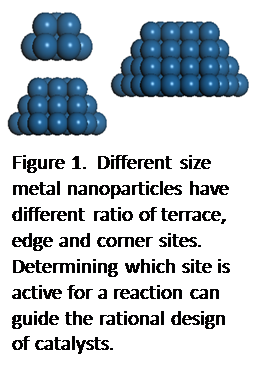
| Figure 1. Different size metal nanoparticles have different ratio of terrace, edge and corner sites. Determining which site is active for a reaction can guide the rational design of catalysts. |
 My second research direction is
proton exchange membrane fuel cells (PEMFC) for generating electricity from
hydrogen. Current challenges for increasing
PEMFC efficiency lie in improving the catalyst.
In order to rationally design an improved catalyst, a
knowledge of the active site of reaction at the atomistic scale is
necessary. The benefit of this knowledge
can be seen from Figure 1 which shows the size of a Pt nanoparticle catalyst
affects the fractions of edge, corner and terrace sites present. Knowledge of which type of site is active
suggests the optimal size of Pt nanoparticles.
Quantum chemistry and in particular Density Functional Theory (DFT) has shown
great success in predicting the activity of catalysts and is becoming an
essential tool for the rational design of catalysts. However, when conducting DFT investigations
it is necessary to include a quantification of uncertainty of DFT with the reason
of not being misleading in making conclusions.2 A quantification of DFT uncertainty
will be conducted in order to generate reliable results.
[1] Smith, R. D. L.; Prévot, M. S.; Fagan, R. D.; Zhang, Z.; Sedach, P.
A.; Siu, M. K. J.; Trudel, S.; Berlinguette, C. P. Photochemical
Route for Accessing Amorphous Metal Oxide Materials for
Water Oxidation Catalysis. Science 2013, 340, 60-63.
[2] Deshpande, S.; Kitchin, J. R.; Viswanathan, V. Quantifying
Uncertainty in Activity Volcano Relationships for Oxygen
Reduction Reaction. ACS Catal. 2016, 6, 5251-5259.
Teaching Interests:
In the undergraduate curriculum, I am particularly interested in and have the background for teaching courses such as: Transport Phenomena, Statistical and Numerical Methods for Chemical Engineering, and Chemical Engineering Kinetics. In the graduate curriculum, I am interested to teach courses such as Chemical Reactor Design and Chemical Process Principles. In any course I teach, I believe the inclusion of computer programming will ensure that students learn attention to detail and how to formulate engineering problems in an explicit manner. I am interested in developing a course entitled Quantum Chemistry of Materials for Catalysis to be offered as a graduate elective. This course will begin with principles of quantum chemistry starting with the Schroedinger equation, followed by Kohn-Sham density functional theory as an approximate solution to the Schroedinger equation. Topics of entropy contributions to free energy and sources of uncertainty in quantum chemistry will be discussed. A project will be conducted at the end of the semester in which students will simulate materials using quantum chemistry for catalyzing chemical reactions of industrial interest.
See more of this Group/Topical: Meet the Faculty Candidate Poster Session – Sponsored by the Education Division