
 Google
 Yelp
 Facebook
 Twitter
 ChEnected
477680 A Benchtop Capillary Flow Layer-By-Layer (CF-LbL) Platform for Rapid Assembly and Screening of Biodegradable Nanolayered Films
A benchtop capillary flow layer-by-layer (CF-LbL) platform for rapid assembly and screening of biodegradable nanolayered films
Ziye Dong, Hyuntaek Lim, Caroline Ahrens, Wei Li *
Department of Chemical Engineering, Texas Tech University, Lubbock, TX, 79409
* Corresponding Author: Wei Li (wei.li@ttu.edu)
Abstract
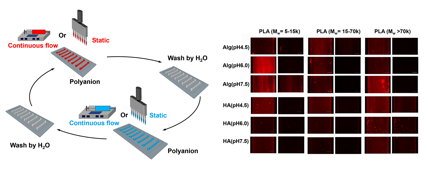
Layer-by-layer (LbL) assembly has been widely recognized as a highly useful approach to forming ultra-thin coatings through the alternating adsorption of materials onto a substrate using complementary interactions. However, current established techniques require large volumes of material solutions and specialized lab equipment limiting their application to new materials discovery, particularly when precious and costly materials are incorporated in the film assembly. In this work, we present the validation and application of a benchtop microfluidic platform for rapid preparation and screening of LbL films. We focus on optimizing LbL films made from naturally derived polymers for applications in gene delivery and cancer detection. The high cost of these biopolymers and small required surface area for cell testing make CF-LbL assembly especially appropriate for such screens. Particular interest has been directed towards films containing alginate (Alg) and hyaluronic acid (HA) as polyanions because these two polymers can be easily modified to link to bio-reactive molecules (small protein drugs or antibodies) through common bioconjugation approaches. Here we validate benchtop CF-LbL by presenting a systematic study of the effect of various flow conditions and channel geometries on the thickness and surface roughness of resulting LbL films. We apply this optimized system to investigate the biocompatibility and degradation behavior of a series of LbL films made from naturally derived polymers. Furthermore, using one optimized film formulation for coating on the inside walls of a microfluidic chip, we successfully demonstrate the utility of this film for capture and rapid release of cancer cells from unprocessed whole blood. We have achieved approximately 80% capture efficiency. Over 95% of captured cells are released in 10 minutes by rapid degradation of LbL films. More importantly, this LbL film coating significantly increased the purity of captured cells by decreasing non-specifically binding of blood cells. This simple platform is expected to be a powerful tool to increase accessibility of LbL film assembly to a broader scientific community.
See more of this Group/Topical: Student Poster Sessions