
 Google
 Yelp
 Facebook
 Twitter
 ChEnected
480133 Catalysis Reactions towards Advanced Energy Applications
Research Experience:
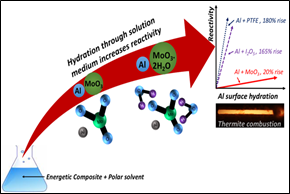
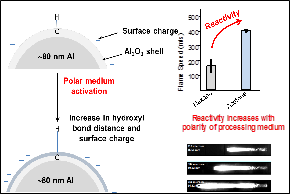
Optimizing reactive efficiencies of particles that possess catalytic properties proves to be a source of major interest from the perspective of generating energy. Energetic materials can be tailored for intended applications through such enhanced surface characteristics. These enhancements can be achieved through simple techniques such as improving the hydration layer around reactant materials and thereby adding to their polarities. This change in polarity is known to boost their thermal properties adding to the energy released during the process of combustion. Simulation models for such structured crystals proves that bonds are affected by the polar nature of the environment particles are subjected to by altering their bond distances, atomic charges and stretching frequencies due to polar and hydrogen bonding forces. It would prove to be greatly beneficial if highly functionalized reactive materials could be developed for generating more effective energetic/ thermitic composites. Figures 1. a. and b. capture the idea of functionalized surface of actively polar molecules and the pronounced effect observed on their reactive output.
a. b.
 |
Research Interests:
Despite having a background in Mechanical Engineering, my research entails a lot of inputs from Chemical Engineering and Chemistry. I work with energetic compositions, with a focus on aluminum as a fuel. My dissertation has been inspired by the curious finding that the mere presence of polar media around polarized compounds like the passivating alumina shell in the fuel crystal can do wonders to improve its thermal behavior under fluorination. Through the understanding of results obtained off the Differential Scanning Calorimetry, I observed that the enthalpy of reaction could be increased significantly when water from the solution affects the reactant particle surface as against when a non-polar medium containing no trace of water was used for suspending these particles. Fourier Transform Infrared spectroscopy enabled me to detect the actually augmented hydration layer at the particle interface. I am also trained to handle a Hitachi S4300 Scanning Electron Microscope – to look at the homogeneity of dispersion matrix. Even with this hand-on experience using such highly precise instrumentation; it is extremely difficult to gauge interactions taking place at the molecular level. This brings the need for me to collaborate with Chemists who specialize in performing ab initio calculations. Exposure to this area of research added depth to my understanding of chemical kinetics from an entirely unique perspective.
Through my knowledge of catalysis and catalysts used in various processes, I would want to focus on its applicability towards understanding basic molecular reactions and surface properties towards producing greener and cleaner fuels by maximizing conversion efficiency. Engineered materials that could be used as adsorbents and catalysts in fuel cells could effectively be used to improve their performance efficacy. Zeolites that are used in ion – exchange beds for water purification and softening can be improved for their efficiency in attracting dirt and minerals by polarizing catalysts to act as electromagnets. Understanding of catalysts through ab initio calculations helps me predict the nature of bonds affected by the hydrogen bonding forces to alter crystal structures when exposed to various environments. This information leads to the ability to tailor materials for suited applications.
In other collaborative simulation efforts, I would like to focus my attention on deriving intermediate reactions taking place which are studied in calorimetric techniques such as the DSC. From this data generated, it would be easier to predict which pathways any reaction mechanism could possibly take enabling us to better concentrate on the most desirable results from these reactions.
Teaching Experience:
I have experience teaching the undergraduate Heat Transfer and Combustion courses for Mechanical Engineering juniors and seniors respectively. I have been actively involved in mentoring masters’ students in our research group where we evolve in an extremely symbiotic atmosphere.
I have found that it always important to keep students engaged through interactions so they develop more interest in what they are learning and in return take back much more than they would have. I like getting feedback from them as to how they were following what I am trying to convey in my lectures. It is really necessary for me to make classes increasingly interesting so students have the motivation to attend each class with equal zeal.
I prefer to start my classes with a short review of the previous lecture and put those in the form of points on the board so they retain what we talked about and then gradually introduce the day’s topics. I think it is very important to grab the students’ attention in the initial few minutes. I try to include a very relatable example for every concept so students understand its applicability. I try to involve the class in a discussion of the concept involved.
Proposal:
Submitted a grant proposal to the Army Research Office on the topic: ‘Energetic Materials’ (PI: Dr. Michelle L. Pantoya).
Ph.D. Dissertation:
‘Altering surface properties toward enhanced aluminum reactivity’
Supervised by Dr. Michelle L. Pantoya, J. W. Wright Regents Endowed Chair Professor, Department of Mechanical Engineering, Texas Tech University, Lubbock, TX – 79409, USA
Publications:
See more of this Group/Topical: Meet the Faculty Candidate Poster Session – Sponsored by the Education Division