
 Google
 Yelp
 Facebook
 Twitter
 ChEnected
480706 Exploiting Natural Processes to Reduce the Need for Petroleum-Based Fertilizers: The Role of Bacterial Chemotaxis in Nitrogen Fixation of Leguminous Plants
Biological nitrogen fixation is a natural process that supplies nitrogen to the soil and reduces the need for petroleum-based fertilizer. Soil bacteria belonging to the genus Rhizobium form a symbiotic relationship with leguminous plants to fix atmospheric nitrogen into ammonia, a form that can be taken up through the vascular system of all plants once released into the soil. This process operates through a specific signaling cycle that induces the migration of rhizobia and formation of nitrogen-fixing nodules on the roots of the host legume.2 It has been shown experimentally that the directed migration of the bacteria is governed by a mechanism called chemotaxis.3,4 Chemotaxis is a physical motile response of bacteria to environmental signals and concentration gradients. It occurs when chemical cues bind with receptor molecules of the rhizobia and alter the swimming pattern and bias the direction of movement towards the source. This chemotactic behavior of the rhizobia is an important trait that facilitates the initial contact and adsorption of symbiotic rhizobia to the host root surface, increases the efficiency of nodule initiation, and increases the rate of infection development.4,5
The aim of this study is to quantify the effect that soil moisture content has on rhizobia chemotaxis and nodule formation. A series of rhizotron experiments were conducted to demonstrate that moisture content impacts nodule formation, with special attention given to nodule primordia formation. Vigna unguiculata, commonly known as the cowpea, was grown in hydroponic conditions on horizontally oriented, rockwool layered petri dishes. Bacteria (Bradyrhizobium spp) were inoculated via a peat slurry at the end opposite the seed, as shown in figure 1. This rhizotron design provided a 144 cm2 observation area for root growth, bacterial migration, and nodule formation. Observation of nodule primordia formation at root locations farthest from the inoculation site indicated chemotactic migration had occurred. By systematically reducing the amount of water supplied, a water content level was reached, at which there was an absence of nodule formation. This suggested a percolation threshold at which a continuous liquid pathway for bacterial motility no longer existed. The next step of this project is to quantify the impact of moisture content. This will be done using a Buchner-funnel tensiometer. With this device, the water content can be controlled in certain pore sizes by adjusting the hydrostatic pressure. With this experiment, it will be possible to identify the desired levels of moisture in soil to facilitate nodule formation. These results will be compared to climate conditions in order to assess the potential for optimizing this natural process for a more sustainable alternative to petroleum-based fertilizers for crop nutrition.
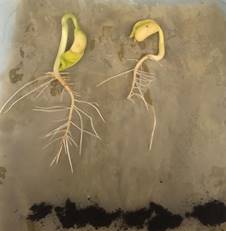
Figure 1: Example of rhizotron set-up from above view point. Chemotactic migration can be determined from location of nodule formation.
1. Food and Agricultural Organization (2008). Retrieved November 26, 2015, from http://www.fao.org/soils-portal/soil-degradation-restoration/en/
2. Bergman, K. (1990, January). The Role of Bacterial Chemotaxis in Initiation of Rhizobium Legume Symbiosis for Nitrogen-Fixation. Journal of Chemical Ecology, 16(1), 114-115.
3. Caetano-Anollés, G., Wall, L. G., De Micheli, A. T., Macchi, E. M., Bauer, W. D., & Favelukes, G. (1988). Role of motility and chemotaxis in efficiency of nodulation by Rhizobium meliloti. Plant Physiology, 86(4), 1228-1235.
4. Soby, S., & Bergman, K. (1983). Motility and chemotaxis of Rhizobium meliloti in soil. Applied and environmental microbiology, 46(5), 995-998.
See more of this Group/Topical: Student Poster Sessions