
 Google
 Yelp
 Facebook
 Twitter
 ChEnected
480784 Textile Wastewater Treatment By Bioinspired Antimicrobial Nanofiltration Membranes
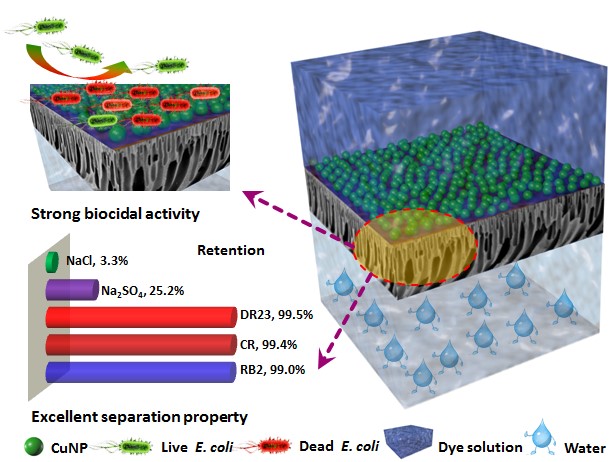
Surface functionalization with advanced nanomaterials offers tailored control and targeted design of surface properties optimal for separations. Such modifications endow materials with improved or new separation qualities such as high hydrophilicity, excellent selectivity and permeability, and enriched antimicrobial activity. In this study [1], we develop two strategies (two-step deposition and co-deposition) that use mussel-inspired polydopamine (PDA) to strongly immobilize copper nanoparticles (CuNPs) onto a porous polymeric membrane. Through bridged surface cavities from ultrafiltration (UF) to loose nanofiltration (NF), these membranes display promising potential for the separation, recycle, and reuse of dye/salt mixtures as resources rather than as environmentally harmful waste. To confirm the optimization of membrane surface properties, a series of materials characterizations was executed: SEM, EDS analysis, AFM, water contact angle, and zeta potential measurements. The results indicate an overall high performance of surface properties with a homogeneous nanoparticle distribution, low roughness, favorable hydrophilicity, and relatively neutral charge. Co-deposition of PDA and CuNPs was verified as a facile and time-saving process that expedited a higher CuNP loading compared to the traditional two-step strategy, as confirmed by SEM and AFM images. The integration of polyethylenimine (PEI)-modified CuNPs with high density of positive charges was shown to play an important role in fine-tuning the hydrophilicity and compatibility with PDA and in largely neutralizing the negative charge of PDA, thus promoting an outstanding salt permeation (82% Na2SO4, 98% NaCl). In addition, CuNP/PDA-modified membranes performed an ultra-high rejection (>99.0%) of three types of textile dyes (600-800 Da), demonstrating a superior NF separation performance. Furthermore, the functionalized membranes display a distinct bactericidal activity with a pronounced reduction of 93.7% in the number of live Escherichia coli (E. coli) bacteria. This study highlights a fast, facile co-deposition strategy to assemble a multifunctional separation coating onto UF support, which renders a vast potential for textile wastewater treatment.
Reference:
[1] Zhu, J., Uliana, A., Wang, J., Yuan, S., Li, J., Tian, M., Simoens, K., Volodin, A., Lin, J., Bernaerts, K., Zhang, Y., & Van der Bruggen, B. (2016). Elevated salt transport of antimicrobial loose nanofiltration membranes enabled by copper nanoparticles via fast bioinspired deposition. Journal of Materials Chemistry A, 4(34), 13211-13222.
See more of this Group/Topical: Student Poster Sessions