
Improved Graphene Oxide Sponge as Superoleophilic Furan Coupling Catalyst
Saikat Dutta, Dionisios G. Vlachos, Basudeb Saha
Hydrophobic materials with repeatable adsorption for oils due to superior oleophilicity also promotes surface adsorption of organics that may promote a chemical reaction. Such dual features in the same material may elevate the application profile from efficient oil absorber to a potential surface-active catalyst in the liquid phase. Graphene materials have been reported for multipurpose absorption applications both in hydrophobic and hydrophilic environments due to incredibly controllable surface wettability. Hydrothermally convertible surface features of a improved graphene oxide (IGO) into its hierarchical form such as graphene oxide foam (GOF) represents a new generation of amorphous carbon materials that offers multipurpose adsorption based applications. The GOF with 3D microstructures enhances surface roughness of parent graphene sheets and propensity for rapid adsorption. A mammoth scope of achieving aggregation state of GO through self-assembly has enabled researchers to develop carbon-frameworks with desired physical and microstructural properties.
In this presentation, we aim to describe how the multilayer IGO is capable of forming IGO-assembly with and without a cross-linker (phytic acid (PA)) to access to IGO-foams (IGO-PA and IGO-H) (Scheme 1). Carbon-frameworks of these IGO-foams are amorphous and possess similar surface features as found in parent IGO as revealed from X-ray diffraction (XRD) analysis. Spectroscopic (Raman, XPS) and microscopic imaging (SEM, HRTEM, AFM) techniques reveal multiple type of surface functional groups and extended twisted sheet like multilayered arrangement of graphene sheets in both foam materials. These foams are also incredibly water-repellent (superhydrophobic) and superoleophilic that enables their use for oil absorption in large volume from water-oil mixture. IGO-H was demonstrated as being capable for absorption of oils drops moving on the widely spread water surface which resembles oil-spill scenario in the sea. As a results of a unique balance between hydrophobicity
Both IGO-PA and IGO-H foams exhibits excellent catalytic activity for C-C coupling of low carbon furanics to long carbon fuel precursors via hydroxyalkylation/alkylation (HAA) reaction under solventless conditions at low temperatures. Considering chemical and thermally tunable hydrophobic and oleophilic surface features, a wide-range of application for which IGO-foams fit which also includes advanced biomass processing based on adsorption.
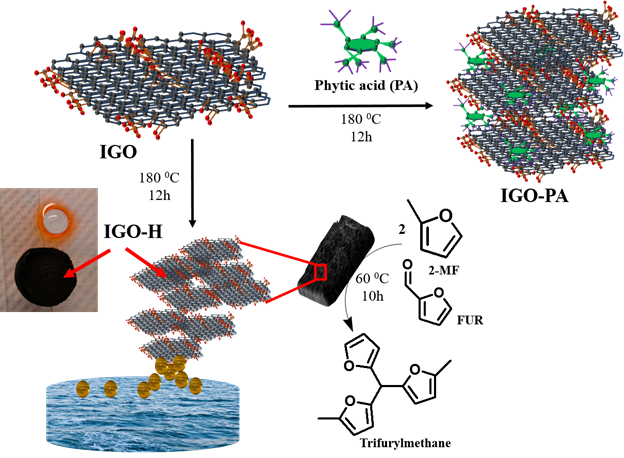
Scheme 1. Preparation protocol of IGO-sponges under hydrothermal condition and its oil-absorption features from oil-water biphasic medium and catalytic applications for solventless HAA of furanics.
See more of this Group/Topical: 2017 International Congress on Energy