
Hydrogenation of phenol to cyclohexanone via tubular nanofiber supported catalyst
Lin Pan and G. G Chase
Abstract
Cyclohexanone is the key intermediate in the manufacture of nylon-6 and nylon-66. The hydrogenation of phenol process is commonly used in industry due to the lower temperature requirement and less byproducts generation compared with the oxidation of cyclohexane1. The hydrogenation process could happen through two path ways: one step or two step reaction. The one step reaction (Figure 1) is applied here. The hydrogenation can be conducted either in liquid phase (low temperature) or gas phase (high temperature). The temperature needed for the one-step reaction is lower than that needed for the two step reaction2.
The liquid phase reaction is preferred in our work because the operation conditions are easier to establish and control in a laboratory environment. Researchers have evaluated many catalysts for use in liquid phase phenol hydrogenation. The catalysts have been applied as dispersed particles in the liquid as a pseudo homogeneous reaction and the catalyst particles have been immobilized on monolithic support structures for heterogeneous reaction. Each approach has its advantages and disadvantages. In general, hydrogen bubbles must transport through the liquid phase to the catalyst particles for the reaction to occur. The transport of individual bubbles to a catalyst particle is somewhat random and challenging to predict. To our knowledge no previous research has evaluated the performance of catalyst supported on a gas-liquid barrier membrane. The membrane is in the form of a hollow tube. Hydrogen gas flows through the inside of the tube and aqueous phenol flows on the outside of the tube. The objective of this work is to the feasibility and to evaluate the reaction kinetics of a prototype tubular membrane reactor shown in Figure 2. The membrane is fabricated using electrospinning techniques.
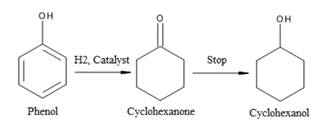
Figure 1. The one step reaction pathway of phenol hydrogenation
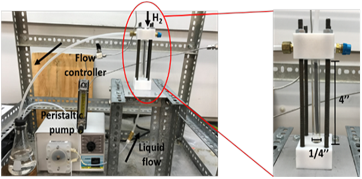
Figure 2. Designed reactor of tubular hydrogenation reactor
Reference
1. Liu, Huizhen, et al. "Selective phenol hydrogenation to cyclohexanone over a dual supported Pd–Lewis acid catalyst." Science 326.5957 (2009): 1250-1252.
2. Shore, Sheldon G., et al. "Vapor phase hydrogenation of phenol over silica supported Pd and Pd-Yb catalysts." Catalysis Communications 3.2 (2002): 77-84.
See more of this Group/Topical: Catalysis and Reaction Engineering Division