
Applying the assumption of dilute conditions, the use of thermodynamic models in the context of liquid chromatography is most often avoided. Chromatographic models are commonly based on component mass balances which consider a single convective phase and a thermodynamic equilibrium between adsorbed phases and liquid phases which is described through an isotherm, being a function of liquid phase concentrations. In some cases, however, the common assumption of dilute conditions is not valid, and one has to account for highly concentrated, non-ideal liquid phases, which might even result in a phase split and subsequent multiphase flow [1,2]. Examples for such non-ideal behavior are certain reactions in chromatographic reactors, or systems where interactions of adsorbing components lead to a considerable enrichment of these components. Under these non-dilute conditions, the thermodynamic equilibrium between adsorbed phase and convective phase(s) is consistently described as a function of liquid phase activities (rather than liquid phase concentrations), and, in the case that solubility limits are exceeded, the phase split and compositions of the convective phases have to be determined. For these problems, a thermodynamic model for the liquid phase(s) is required.
In this contribution, we consider the quaternary system phenetole (PNT), 4-tert-butylphenole (TBP), methanol and water at 296 K and ambient pressure, and its interaction with the adsorbent Zorbax 300SB-C18. In order to describe the dynamic, chromatographic behavior of this system under non-dilute conditions, accounting for adsorption and possible phase separations/ two-phase flow, we have to characterize the thermodynamic behavior of this system.
In a first step, we characterize the thermodynamic behavior of the convective phase(s), i.e. of the quaternary system in the absence of the adsorbent, through liquid-liquid, solid-liquid, and solid-liquid-liquid equilibrium experiments. A UNIQUAC model is used to quantitatively describe the thermodynamic properties of the system (see Figure 1), with model parameters fitted to the experimental data.
Secondly, the thermodynamic equilibrium between the convective phase(s) and the adsorbed phase has to be analyzed. For this purpose, adsorbed phase concentrations of the adsorbing components PNT and TBP are determined experimentally through dynamic column experiments as a function of the liquid phase composition (compare Figure 2a). Liquid phase activities can be calculated from the liquid phase composition applying the established UNIQUAC model. Determined adsorbed phase concentrations can be related to liquid phase activities through simple isotherms (see Figure 2b). The established isotherms describe the adsorption behavior for a very broad range of conditions (diluted to highly concentrated and multi-phase conditions), while common isotherms, being a function of liquid phase concentrations, are only valid in a low concentration range of the adsorbing component and for a constant solvent (methanol : water) ratio.
Application of the established UNIQUAC model and adsorption isotherms in the chromatographic model provides an accurate description of the chromatographic behavior for a broad range of conditions.
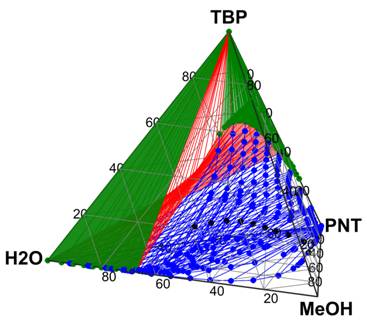
Figure 1: Thermodynamic model of the quaternary system PNT-TBP-methanol-water (prediction by UNIQUAC model)
|
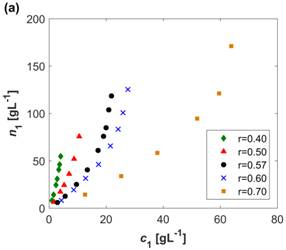
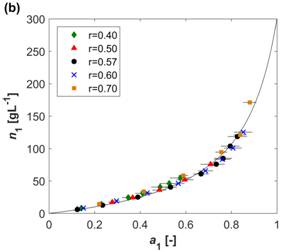
Figure 2: (a) experimental adsorption data for PNT at different solvent ratios r (methanol content in solvent in mass fractions), over the liquid phase concentration of PNT, (b) adsorption data for PNT, with liquid phase compositions converted to liquid phase activities by applying the UNIQUAC model.
References
[1] Jermann S., et al., (2015), J. Chrom. A, 1425, 116-128
[2] Ortner F., Mazzotti M., (2017), in preparation
See more of this Group/Topical: Engineering Sciences and Fundamentals