
ABSTRACT
Mitchell and Mannan (2007) evaluated resilience of simple process systems like steam pipe, water pipe, water pump and heat exchanger etc., and considered physical failures of these systems. However, they did not provide any mathematical background and their approach was too simplistic. Hence, it could not be directly applied to complex process systems such as absorber, regenerator and distillation columns. Linh et al. (2012) reported resilience analysis considering physical failure of the process systems to improve the safety of process plants.
In contrast to physical failure of process systems, quantification of system resilience has been carried out considering performance failure of process systems under this work. The inherent resilience for process systems can be conceptualized from the perspectives of material resilience.
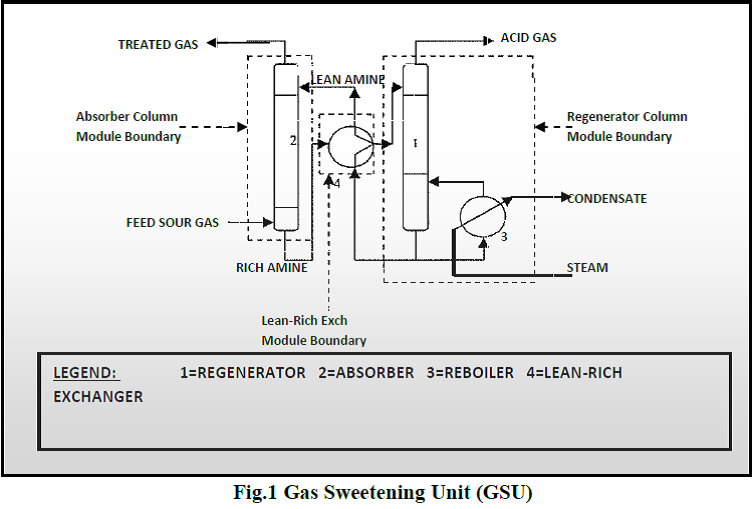
Correlations have been developed to assess resilience properties of constituent process systems pertaining to a Gas Sweetening Unit (GSU) as a case study. Fig.1 shows the schematic flow diagram of the Gas Sweetening Unit (GSU).
A steady state condition has been considered and system stress and system strain equations have been developed to quantify the system resilience.
This study has enabled developing a new method for identification of thermodynamically efficient operating capacity regime for optimization of energy usage in process systems. Optimum energy usage for a process system is achieved when it is operated at the most thermodynamically efficient capacity regime and this is evaluated by estimation of newly conceived Thermodynamic Coefficient of Performance (THCOP) data at various capacities.
This work provides general formulae for quantification of system resilience properties of one absorber column, one regenerator column, one shell and tube heat exchanger and associated one process as well as one utility pipeline system pertaining to a GSU (Fig.1).
It is found that the GSU (Fig.1) operating capacity range of 80%-100% is the most thermodynamically efficient operating capacity regime. The minimum operating capacity for the GSU is considered as 1% whereas the maximum operating capacity is 150%. The design capacity (i.e., 100%) of the GSU is 27814 kg/hr. The GSU is designed to sweeten sour natural gas containing 1.28 wt% of H2S to sweet natural gas containing less than or equal to 1 ppmw H2S.
It is found that absorber column and regenerator column systems under study possesses inherent resilience of around 5% and 15% respectively with regard to variation in upstream feed sour gas flow rate beyond 100% design flow rate, i.e., 27814 kg/h.
It is also found that the lean-rich exchanger system under study possesses inherent resilience of around 10% with regard to variation in upstream feed sour gas flow rate beyond 100% design flow rate.
It is noticed that the inlet feed sour gas pipeline system (process pipeline) indicates drastic fall in modulus of resilience value (Ur) and great increase in modulus of elasticity (Esys) value above feed gas mass flow rate of 100% indicating attainment of allowable pressure drop and limiting or yielding stress.
It is also found that the utility pipeline system (which carries superheated steam) shows a plateau at very high steam flow rate (57600 kg/hr-64800 kg/hr) indicating attainment of allowable pressure drop and limiting or yielding stress region for the system in case of flow variation.
Results also indicate that similar to a material, all the process systems under study (i.e., absorber, regenerator, lean-rich exchanger, process pipeline and utility pipeline) of Gas Sweetening Unit.(GSU, Fig.1) demonstrate inverse relationship of modulus of resilience (Ur) with modulus of elasticity (Esys) in all applicable operating variable deviation regimes.
Computer simulation using a process simulator SIMULATION SCIENCES INC, Pro/II has been utilized for this study.
Finally, one example is given regarding design procedure in relation to incorporation of 50% over capacity factor or inherent resiliency in the absorber column by augmentation of number of column trays.
Literature Cited
[2] Mitchell S M. and M. Sam Mannan (2007),
Ph.D Thesis, “Resilient Engineered System: The Development of an Inherent
System Property”, Texas A&M University, Texas, U.S.A. Nomenclature Ur = Modulus of Resilience for system (kJ/m3-sec),
Esys = System Modulus of elasticity, (kJ/m3-sec)
See more of this Group/Topical: Process Development Division