
Technologies such as horizontal drilling and hydraulic fracking are yielding new supplies of crude oil and natural gas liquids and so, pipelines, which represent the most reliable and cost-effective way of transporting large volumes over long distances, are expanding. In the U.S., the total mileage of 192,396, reflects a 9.3% increase over the last 5 years [1]. In 2013, pipeline operators delivered 6.6 million barrels of refined products (e.g., gasoline, diesel, jet fuel) and natural gas liquids (propane, ethane). Increased mileage and volumes represents a challenge for operators to deliver the benefits of increased energy production to consumers.
Most pipeline scheduling models rely on a continuous-time and -volume representation to better adapt to segments of different length and diameter. They allow the flowrate to vary between given lower and upper bounds, to better utilize the capacity of the pipeline. Since flowrates need not be defined as model variables, models are typically of the mixed-integer linear programming type (MILP) unless an accurate representation of the pumping cost is needed [2]. Another classification criterion is related to the handling of materials as they move through the pipeline. The most popular option is to work with batches [3-5] that need to be related to the actual products. This is because it facilitates the calculation of the left and right coordinates needed to exactly locate products inside the pipeline, which trigger entry and exiting events.
This paper presents a new formulation that does not need to define batches. It is derived from Generalized Disjunctive Programming (GDP) [6-8], building on recent work for a batch-centric formulation [5] that was the subject of last year AIChE annual meeting. The main challenge is that coordinates need to be reset following a product complete exit from a segment, so that a new lot of the same product can enter at the other end (it is not an issue in batch-centric models since batches never re-enter a segment). The new coordinate constraints prevent multiple products to enter/leave a segment during a time slot, which can lead to more time slots being required to represent a schedule. One advantage, is that there are no other decisions that can compromise solution quality, contrary to the batch centric model that has a few tuning parameters related to the definition of old batches from the initial pipeline status and new batches injected. The other advantage, is that it becomes possible to rigorously enforce forbidden product sequences, very common in practice to reduce product contamination.
Results over a set of seven benchmark problems from [5], involving straight pipelines with unidirectional flow and multiple intermediate dual purpose nodes, show that the new formulation can reduce the makespan of Ex2 by 8%. On the other hand, it fails for Ex3 since all feasible schedules involve multiple batches of a product simultaneously on a segment, which is not currently allowed, and returns a suboptimal solution for Ex1 (dealing 345 km of the Iranian pipeline system). Thus, there is not a single best performer amongst the GDP-based formulations.
The GDP product-centric formulation has also been compared to a Resource-Task Network (RTN) counterpart [9]. After minor modifications to the RTN, both models were found identical, i.e. they can generate the same schedule using the same number of event points. The benefit of the new formulation, is that it reduces problem size by a factor of 3-5, resulting in orders of magnitude improvements in performance.
The new formulation is modular and can easily be extended to other configurations (tree-like, mesh). Furthermore, it can tackle problems with reversible flow.
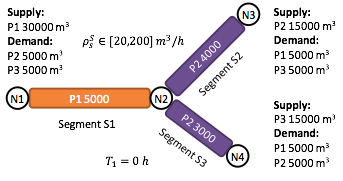
Given the segment volumes, flowrate range (same for all segments), product supply and demand of the three products (P1-P3) at nodes N1, N3-N4 (node N2 is just a connection node), and initial status of the pipeline, can you find the minimum makespan for this reversible flow problem?
Acknowledgments: Financial support from Funda‹o para a Cincia e Tecnologia (FCT) through projects IF/00781/2013 and UID/MAT/04561/2013.
References:
[1] Association of Oil Pipe Lines, 2014. U.S. Liquids Pipeline Usage & Mileage Report. http://www.aopl.org/wp-content/uploads/2014/10/U.S.-Liquids-Pipeline-Usage-Mileage-Report-Oct-2014-s.pdf (accessed 30.01.2017).
[2] Cafaro, V.G., Cafaro, D.C., Mendez, C.A., Cerda, J. MINLP model for the detailed scheduling of refined products pipelines with flow rate dependent pumping costs. Comput. Chem. Eng. 2015, 72, 210-221.
[3] Cafaro, D.C., Cerda, J. Optimal scheduling of multiproduct pipeline systems using a non-discrete MILP formulation. Comput. Chem. Eng. 2004, 28, 2053-2068.
[4] Mostafaei, H., Castro, P.M., Ghaffari-Hadigheh, A.. A novel monolithic MILP framework for lot- sizing and scheduling of multiproduct treelike pipeline networks. Ind. Eng. Chem. Res. 2015, 54, 9202.
[5] Mostafaei, H., Castro, P.M., 2017. Continuous-Time Scheduling Formulations for Straight Pipelines. AIChE J. Doi: 10.1002/aic.15563.
[6] Balas, E. Disjunctive programming. Annals of Discrete Mathematics 1979, 5, 3-51.
[7] Raman, R., Grossmann, I.E.. Modeling and computational techniques for logic based integer programming. Comput. Chem. Eng. 1994, 18, 563-578.
[8] Castro, P.M., Grossmann, I.E. Generalized Disjunctive Programming as a Systematic Modeling Framework to Derive Scheduling Formulations. Ind. Eng. Chem. Res. 2012, 51, 5781-5792.
[9] Castro, P.M. Optimal scheduling of pipeline systems with a resource-task network continuous-time formulation. Ind. Eng. Chem. Res. 2010, 49, 11491-11505.
See more of this Group/Topical: Computing and Systems Technology Division