
Graphic Synthesis Method for Multi-technique Integration Separation Sequences of Multitudinous Refinery Gases
Xuehua Ruan, Hongyan Xiao, Xiaobin Jiang, Xiaoming Yan, Yan Dai, Gaohong He
School of Petroleum and Chemical Engineering, State Key Laboratory of Fine Chemicals, Dalian University of Technology, Panjin, Liaoning, P.R. China, 124221
Corresponding Author Email: hgaohong@dlut.edu.cn
In petroleum and chemical industries, considerable crude oil, i.e., 3~8 %, is converted into refinery gases and used as furnace fuels. Many valuable species in the refinery gases, e.g., H2, C2H6, C2H4, C3H8 and C4H10, are depleted. Currently, this wastage is going on increasing because more and more hydro-processes are built up for refining heavy sour crude oils to high quality products. Accordingly, the effective separation of valuable species from refinery gases has been one of the most potential approach to improve crude oil utilization percentage.
Nowadays, some separation unit operations have been attempted to fractionate and reclaim refinery gases, e.g., pressure swing adsorption, glassy polymer membrane permeation and cryogenic condensation for recovering H2, shallow condensation, gasoline absorption and rubbery polymer membrane permeation for concentrating light hydrocarbons, and distillation for further separating hydrocarbons. Nevertheless, any simplex technique cannot fractionate all the valuable components efficiently and sufficiently from multitudinous refinery gases. It is necessary to integrate various techniques together as the hybrid processes to achieve the recovery task. In this instance, a shortcut method is established in this work to construct the multi-technique integration processes, in which highly efficient separation unit operations are coupled together within an optimal sequence to improve efficiency.
This shortcut synthesis method is a graphic means based on expressing separation units by vectors in composition space. Three supporting technical measures are summarized:
1. After ranking components with their separation characteristics and belongings in products, refinery gases are reduced to be pseudo-ternary mixtures of H2, light hydrocarbons and fuel gases, meanwhile the composition space is visualized into triangular coordinate system.
2. Based on the efficiency analysis, dominant feed ranges for adsorption, condensation, glassy and rubbery membrane separation are determined, in which the represented technique could be more efficient than the others for the composition matched refinery gases.
3. Separation operations, usually acting with the selectivity unique to a certain species group, are estimated quickly by the shortcut calculations and then represented with vectors in the triangular coordinate system.
The shortcut synthesis method and its application for construct multi-technique integration systems are sketched out in Figure 1.
|
Figure 1. Graphic synthesis of a multi-input cascade coupling separation sequence.
|
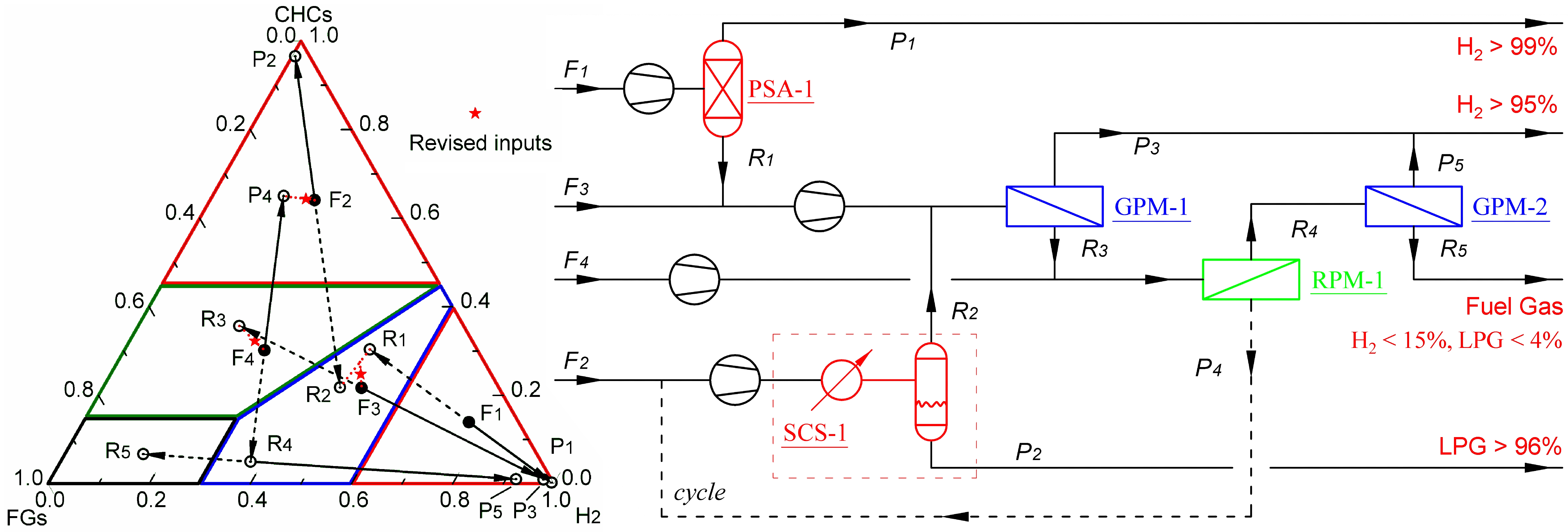
The synthesis is launched by positioning the feedstock in the triangular coordinate system according to the composition. According to the location of the feed stream, the separation unit suitable to deal with this stream can be determined facilely by matching with the dominant ranges. Afterwards, the shortcut calculations are conducted by vector analysis to orientate the residue from a separation unit and select the next separation unit.
Thanks to running the separation unit operations in their preferred ranges and avoiding the stream mixing with great composition difference, the multi-technique systems designed by the expert synthesis approach can reclaim refinery gases sufficiently and efficiently. For multitudinous refinery gases in large-scale petrochemical complex, the overall recovery ratio for valuable species is higher than 95 %, while the specific energy consumption is usually lower than 0.50 kWh/Nm3 refinery gases. The integration processes designed by this means have been successfully industrialized in Sinopec and PetroChina.
Acknowledgement:
The authors are grateful to the financial support from National Natural Science Foundation of China (No. 21606035, U1663223, 21527812), Education Department of the Liaoning Province of China (LT2015007), and Changjiang Scholars Program (T2012049).
See more of this Group/Topical: Topical Conference: Process Intensification & Modular Chemical Processing