
Multivariate monitoring of a continuous manufacturing process for API synthesis: enhancing the power of real time data
Melanie Dumarey, Product Development and Supply, R&D, GSK (melanie.x.dumarey@gsk.com)
Martin Hermanto, SGP Technical Development (TD), Global Manufacturing Site, GSK (martin.x.hermanto@gsk.com)
The pursuit of efficient manufacturing approaches has increased the implementation of continuous processing technologies within the pharmaceutical industry as they can enhance the supply chain flexibility, reduce the environmental and spatial footprint and deliver more consistent quality. An additional advantage is the enhanced opportunities for process monitoring delivering high volumes of data which can be linked by multivariate tools to assure consistent product quality and optimal process operability. Traditionally only a few process sensors, e.g. those recording controlled process parameters, are monitored proactively and fitted with an alarm, whilst many others are only studied in case of an anticipated problem or as part of a root cause analysis.
In the presented case study, multivariate modelling tools were applied to exploit the wealth of process data generated during the synthesis of an active pharmaceutical ingredient (API) combining five chemical transformations in a continuous flow process. Not only the controlled process parameters as flow rate and temperature were monitored, but also not quality critical sensors such as pump speeds and pressures were included. In total 69 process sensors measuring flow rates, temperatures, reactor pressures, pump suction and discharge pressures, pump speeds and conductivities were summarized by multivariate models. The aim was to detect and prevent upcoming process failures based on the real-time multivariate trends. The main technical challenge was balancing sensitivity and robustness of the implemented models ensuring significant process changes were detected and minimizing false alarms requiring interventions by the plant operators.
Multivariate monitoring was extensively tested during development campaigns at the R&D facilities, where on several occasions it successfully detected upcoming process failures (e.g. upcoming pump blockage) before activation of the univariate quality-limiting alarm. In the example visualized in Figure 1 an upcoming pump blockage was detected based on the multivariate trend, which flagged an increase in pump speed approximately one hour before the flow rate was exceeding the defined limits. As the process remained within the proposed control ranges before the flow rate excursion, the product quality was not affected at the time of the multivariate model excursion and corrective actions could have been taken to prevent process failure. Secondly, multivariate models of the generated data were used to perform a retrospective root cause analysis of the recurrent blockage of a reagent supply. The outcome of this analysis, i.e. the blockages originated from supply and not from reactor, facilitated further investigations by narrowing down the possible causes.
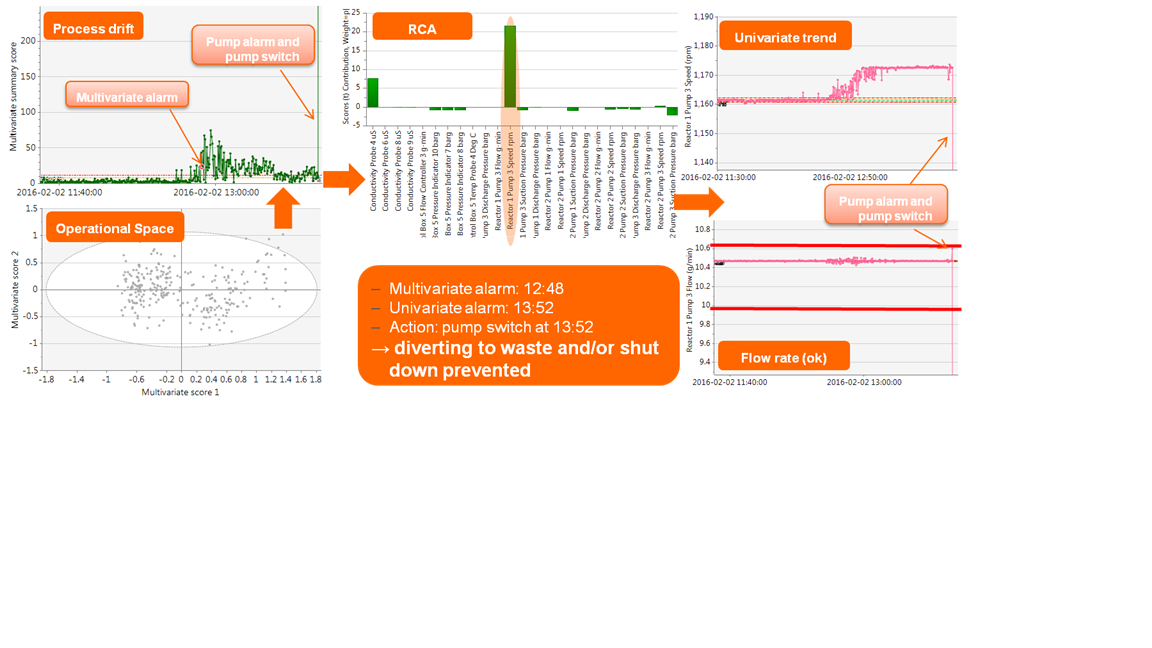
Figure 1: Flow chart for the multivariate monitoring of a primary continuous process displaying symptoms of an upcoming process failure (pump blockage)
Based on these encouraging results, the informatics platform and modelling approach were transferred to the manufacturing site, where it detected other patterns indicative of process drift. In the future, the same methodology will be implemented as part of the predictive maintenance strategy for commercial manufacture. More specifically, any significant changes in the process trend will trigger a well defined action, e.g. a pump switch if standby pumps available, or a controlled shut down if no corrective action is feasible. These early interventions aim at increasing manufacturing efficiency by avoiding divert to waste of the process stream or preventing a forced shut down.
The application described in this paper supports GSK’s intent to increase the use of advanced analytics and modelling in order to enhance quality by design development and improve quality assurance and efficiency of manufacturing processes. As part of the same intent, online HPLC capability was developed for the first primary continuous process introduced at GSK’s commercial manufacturing plant (specifically Singapore), where it is now used for real time process monitoring, continuous improvement and support of investigations triggered by the quality management system. Enhanced monitoring combining online HPLC data and multivariate modelling tools is currently under investigation. All these new technologies introduced significant improvements to process understanding, process robustness and quality assurance. GSK’s longer term aim is to develop reliable and accurate tools to support real time release of API or even to implement real time control models enabling process optimization in real time, which would further improve product quality and manufacturing efficiency.
Acknowledgements
Peter Shapland, Hannah Robinson, Peter Hamilton and Irene Areri for keeping the continuous primary process and supporting platforms running and helping to interpret observed process changes.
Ian Barylski for the informatics support enabling the new technology.
Malcolm Berry for leading the project and supporting communications.
See more of this Group/Topical: Pharmaceutical Discovery, Development and Manufacturing Forum