
Advanced Ni-CeO2 Nanocatalysts for Chemical CO2 Recycling
T. Smith, T. Stroud, E. Le Saché, H. Arellano-Garcia, T.R. Reina*
Department of Chemical and Process Engineering, University of Surrey, Guildford, GU2 7XH, UK
*Corresponding author: t.ramirezreina@surrey.ac.uk
Introduction
Carbon dioxide is one of the major issues facing the world currently, the adverse effects on the environment that CO2 emissions cause are well documented. Major steps are being taken by industry to mitigate these effects, with a proportion of the CO2 produced being captured each year. This scheme to reduce carbon emissions into the atmosphere is part of a worldwide initiative, whereby the carbon captured can be stored, but there is still a lot of progress to make within this field before this is a truly viable option. There is however, another exciting alternative which is the chemical upgrading of CO2 to obtain fuels and chemicals [1] [2]. This way, the depletion of CO2 emissions is accompanied by an extra motivation in terms of the generation of added-value products.
Among the different alternatives for CO2 utilisation, dry reforming of methane is a promising route leading to the production of syngas (H2 and CO) [3]. This is a highly useful and valuable intermediary, which can be used in processes like the Fischer-Tropsch Synthesis to create long chain hydrocarbons, such as diesel [4].
The issue that arises in the dry reforming process, is the deactivation of the catalysts used in the reaction of the feed chemicals. This deactivation is due to sintering of the active phase and/or carbon deposition [3] [5]. In order to overcome these problems noble metal based catalysts have been employed but their cost make them unsuitable for a real application.
The aim of this work is to develop a highly active dry reforming catalyst based on Ni. Considering the disadvantages of Ni in terms of deactivation, we have developed multicomponent materials based on monometallic and bimetallic Ni/CeO2/Al2O3 catalysts with excellent features for reforming reactions. In this study, all the catalysts contain 10 %wt. Ni and 20 %wt. CeO2. As for the bimetallic formulations, Pt and Sn have been selected as promoters with a nominal loading of 0.3 and 0.8 % wt. respectively.
Experimental
The catalysts were prepared by wet sequential impregnation using alumina (Sasol) and the relevant precursors (Sigma Aldrich) employing a Rotovap, with a session of drying and calcining between each step of the impregnation. The drying was performed at 80°C and was left overnight, the calcination was performed at 700°C for 4 h.
The dry reforming of methane was carried out at atmospheric pressure in a quartz tube reactor. 0.1 g of catalyst was used per reaction supported upon a reactor bed of quartz wool. The catalyst was reduced in situ at 800°C for 1 h, in a 100 mL/min flow containing 20% H2 and 80% N2. The reaction was then conducted at 700°C for over 20 h, in a 100 ml/min flow containing 12.5% CH4, 12.5% CO2 and 75% N2 (WHSV = 60,000 mL g-1 h-1). The gas products of the reaction where analysed using an ABB AO2208 gas analyser. The spent catalysts were recovered and characterized.
All the fresh catalyst samples have been characterized fully, by XRD, H2-TPR and N2 adsorption. The spent samples have also been characterized fully, post reaction, by XRD, Raman and SEM.
Results and Discussion
The textural properties of the sample catalysts are shown below in Table 1. What can be observed from the data is that the specific surface area as well as the pore volume of the catalyst is reduced by the addition of ceria. However, the addition of Sn and Pt does not affect the textural properties of the catalysts. The decrease in the surface area can be attributed to ceria species covering the surface of Al2O3, this is corroborated by the decrease in pore volume.
Table 1: Textural properties of the catalyst samples.
Catalyst | BET (m2 g-1) | Pore Volume (cm3 g-1) |
Ni/Al | 164 | 0.42 |
Ni/CeAl | 116 | 0.28 |
SnNi/CeAl | 120 | 0.29 |
PtNi/CeAl | 118 | 0.28 |
The XRD data shown below in Figure 1 provides insight into the chemical structure of the prepared catalyst samples. The absence of any crystalline peak attributed to Ni species indicates a good metallic dispersion and small particle sizes. However, the presence of NiAl2O4 cannot be fully discarded since the spinel peaks overlap with those of the bare Al2O3. In addition, the presence of ceria fluorite type structures is evidenced in the XRD patterns. As for the bimetallic samples, the XRD depicted for PtNi/CeAl is comparable to that of the Ni/CeAl base catalyst except for the small PtO peak at 2Ө = 40°, while the SnNi/CeAl catalyst shows a very similar XRD pattern to Ni/CeAl.
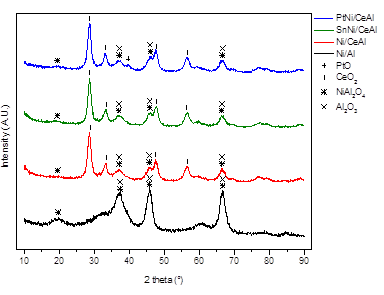
Figure 1: XRD patterns of the catalysts.
The redox properties of the catalysts are shown in the H2-TPR profiles displayed in Figure 2. All the profiles present, contain a peak at high temperatures (650-850°C), this is due to the bulk reduction of the NiAl2O4 spinels, which due to their structure require a high temperature to be reduced. The later agrees with the XRD data. The three catalysts containing ceria exhibit a shoulder at 850°C as well as much larger H2 consumption peak than the base Ni/Al catalyst. This is attributable to the bulk ceria reduction occurring in the temperature range 700-900°C. Also, a reduction process at 250°C on the PtNi/CeAl profile was identified and attributed to the reduction of PtO.
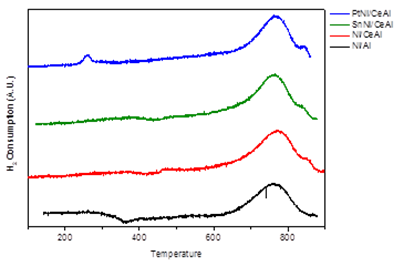
Figure 2: H2-TPR profiles of the catalysts.
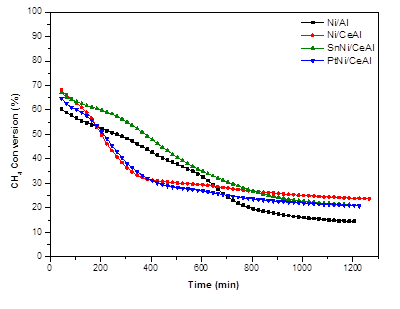
Figure 3: CH4 conversions of the catalysts.
Figure 3 and Figure 4 below show the CH4 and CO2 conversions for all the catalyst after 20+ h on the reaction stream. It can be seen that the addition of ceria helps to significantly stabilise the catalyst due to its high oxygen storage capacity (OSC), in comparison the Ni/Al conversions are observed to drop especially after 10 hours. This is attributed to the formation of hard carbon on the surface of the catalyst blocking the accessibility of the molecules to the active sites. The effect the promoters have on the conversions differs, the Sn promoted catalyst has higher conversions to begin with before stabilising at similar conversions to the other ceria based catalyst. This has been attributed to the smaller particle size and higher particle dispersion the Sn promotion causes. By contrast the addition of Pt as a promoter hardly affects the catalytic performance of the Ni/Ce/Al sample. The Sn promoted catalyst also had the highest H2/CO ratio to begin with, of 0.97, before stabilising at a similar value to the other catalysts of around 0.75.
The characterisation performed post reaction on the spent catalysts (not shown for sake of briefness) concur with the conversion hypothesis. Large concentration of hard carbon were deposited on the Ni/Al while smaller concentrations and softer carbon haven been found on the ceria and ceria-tin promoted catalysts.
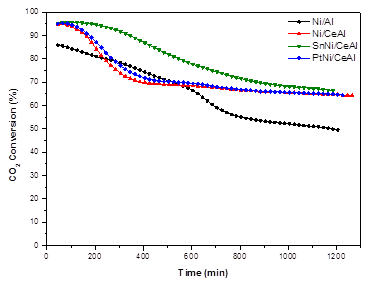
Figure 4: CO2 conversions of the catalysts.
Conclusions
This work evidences that multicomponent Ni based catalysts can be efficiently utilised for the chemical CO2 recycling via dry reforming. High levels of CO2 conversion and good H2/CO ratios have been achieved in general. The bimetallic Ni-Sn system supported on CeO2-Al2O3 was the most promising material among the studied catalysts. The excellent behaviour of this catalyst is due to its improved redox properties and the Ni-Sn synergy which prevents active phase sintering and carbon poisoning.
Further studies are currently being undertaken by our group to discern the effect of the operating conditions as well as the long-term stability of these advanced materials, in order to explore their potential application in real CO2 utilisation processes. References
x
1. | Pires JCM, Martins FG, Alvim-Ferraz MCM, Simoes M. Recent Developements on Carbon Capture and Storage: An Overview. Chemical Engineering Research and Design. 2011; 89(9): p. 1446-1460. |
2. | Leung DYC, Caramanna G, Maroto-Vler MM. An Overview of Current Status of Carbon Dioxide Capture and Storage Technologies. Renewable and Sustainable Energy Reviews. 2014; 39: p. 426-443. |
3. | Pakhare D, Spivey J. A Review of Dry (CO2) Reforming of Methane over Noble Metal Catalysts. Chemical Society Reviews. 2014; 43: p. 7813-7837. |
4. | de Araujo GC, de Lima SM, Assaf JM, Pena MA, Fierro JLG, Rangel MdC. Catalystic Evaluation of Perovskite-Type Oxide LaNi1-xRuxO3 in Methane Dry Reforming. Catalysis Today. 2008; 133: p. 129-135. |
5. | Charisiou ND, Siakavelas G, Papageridis KN, Baklavaridis A, Tzounis L, Avraam DG, et al. Syngas Production via the Biogas Dry Reforming Reaction Over Nickel Supported on Modified with CeO2 and/or La2O3 Alumina Catalysts. Journal of Natural Gas Science and Engineering. 2016; 31: p. 164-183. |
x
See more of this Group/Topical: Catalysis and Reaction Engineering Division