
MIXING EXPERIENCES
Abstract
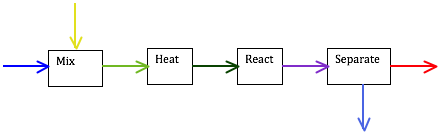
Chemical engineers design and develop processes to convert raw materials into desired products. In order to accomplish this, the raw materials may be mixed, heated, reacted and separated as diagrammed in Figure 1. Each process is designed with a specific order to the steps, and each step requires the design of specific equipment. Chemical engineering students are taught to design both the process and the equipment. Full courses, or significant portions of courses are devoted to the heating, reacting and separating steps. However little course time is devoted to the mixing steps and often hands-on opportunities are not available in laboratories.
| Figure SEQ Figure \* ARABIC 1. A pictorial view of chemical engineering.
|

| Mix |
| Heat |
| React |
| Separate |
Mixing is a central operation in most industries: the food, pharmaceutical, paper, plastics, ceramics and rubber industries all include mixing steps. Despite its widespread use, the process is difficult to analyze. Advances in obtaining experimental measurements and analyzing the data are helping to meet the challenges, but unexpected results due to mixing continue to arise during the scale up of a new process. Inefficiencies due to this lack of understanding have been estimated to cost $1-10 billion per year1.
Mixing experiments have been published, with the purpose of providing students with practical experience2, 3. The experiments investigate mixing of both Newtonian and non-Newtonian fluids using classic impellers. The experiments provide a general introduction and experience with the dimensionless variables. However, the equipment is not available at all institutions, and only two impellers are used.
To address these issues, students completed a mixing experiment at XX University that was developed with a colleague at Philadelphia Mixing Solutions, Ltd1. The necessary equipment is likely available in a standard chemical engineering laboratory. Philadelphia Mixing Solutions generously donated six impellers for the study, and will provide similar impellers to institutions that wish to include mixing in the curriculum. Details of the experiment procedure and analysis will be provided in the full paper.
The experiment was implemented for the first time in the Spring 2017 semester. After a brief introduction to mixing, twelve groups of four students measured the mixing time for an impeller at a variety of stirring rates. They calculated the dimensionless mixing time, Reynolds number and power supplied. A guest speaker from the mixing industry presented mixing theory and its limitations and challenged the students to compare their results to theory. One class period was also devoted to scale up methods. In total, three class periods and two hours in the laboratory were spent on the topic of mixing.
An assessment of student learning showed that after completing the experiment:
á The students had a greater understanding of what is ÒmixedÓ. They were able to apply what they learned in process controls (response to a step change) and determine when the solution was 90% homogeneous.
á The students are conversant in the language of mixing. In conversations with the instructor they correctly used phrases such as radial and axial mixing, impeller Reynolds number and power number. The written reports echoed this.
á The students showed an understanding of the trade off between shear and efficiency among different impellers. In fact, when shown six different impellers, the students can now provide their name and their mixing characteristics.
While these students are certainly not mixing experts, they now have knowledge that will be valuable to future employers. Future offerings will include readings from the literature and small hands on activities during class.
References:
1. Grenville, R.K., ÒMixing in the chemical engineering curriculumÓ, Paper ID #11457, American Society of Engineering Education Annual Conference, Seattle, WA (2105).
2. Ascanio, G., Legros, R., Tanguy, P.A., ÒA Fluid-Mixing Laboratory for ChE UndergraduatesÓ, Chemical Engineering Education 37(3) :296-299 (2003).
3. Pour, S.B., Norca, G.B., Fradette, L., Legros, R., and Tanguy, P.A., ÒSolid-Liquid and Liquid-Liquid Mixing Laboratory for ChE UndergraduatesÓ, Chemical Engineering Education 41(2): 101-106 (2007).
See more of this Group/Topical: Education Division