
Abstract for AIChE 2017 Antoine Klaue
Insight into the formation mechanism of an industrially relevant Ziegler-Natta catalyst
Antoine Klaue1, Hua Wu1, Massimo Morbidelli1, Matthias Kruck2, Nic Friederichs2, Francesco Bertola2
1Institute for Chemical and Bioengineering, department of Chemistry and Applied Biosciences, ETH Zürich, 8093 Zürich, Switzerland
2SABIC, Technology & Innovation, P.O. Box 319, 6160 AH Geleen, The Netherlands
Ziegler-Natta
(ZN) type polymerization processes have become very mature in terms of
engineering and optimization [1]. However, few studies in the open literature exist
dealing with the detailed chemistry during the formation of the ZN catalyst particles
[2], of which knowledge is important in controlling the size and morphology of
the ZN catalyst particles, thus those of the final polymer beads. In this work,
we take a typical industrial ZN recipe to monitor the formation mechanism of
the ZN catalyst particle. The recipe is a simple one-pot process [3], where an excess
amount of aluminum alkyl dichloride is added into a precursor composed of
magnesium and titanium alkoxides dissolved in hexane under agitation, leading
to precipitation of the ZN catalyst particles.
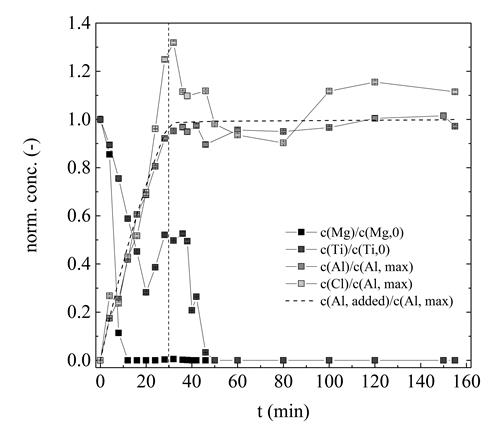
Figure 1 Composition measurement
of the liquid phase during the particle formation process by ICP-OES. The
dashed line symbolizes the feed time.
[1] Böhm, L. L., Angew. Chem. Int. Ed.
2003, 42, 5010-2030
[2] Chien, J. C. W., J. of Polym. Sci.,
1982, 20, 2019-2032
[3] Berger E., Derroitte, J.-L. (Solvay Cie, Brussels,
Belgium). Polymerization of olefins, U.S. Patent, August
26, 1975.
See more of this Group/Topical: Catalysis and Reaction Engineering Division