
The catalytic conversion of biomass-derived feedstocks to value added chemicals is an important challenge to alleviate the dependence on petroleum-based resources. To accomplish this, the inherently high oxygen content of biomass compounds, such as that of lignocellulosic biomass, requires significant reduction via hydrodeoxygenation strategies. The unsaturated carboxylic acid itaconic acid (IA) can be produced from biomass via fermentation pathways, for example. A pathway of interest is the conversion of IA to isoprene, facilitating the renewable production of an industrially relevant diolefin. IA is successively hydrogenated to yield 3-methyl tetrahydrofuran (3-MTHF), in a one-pot cascade reaction (Figure 1A), where a Pd-Re/SiO2 bimetallic catalyst results in the highest 3-MTHF yield (80%, Figure 1B). The 3-MTHF is then converted to isoprene, and other pentadienes, through an acid catalyzed vapor-phase dehydra-decyclization. Multiple solid acid catalysts, including aluminosilicates, metal oxides and phosporous modified zeolites, were screened for the dehydra-decyclization step. All silicon phosphorous containing zeolites were found to be the most selective (70% isoprene and 20% pentadienes), where the major side reaction involved a retro-prins condensation of 3-MTHF to butane and formaldehyde. Through kinetic studies, an investigation into the effect of Brønsted acid strength, pore size and operating conditions on the selectivity to isoprene are discussed.
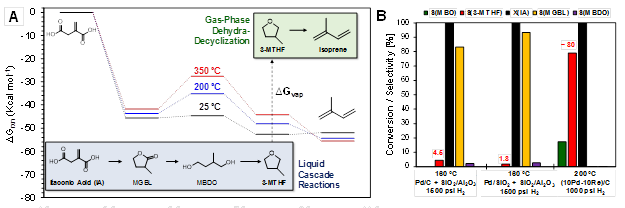
Figure 1. A. Itaconic acid, produced by glucose fermentation, is converted by one-pot hydrogenation to 3-methyl-tetrahydrofuran (3-MTHF). Gas-phase dehydra-decyclization of 3-MTHF with solid acid catalysts yields isoprene. B. Three conditions of experimental conversion of IA (5 wt% in H2O) to 3-MTHF (red) with supported metal catalysts and hydrogen pressure after 24 hours. Products include methyl-butanol (■, MBO), resulting from the over-hydrogenation of 3-MTHF.
[1] Abdelrahman, O. A.; Park, D. S.; Vinter, K. P.; Spanjers, C. S.; Ren, L.; Cho, H. J.; Zhang, K.; Fan, W.; Tsapatsis, M.; Dauenhauer, P. J. ACS Catal. 2017, 7, 1428-1431.
See more of this Group/Topical: Catalysis and Reaction Engineering Division