
Structure-Property Relationships for Unidimensional, Large and Extra-Large Pore Zeolites Using Alkane Hydrocracking and Hydroisomerization as Probe Reactions
Viktor J. Cybulskis1, Stacey I. Zones2, Tracy M. Davis2, Cong-Yan Chen2, Michael W. Deem3 and Mark E. Davis1
1Chemical Engineering, California Institute of Technology, Pasadena, CA 91125, USA
2Chevron Energy Technology Company, Richmond, CA 94802, USA
3Bioengineering, Rice University, Houston, TX 77005 USA
High-silica zeolites (Si/Al > 30) are versatile catalytic materials in petroleum refining processes due to their thermal stability, shape selectivity, and chemical functionality. However, of the 232 known [1] and more than 330,000 predicted [2] zeolite structures, the global refining market is dominated by five main frameworks: FAU, MOR, MFI, *BEA and FER [3]. While these zeolites often deliver satisfactory commercial performance, the development of materials with improved function or entirely new structures for future applications requires a deeper understanding of how specific properties, such as composition, framework topology, and acid site function, can influence the product distribution for a given reaction.
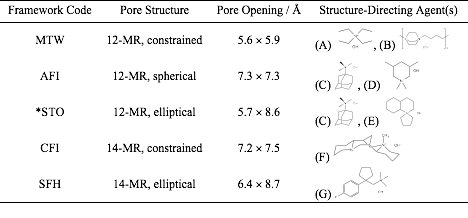
For the present study, large and extra-large pore zeolites were prepared from the corresponding structure-directing agents (SDAs) shown in Table 1 to investigate the effects of the organo-cation guest molecules and synthesis conditions on zeolite crystallinity, microporosity, and heteroatom incorporation. Unidimensional (1D) structures were chosen so that the zeolite pore opening could be used to adequately describe the confining size. Hydrocracking and hydroisomerization of n-hexane (nC6) and n-decane (nC10) were used as probe reactions on these Pt-exchanged, 12- and 14-membered ring (MR) zeolites to examine the effect of pore structure on shape selectivity by comparing the distributions and yields of branched C6 and C10 isomers. Elucidation of these structure-property relations support de novo computational design efforts to predict chemically-synthesizable SDAs and produce a novel, 1D zeolite framework with tailored catalytic properties.
Table 1. 1D, 12- and 14-MR zeolites synthesized from the corresponding SDAs
References:
[1] C. Baerlocher and L.B. McCusker, Database of Zeolite Structures, http://www.iza-structure.org/databases/. Accessed March 27, 2017 (2017).
[2] R. Pophale, P.A. Cheeseman and M.W. Deem, Phys. Chem. Chem. Phys. 13, 12407 (2011).
[3] W. Vermeiren and J.P. Gilson, Top. Catal. 52, 1131 (2009).
See more of this Group/Topical: Catalysis and Reaction Engineering Division