
Research Interests:
New catalysts enabled the creation of many important technologies in the 20th century. For example, processes such as ammonia synthesis for fertilizer, fluidized catalytic cracking for high-octane gasoline, olefin polymerization for plastics and elastomers, and three-way catalytic converters for automotive emissions control all have made very large, positive impacts on society. Effective use of heterogeneous catalysts in future applications for key areas of interest, such as energy, consumer goods, and infrastructure, requires both rational design of these nanomaterials at the molecular level and development of new, alternative routes to produce high-value chemicals from carbon-containing resources.
The increased accessibility of unconventional gas sources in shale formations throughout the world presents an unprecedented opportunity to devise new reaction pathways to transform lower alkanes, such as methane (CH4), into a diverse range of suitable chemical precursors with enhanced selectivity and reduced environmental impact. One possible strategy for harnessing CH4 as a chemical feedstock in the near-term is through formaldehyde (CH2O): the simplest alkanal derived from CH4 via methanol (CH3OH) and synthesis gas (CO/CO2/H2) that can serve as a primary building block molecule (Scheme 1, blue path). Drawing from the concept of the formose reaction for sugar synthesis in prebiotic chemistry, I propose to combine CH2O with biomass-derived glycolaldehyde (diose) through a series of intermolecular C-C coupling reactions over molecular sieve catalysts to produce a variety of useful oxygenated intermediates (e.g., alpha-hydroxy carboxylic acids, esters, ketones) and simple carbohydrates (e.g., trioses) in alcoholic and aqueous media. In addition to its viability for terrestrial chemicals production, CH2O may also hold long-term promise for synthesis of edible, chiral sugars (e.g., D-glucose) from CO2 and H2 during extended missions in space and on Mars (Scheme 1, red path).
| Scheme 1. Formaldehyde (CH2O) as a chemical building block for CH4 utilization (Earth) and carbohydrate synthesis (Space). |
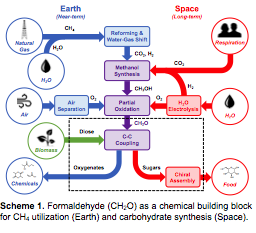
For this approach, I will use the catalytic functionalization of CH2O, a model chemical building block, as a core research theme (Scheme 1, outlined region) to support the development of short- and long-term projects in areas such as:
1) Design, synthesis, and application of tailored molecular sieves
By combining a priori prediction of energetically favorable organic structure directing agents (OSDAs) and knowledge of organic-inorganic guest-host interactions, I will selectively produce targeted molecular sieves - the beginning elements of such a methodology have been successfully demonstrated in academia by the Davis research group at Caltech in combination with the Deem research group at Rice University. I plan to capitalize on their early successes and further develop this methodology using the reaction pathways outlined above as the initial system for implementation.
Additional research focuses will include:
- Experimentally deriving structure-property relationships to guide computationally-driven design and synthesis of new molecular sieve frameworks and compositions
- Examining effects of OSDAs and synthesis conditions on framework topology, intra-crystalline acid and metal site functionality, and enantioselectivity
- Investigating molecular sieve performance for adsorption and separation of oxygenates and carbohydrates
- Exploring catalytic functionality for chiral assembly of small molecules
2) Assessment of catalytic active site function, tunability, and mechanistic implications
Once the new structures are developed, I will utilize existing characterization methods to investigate the ability of acid and metal centers in these molecular sieves to manipulate CH2O carbonyl functionality and catalyze reactions involving C-C and C-O bond formation as well as intramolecular carbon and hydrogen shift reactions.
Furthermore, I aim to:
- Understand the influences of molecular sieve pore structure, active site confinement, and local geometric and electronic structure on product selectivities and turnover frequencies for the reaction pathways outlined above
- Elucidate key reaction pathways and determine the relevant kinetic parameters for these systems by combining in situ and operando spectroscopic techniques with isotopic labeling experiments
Teaching Interests:
A student-focused teaching approach that values and facilitates individual learning is essential for more effective chemical engineering instruction. Students must not only become proficient at problem solving, but must learn to think for themselves, cultivate a sense of professionalism, and develop critical skills needed to succeed as practicing engineers. Engineering coursework is especially conducive to this type of multi-faceted learning approach because of the ability to integrate theory with practical applications. However, the critical link between principles and practice, which can be a powerful motivator for learning in many students, is often missing from the college classroom. Thus, one of my primary objectives as an instructor is to bridge this gap and help students organize theory and facts and apply these concepts to solve new problems.
Students will be introduced to theory through traditional, lecture-based instruction that will be supplemented with real-world examples to model scenarios that the students could encounter as practicing engineers. The appropriate mix of theory and application will be dependent upon the exact nature of the course as well as the audience. For instance, undergraduate students may be more interested and receptive to examples that are industrially-relevant, whereas graduate students may appreciate topics more closely tied to research and development in a laboratory environment. Potential teaching methods include:
- Conducting break-out sessions and solving short problems in small teams
- Demonstrating the use of software tools to solve more complex problems
- Performing small-scale experiments (if possible) to supplement course concepts
- Evaluating case studies on relevant incidents in industry and academia
- Discussions with invited guest speakers
Throughout my instruction, I will integrate themes of ethics, professionalism, and process safety into the curriculum that align with the course objectives. Having early exposure to these topics will help inform how students approach problem solving in their future work by enabling them to consider the potential impacts of decisions that engineers may face.
Core courses that I am most interested in teaching include kinetics and reaction engineering, thermodynamics, mass and energy balances, unit operations, and engineering materials. Additionally, I would also like to design new upper-level undergraduate and graduate courses in engineering ethics for safety and the environment, industrial catalysis and chemical technology, catalysis and spectroscopic methods, and engineering entrepreneurship.
See more of this Group/Topical: Meet the Faculty Candidate Poster Session - Sponsored by the Education Division