
Introduction
Core-shell nanoparticles (NPs) have become increasingly attractive as a catalytic design platform due to their unique ability to simultaneously enhance the activity, increase the durability, and reduce the loading of noble metal (NM) catalysts. However, these materials have been limited by the lack of independent control over the core and shell compositions, shell thickness, and particle size [1]. To address these issues, our group recently developed a novel method for the synthesis of transition metal carbide (TMC) core-NM shell (denoted NM/TMC) NPs with precise control over the core-shell architecture [2]. Group 4-6 TMCs are earth-abundant compounds with high sinter-resistance, electrical conductivity, and chemical stability, making them ideal candidates for core materials [3].
Transition metal nitrides (TMNs) share all of these favorable material properties of TMCs but have rarely been investigated in core-shell materials. Here, we present the ability to synthesize NM/TMN core-shell NPs with varying core and shell compositions and controllable shell thickness via nitridation of the corresponding NM/TMC. The impacts of titanium tungsten nitride (TiWN) and titanium tungsten carbide (TiWC) cores on the electronic properties of a Pt shell are compared, and the effect of these differences on catalytic properties was investigated by measuring the activity for the hydrogen oxidation reaction (HOR) under the presence of CO to assess the CO tolerance. The results illustrate how the use of nitride versus carbide cores offers an effective way to tune the reactivity of NM catalysts.
Materials and Methods
NM/TMC NPs were nitrided under NH3 at 800°C for 3 h to form NM/TMN NPs. Synthetic details for NM/TMC are provided elsewhere [2]. All materials were supported on carbon. Electrochemical measurements were performed at 30°C on a rotating disk electrode with a Ag/AgCl reference and platinum counter electrode. All potentials are reported versus a reversible hydrogen electrode (RHE). For comparison, catalyst loadings were targeted to have roughly equal Pt surface areas. HOR scans were performed in H2-sat 0.1 M HClO4 at 2 mV/s and 1600 rpm with iR compensation. To test CO tolerance, the working electrode was first held at 0.025 V until the electrolyte equilibrated with 1000 ppm CO before starting the HOR scan.
Results and Discussion
Pt/TiWC NPs with varying Pt coverage were synthesized using the method previously reported by our group and transformed into Pt/TiWN NPs via nitridation at 800°C. The high sinter-resistance and strong interfacial bonds of Pt/TiWC prevent particle agglomeration and preserve the core-shell structure while the core is converted into a nitride, which is confirmed by XRD, STEM-EDX, TEM, XPS, and CHNS analysis (Figure 1A).
XPS spectra of the core-shell materials reveal shifts in the core electron binding energies, called core level shifts (CLSs), for both the W 4f and Pt 4f signals. These CLSs indicate a significant change in the Pt electronic structure, as shifts in the core level energies of metal overlayers are reflected in similar shifts in the valence d-band center, which is known to correlate strongly with adsorbate binding energies and thus the reactivity [4-5]. The XPS results suggest downward shifts in the Pt d-band center for the core-shell materials compared to a pure Pt surface and an even lower d-band center and weaker binding for Pt/TiWN compared to Pt/TiWC.
To probe the difference in adsorbate binding and reactivity among our core-shell and commercial Pt (denoted Ptcomm) catalysts, we used CO as a model adsorbate and measured the HOR activity in the presence of CO (Figure 1B). Strong CO binding is a common problem for Pt catalysts, poisoning the surface and impeding reactivity. In the presence of 1000 ppm CO, the HOR activity of Ptcomm is completely suppressed by CO adsorption and is not recovered until above 0.5 V when CO can be oxidized off the surface. In contrast, both core-shell materials retain HOR activity at potentials as low as 0.1 V, thus demonstrating dramatically improved CO tolerance and reduced CO bond strength. Furthermore, 2-3 monolayer (ML) Pt/TiWN displays even greater CO tolerance than 2-3 ML Pt/TiWC, indicative of weaker CO binding as predicted from the XPS CLSs.
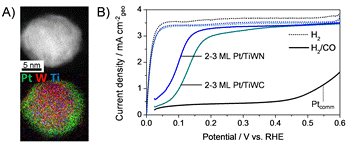
Figure 1. A) STEM-EDX map of 2-3 ML Pt/TiWN. B) HOR polarization curves in H2-sat 0.1 M HClO4 at 1600 rpm with (solid line) and without (dotted line) 1000 ppm CO.
Significance
In addition to Pt/TiWC, the synthetic method can be applied to core-shell NPs of varying NM/TMC compositions, demonstrating a promising way of synthesizing new core-shell architectures with tunable electronic properties that can serve as next generation catalysts.
References
1. Yang, H. Angew. Chem. Int. Ed. 50, 2674-2676 (2011).
2. Hunt, S.T., Milina, M., Alba-Rubio, A.C., Hendon, C.H., Dumesic, J.A., and Román-Leshkov, Y. Science 352, 974-978 (2016).
3. Zhong, Y., Xia, X., Shi, F., Zhan, J., Tu, J., and Fan, H.J. Adv. Sci. 3, 1500286 (2016).
4. Weinert, M., and Watson, R.E. Phys. Rev. B 51, 17168-17180 (1995).
5. Kitchin, J.R., Nørskov, J.K., Barteau, M.A., and Chen, J.G. J. Chem. Phys. 120, 10240-10246 (2004).
See more of this Group/Topical: Catalysis and Reaction Engineering Division