
Aldol condensations are important reactions which are used in a wide range of processes to produce new carbon-carbon bonds, for example in the pharmaceutical industry for the production of chalcones and in the fine chemical industry for the production of 2-ethylhexanol for PVC plasticizers [1]. A potential novel application in the bio-based industry is the production of liquid fuels from lignocellulosic biomass by upgrading smaller furanic molecules to heavier hydrocarbons [2]. Currently, homogeneous bases such as KOH or NaOH are typically used as aldol condensation catalysts. Despite their excellent activity, these catalysts are dangerous to handle, pose an environmental risk, and are difficult to separate from the final product stream [1]. Hence, innovative heterogeneous catalysts are pursued to establish a more sustainable alternative.
Due to their large pore sizes, large surface areas and the easy incorporation of different types of active sites, mesoporous silicas are promising supports for many types of catalysts. By grafting amine groups on a fraction of the weakly acidic surface silanols, an acid-base aldol condensation catalyst can be obtained. Previously, it has been demonstrated that the residual silanols enhance the catalytic activity of the amine active site by promoting the attack of its nitrogen lone electron pair on the carbonyl group of the reactants [3]. Previous research on acid-base mesoporous silica catalysts has shown that the highest catalytic activity can be achieved when a methyl substituted secondary amine is attached with a propyl linker to the support, and is fully promoted by surface silanols [4]. When the amines are randomly grafted on mesoporous silica, full promotion is achieved when at least 1.7 silanols are available per amine [5].
Although catalyst lifetime is an important factor for the industrial application of a material, no systematic investigation of the deactivation behavior of these cooperative acid-base catalysts has been performed, yet. In this work, a detailed investigation is performed on the factors which induce catalyst deactivation. Using this information, complete catalyst reusability has been achieved.
First, a heterogeneous acid-base cooperative catalyst has been synthesized by grafting of N‑methylaminopropyltrimethoxysilane (MAPTMS) on a mesoporous silica gel. The amine density is kept low in order to ensure full promotion by an excess of weakly acidic surface silanol groups. An unpromoted amine catalyst is obtained by, subsequently, end-capping the promoting silanol groups using 1,1,1,3,3,3-hexamethyldisilazane (HMDS). Both materials are characterized by means of nitrogen adsorption-desorption measurements and elemental (CHN) analysis. These catalysts were then employed in the aldol condensation reaction of 4-nitrobenzaldehyde with acetone at 55 °C in a batch-type reactor, using DMSO as a solvent and methyl-4-nitrobenzoate as internal standard. The results of these experiments show that the reaction rate remains constant throughout an experiment, i.e., the slope of the conversion versus batch time graph remains constant. However, subsequent reuse of the spent catalyst yields a lower, albeit also constant, reaction rate. Hence, it seems that catalyst deactivation has occurred upon unloading the catalyst from the reactor. The ratio of the turnover frequency in the second run to that of the first run is used as a measure for the catalyst reusability. For the cooperative acid-base catalyst this ratio amounts to 38 ± 10%, while with the unpromoted amine catalyst a reusability of 77 ± 10% is achieved.
To investigate the nature of the deactivation, the spent catalysts have been characterized via nitrogen adsorption-desorption and CHN analysis. No evidence of pore-blocking was observed. Interestingly, after reaction, the amount of nitrogen in the samples increased with 60% for the cooperative catalyst and with 10% for the unpromoted amine catalyst. This indicates the presence of reaction intermediates on the surface. Raman spectroscopy confirms the presence of aromatic rings, conjugated with double bonds and nitro groups, covalently attached to the active site.
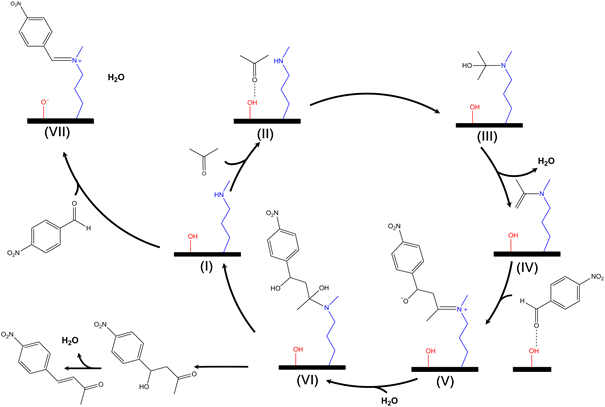
Figure 1: catalytic reaction cycle of the aldol condensation of acetone with 4-nitrobenzaldehyde, catalyzed by a secondary cooperative aminated silica catalyst [3-5]
Possible intermediate species that comply with the organic groups identified using Raman spectroscopy are displayed in Figure 1 as species (VII), (V) and (VI). Species (VII) is the iminium ion of a 4-nitrobenzaldehyde molecule. However, this undesired side-reaction is suppressed by using a large excess of acetone. The other potentially remaining species are the product iminium ion (V) and the product carbinolamine (VI). This iminium ion can undergo hydration to form the carbinolamine and subsequently desorb from the catalytic site. However, when drying the catalyst after a catalytic run, iminium ions that are still present on the surface could dehydrate and form a stable conjugated compound that acts as a site-blocking species, as displayed in Figure 2.
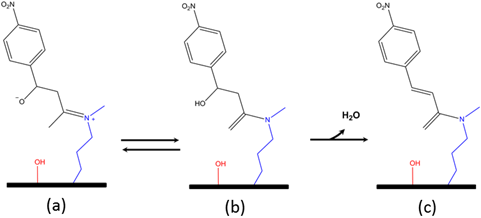
Figure 2: the iminium intermediate species (a) from the catalytic cycle is in equilibrium with its enamine form (b) and can further dehydrate into a stable conjugated species (c) which acts as a site blocker to the amine active site
Adding extra water to the reactor could increase the water-assisted desorption step of the iminium intermediate, as displayed in Figure 1, and thereby reduce its surface coverage upon unloading the catalyst from the reactor. In this work, 0.5 wt% to 3 wt% water is co-fed to the batch reactor. The first and second run turnover frequencies of both the acid-base catalyst, as well as the unpromoted amine catalyst, as a function of the water amount in the reactor, are displayed in Figure 3. When adding at least 0.5 wt% water, the unpromoted amine catalysts are completely reusable, exhibiting a turnover frequency ratio of 92 ± 10%. The maximum reusability achieved with the cooperative acid-base catalysts amounted to 72 ± 10%. This indicates that the promotional ability of the silanol groups irreversibly decreases due to the presence of water, while the activity of the amine sites can be fully recovered.
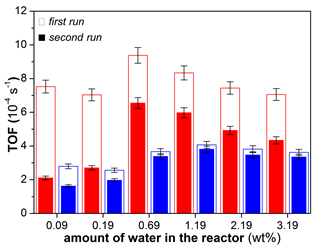
Figure 3: turnover frequency (s-1) for the aldol condensation of 4-nitrobenzaldehyde with acetone as a function of water in the reactor. Aminated silicas promoted by silanols (red) and unpromoted (blue), empty bars are a first run, full bars are a second run. Error bars indicate a 95% confidence interval. Karl-Fischer titrations have been performed to correct for water in the organic solvents.
Additionally, Figure 3 shows that a small amount of water has a beneficial effect on the reaction rate. In contrast, a high amount of water has a negative effect on the reaction rate. This is directly related to the effect of the water concentration in the catalytic cycle, as shown in Figure 1. Firstly, the enamine (species IV) can react with water leading to the desorption of acetone, which decreases the overall reaction rate. Secondly, by adding water, the rate of the water-assisted desorption step of the iminium ion (V) increases, thereby freeing up catalytic sites and increasing the overall reaction rate.
In this work it has, thus, been shown that the catalyst reusability can be drastically increased with the addition of water, causing a reduction in surface coverage of iminium species that could otherwise dehydrate to a stable site blocking species when the catalyst is dried. For the unpromoted amine catalyst, 0.5 wt% additional water already causes the catalyst to be fully reusable. However the cooperative acid-base catalysts cannot be made fully reusable due to a loss of the promotional ability of the silanol groups. The applicability of aminated mesoporous silica catalysts for continuous aldol condensation processes has, hence, been confirmed in this work by proving that a stable catalyst regime can be obtained by co-feeding a small amount of water. Further testing of these catalysts in a continuous-flow reactor will yield more information about the deactivation behavior of the catalyst with time-on-stream.
[1] G. Kelly, F. King, and M. Kett, "Waste elimination in condensation reactions of industrial importance," Green Chemistry, vol. 4, no. 4, pp. 392-399, 2002.
[2] Q. Deng et al., "Efficient synthesis of high-density aviation biofuel via solvent-free aldol condensation of cyclic ketones and furanic aldehydes," Fuel Processing Technology, vol. 148, pp. 361-366, 2016.
[3] N. A. Brunelli, K. Venkatasubbaiah, and C. W. Jones, "Cooperative catalysis with acid–base bifunctional mesoporous silica: impact of grafting and co-condensation synthesis methods on material structure and catalytic properties," Chemistry of Materials, vol. 24, no. 13, pp. 2433-2442, 2012.
[4] J. Lauwaert, E. De Canck, D. Esquivel, P. Van Der Voort, J. W. Thybaut, and G. B. Marin, "Effects of amine structure and base strength on acid–base cooperative aldol condensation," Catalysis Today, vol. 246, pp. 35-45, 2015.
[5] J. Lauwaert, E. De Canck, D. Esquivel, J. W. Thybaut, P. Van Der Voort, and G. B. Marin, "Silanol‐Assisted Aldol Condensation on Aminated Silica: Understanding the Arrangement of Functional Groups," ChemCatChem, vol. 6, no. 1, pp. 255-264, 2014.
See more of this Group/Topical: Catalysis and Reaction Engineering Division