
T. Stroud, T. Smith, E. Le Saché, H. Arellano-Garcia, T.R. Reina*
Department of Chemical and Process Engineering, Faculty of Engineering and Physical Sciences, University of Surrey, Guildford, UK
Corresponding author: t.ramirezreina@surrey.ac.uk
Introduction
Prevention of CO2 reaching the upper atmosphere is a topic of great interest in the world today. Co-currently, green energy production and chemical feedstock sources are being highly researched, where combining these issues represents the most efficient solution. Dry reforming of methane (DRM) represents one such solution:
CH4 + CO2 ⇌ 2CO + 2H2
DH298K = +247 kJ/mol DG298K = +170 kJ/mol
The products of this reaction (known colloquially as syngas) are a highly useful precursor for a number of chemical processes, such as the production of methanol and synthesis of liquid fuels via Fischer-Tropsch (FTS).
Given the endothermic nature of the reaction, high reaction temperatures are required to achieve favourable conversions of the reactants to syngas. Unfortunately, elevated temperatures also promote the formation of solid carbon via a number of further side reactions [1]. This carbon then deposits on the surface of the catalyst which (alongside metal sintering) causes the catalyst to deactivate.
Hence an effective catalyst must resist sintering and be resilient towards the formation of carbon upon the surface; whilst also being relatively inexpensive, such that it can be realistically employed within the wider industry. Nickel has previously been identified as a viable active metal to use, whilst an alumina (Al2O3) support helps disperse the Ni over a wider surface area, improving the activity over that of just Ni alone [1].
However, this still suffers from severe carbon deactivation and hence there remains potential for improvement. The aim of this work is to develop advanced catalysts for chemical CO2 recycling via DRM using tin and ceria as promoters of Ni/Al2O3 Experimental
Catalysts were prepared by the method of sequential impregnation, where a base of 10 wt.% Ni was first prepared by adding the appropriate amount of Ni(NO3)•6H2O (Sigma-Aldrich) to an alumina (SASOL) base, using acetone (Sigma-Aldrich) as the solvent. This was then thoroughly mixed for 30 minutes, before evaporating the acetone off with the aid of a vacuum pump. The sample was then further air dried in an oven overnight at 80 °C, after which calcination was performed at 700 °C for 4 hours. The resultant Ni/Al catalyst was employed as a reference material in this paper. Following the same preparation method, 3 promoted catalysts were prepared: Sn 0.02 mol.% Ni/Al, Sn 0.04 mol.% Ni/Al, Sn 0.02 mol.% Ni/Ce-Al. The tin was added using a SnCl2 (Sigma-Aldrich) precursor and the ceria by Ce(NO3)2•H2O (Sigma-Aldrich) aiming for a nominal CeO2 loading of 20 wt.%.
Experiments were run in a quartz tube reactor at atmospheric pressure, utilising quartz wool as a reactor bed. An electric fired oven was used to ramp up (15 °C/min) and maintain the temperatures used for reduction (800 °C) and reaction (700 °C). Reduction was performed in a total flow of 100 ml/min for 1 hour in an atmosphere consisting 20 % H2 (BOC) and 80 % N2 (BOC).
Each reaction was run for over 20 hours, using 0.1 g of catalyst and a total inlet flow of 100 ml/min, corresponding to a weight hourly space velocity (WHSV) of 60, 000 ml/(g-cat h). Of the inlet flow, 12.5 % was CO2 (BOC), 12.5 % CH4 (BOC) and the remainder being that of N2.
All fresh catalysts were characterised by means of XRD, H2-TPR and N2 physisorption (BET) analysis. Selected spent catalysts also underwent SEM and Raman. Results and Discussion
H2-TPR analysis (not shown here) confirms that a reduction temperature of 800 °C is sufficient to reduce the metal oxides to their elemental forms, whilst the XRD data (Figure 1) shows the Ni particles have been well dispersed. The increase of Sn loading as a promoter appears to have little effect on the crystalline structure of the samples, whereas cerium shows typical diffraction peaks of CeO2 fluorite phases.
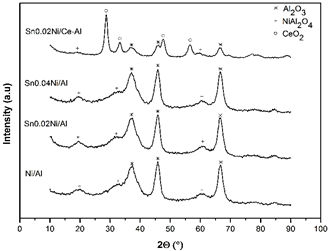
Figure 1 XRD profiles of the sample catalysts
N2 physisorption results (Table 1) show the addition of Sn does not affect the textural properties of the reference Ni/Al material. However CeO2 reduces the surface area and volume of the pores, which is down to the CeO2 nanoparticles covering the surface of the primary support (Al2O3).
Table 1 Results of N2 physisorption analysis on fresh catalysts
Sample | SBet (m2/g) | VPore (cm3/g) | DPore (nm) |
Ni/Al | 164 | 0.42 | 10.1 |
Sn0.02 Ni/Al | 173 | 0.42 | 9.8 |
Sn0.04 Ni/Al | 172 | 0.42 | 9.8 |
Sn0.02 Ni/Ce-Al | 120 | 0.29 | 9.6 |
In terms of catalytic performance, both methane and CO2 conversions (Figure 2 and Figure 3 respectively) are improved by the addition of Sn, showing less deactivation with time when compared with the un-promoted Ni/Al catalyst. Initially, both the un-promoted and 0.04 Sn sample appear to perform better than the 0.02 Sn catalyst, but this quickly changes around the 500 minute mark for CH4 conversion and 450 minute mark for CO2. Increasing the quantity of Sn from 0.02 mol.% to 0.04 mol.% exhibits a decrease in performance with time. This is theorised to be down to the extra Sn blocking the active sites [2], therefore reducing performance; hence a ratio of 0.02 mol.% of Sn was selected as the optimum to be further improved upon.
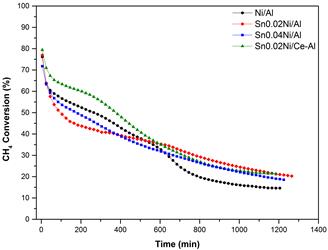
Figure 2 Methane conversions for the catalysts over a period of approximately 20 hours
Ceria is an excellent redox promoter due to its high oxygen storage capacity [3]. Therefore by adding CeO2, the amount of surface oxygen available increases [1]. This helps with the removal of carbon species from the catalyst surface, increasing the lifespan and improving activity. This has been observed in the case of the multicomponent catalyst (Ni-Sn/Ce-Al), with conversions being greater for longer periods of time in the case of methane. An impressively high peak of 95 % CO2 conversion can be seen, with a seemingly stable 66 % conversion after approximately 20 hours of on-stream operation. Lower conversions of methane (around 20 % after 20 hours) in comparison to CO2 are to be expected, due to decomposition of CH4 being the rate determining step and also the primary depositor of carbon [4].
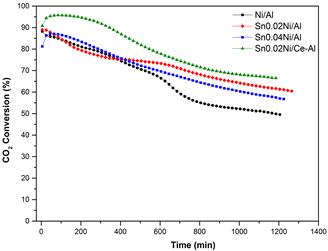
Figure 3 Carbon dioxide conversions for the catalysts over a period of approximately 20 hours
For the H2/CO ratio (Figure 4), the Ce doped sample appears the best candidate early on, peaking at a ratio of 0.97 after ca. one hour of operation. However this eventually decreases down to the same level (a ratio of around 0.75) of the un-promoted and 0.04 Sn samples after 20 hours. The Sn0.02 Ni/Al catalyst shows a slightly more favourable ratio of 0.81 after 20 hours, showing the addition of tin is also effective at improving the H2/CO ratio; with the optimum ratio again being 0.02 mol.%.
With the addition of ceria, a slight drop in performance is observed when compared with the 0.02Sn promoted catalyst. At the end of the experiment, a higher conversion of CO2 is present for Ce, with a similar methane conversion. This therefore results in a comparatively greater abundance of CO being present in the product stream (as the H2 is only formed by methane decomposition), giving a lower ratio. The observed trend could be due to the ability of ceria to catalyse the reverse water shift reaction, RWGS (CO2 + H2 ⇌ H2O + CO) which explains greater CO2 conversion and the smaller H2/CO ratio for the ceria promoted sample.
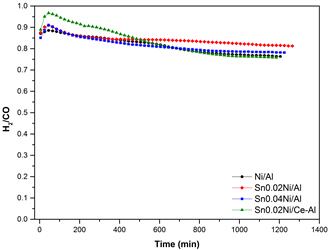
Figure 4 Syngas product ratio for each catalyst over a period of approximately 20 hours Conclusions
The addition of tin as a promoter to a nickel alumina catalyst shows a marked improvement in conversions of both carbon dioxide and methane to syngas. However, adding too large amounts of tin can have a detrimental effect on catalytic performance by restricting access of reactants to the active nickel sites. It has been found that 0.02 mol.% is an optimum tin loading.
Addition of ceria to the alumina support
increases resistance to carbon formation on the surface, exhibiting higher
conversions for a longer period of time. In parallel, ceria aids the RWGS
reaction boosting the CO2 conversion. When included together, tin
and ceria work synergistically, resulting in a very promising catalyst for dry
reforming reactions.
x
1. Charisiou N.D., Baklavaridis A., Papadakis V.G., Goula M.A. Syn Gas Production via the Biogas Reforming Reaction Over Ni/MgO–Al2O3 and Ni/CaO-Al2O3 Catalysts. Waste and Biomass Valorization. 2016; 7: p. 725-736. 2. Hou Z., Yokota O., Tanaka T., Yashima T. Surface Properties of a Coke-Free Sn Doped Nickel Catalyst for the CO2 Reforming of Methane. Applied Surface Science. 2004; 233: p. 58-68. 3. Reina T.R., Ivanova S., Centeno M.A., Odriolzola J.A. Boosting the Activity of a Au/CeO2/Al2O3 Catalyst for the WGS Reaction. Catalysis Today. 2015; 253: p. 149-154. 4. Wei J., Iglesia E. Isotopic and Kinetic Assessment of the Mechanism of Reactions of CH4 With CO2 or H2O to Form Synthesis Gas and Carbon on Nickel Catalysts. Journal of Catalysis. 2004; 224(2): p. 370-383. x
See more of this Group/Topical: Catalysis and Reaction Engineering Division