
Hydrodeoxygenation of anisole as bio-oil model compound over supported non-sulphided CoMo catalysts: effect of Co/Mo ratio and support
Chanakya Rangaa, Rune Lødengb, Vaios I. Alexiadisa, Joris W. Thybauta*
aLaboratory for Chemical Technology, Ghent University, Technologiepark 914, B-9052 Ghent, Belgium.
bSINTEF Materials & Chemistry, Department of Kinetics and Catalysis, N-7465 Trondheim, Norway.
*Corresponding Author: Joris W. Thybaut, E-mail: Joris.Thybaut@UGent.be
Introduction
Fast pyrolysis is considered as one of the prominent approaches to obtain liquid organic products with high yield from lignocellulosic biomass. However, pyrolysis oils (bio-oil) cannot be directly used as a fuel or fuel additive due to the high oxygen content 1, which results in undesirable properties such as low thermal and chemical stability, low heating value, immiscibility with conventional, fossil fuels and high acidity. These oils, hence, require upgrading via oxygen removal and increase in hydrogen content. Catalytic hydrodeoxygenation (HDO) is one of the most promising routes to upgrade pyrolysis oils for producing liquid transportation fuels 2.
The complexity of fast pyrolysis oil has prompted the use of model compounds such as phenolics, furans, ethers, acids etc. to study the intricacies of hydrodeoxygenation 1, 3. Anisole, because of its methoxy group, has already been widely investigated as a model compound for lignin derived bio-oil 4. The low sulfur content in bio-oil renders the use of traditional sulfided catalysts (NiMoS and CoMoS) for hydroprocessing less suited, as they require the presence of sulfur to retain their activity and, hence, result in contaminated end products. To mitigate this issue, non sulfided transition metal (Ni, Co, Mo) catalysts on various supports have been investigated for hydrotreatment of bio-oil model compounds 5-8, yet significant challenges remain in improving the catalyst activity, selectivity and stability. Our previous work on MoO3/ZrO2 catalysts provided insight in the effect of catalyst structural composition with varying preparation conditions on catalyst performance 7-8. The present work explores the intricacies of anisole HDO reaction pathways upon addition of Co to the Mo catalysts by assessing their intrinsic kinetics performance in non-sulphided form. The catalyst performance is correlated with properties such as reducibility, active site dispersion, crystallite size, metal-support interaction.
Results
A series of supported CoMo catalysts were prepared with varying Co/Mo ratio (0.25, 0.58, and 1.07) while keeping the Mo loading between 8.3 – 10.2 wt%. A sequential incipient wetness impregnation (with Mo being introduced first) method using aqueous solutions of the corresponding precursor salts was employed during the synthesis procedure. Two different supports, i.e., Al2O3 and ZrO2, were used. Material physicochemical characteristics were evaluated through ICP-OES, BET, (in-situ) XRD, H2-TPR, NH3-TPD, CO chemisorption, (S)TEM, and XPS techniques. The performance of these CoMo catalysts was tested for anisole HDO at gas phase conditions in a fixed bed tubular reactor in plug flow regime. A high-throughput kinetics screening set-up (HTK-S) 9 comprising 16 plug flow reactors with an internal diameter of 0.00211 m and a length of 0.85 m was used for the acquisition of intrinsic kinetic data.
CoMo/Al2O3 catalysts promote the transalkylation and isomerization reactions whereas, ZrO2 supported ones promote mainly hydrodeoxygenation and transalkylation reactions. Catalyst stability as well as anisole conversion increased with Co/Mo ratio. Figure 1 displays the anisole conversion and product selectivity for CoMo/ZrO2 and CoMo/Al2O3 catalysts with Co/Mo = 1.07 during a stability test (TOS of 50 h). Al2O3 supported catalysts displayed higher anisole conversions compared to ZrO2 ones at the tested operating conditions. Further reaction pathway elucidation is done with the use of intrinsic kinetic measurements varying space time (50 – 250 kgcat s mol-1), temperature (523 - 623 K) and H2/anisole inlet molar ratio (50-150 mol mol-1) with best performing catalysts. Catalyst deactivation causes will be explored through characterization (O2-TPO, XRD, XPS, (S)TEM) of spent catalyst samples.
Addition of Co improved the catalyst stability compared to the MoO3 catalysts in our previous study 7-8. Catalyst activity-structure correlations drawn from present study can serve significantly in guiding the synthesis of next generation catalysts with better catalyst stability and activity during anisole HDO.
(a)
|
(b)
|
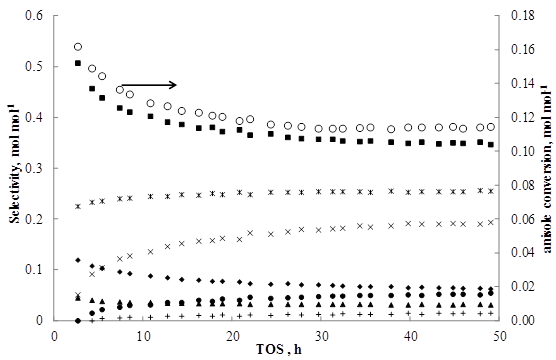
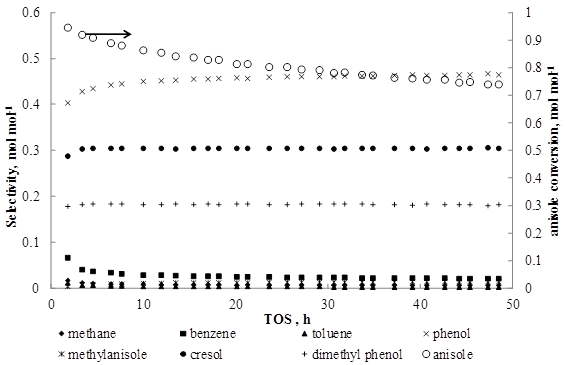
Figure 1 Time on stream (TOS) experiment with (a) CoMo/ZrO2 and (b) CoMo/Al2O3 at T = 573 K, PT = 0.5 MPa, H2/anisole = 50 mol mol-1, space-time = 220 kgcat s mol-1anisole. Co/Mo = 1.07 for both catalysts.
Conclusions
Supported CoMo catalysts observed to be relatively stable than the MoO3 catalysts at the tested operating conditions during anisole HDO over 50 h TOS. Al2O3 supported catalysts exhibited higher anisole conversions and relatively lesser stability compared to ZrO2 ones at the tested operating conditions. Catalysts stability as well as HDO activity observed during an extensive experimental campaign are correlated to the key properties such as active site dispersion, reducibility, crystallite size, and metal-support interaction. This will further enhance our understanding of the catalyst activity, stability and selectivity towards anisole HDO and provide valuable insights into the corresponding reaction pathways.
Acknowledgments
This research work is supported by the Innovative Catalyst Design for large-scale sustainable processes (i-CaD) project, which is a European Research Council (ERC) consolidator grant, by the European Commission in the 7th Framework Programme (GA nº 615456). It also fits in the framework of the FAST industrialization by Catalyst Research and Development (FASTCARD) project, which is a large scale collaborative project supported by European Commission in the 7th Framework Programme (GA nº 604277).
Keywords:
hydrodeoxygenation, reaction pathways, catalyst stability
References
1. Ruddy, D. A.; Schaidle, J. A.; Ferrell III, J. R.; Wang, J.; Moens, L.; Hensley, J. E., Green Chemistry 2014, 16 (2), 454-490.
2. Li, C.; Zhao, X.; Wang, A.; Huber, G. W.; Zhang, T., Chem. Rev 2015, 115 (21), 11559-11624.
3. Furimsky, E., Applied Catalysis A: General 2000, 199, 147–190.
4. He, Z.; Wang, X., Catalysis for Sustainable Energy 2013, 1 (1), 28–52.
5. Sankaranarayanan, T. M.; Berenguer, A.; Ochoa-Hernandez, C.; Moreno, I.; Jana, P.; Coronado, J. M.; Serrano, D. P.; Pizarro, P., Catalysis Today 2015, 243, 163-172.
6. Zuo, H.; Liu, Q.; Wang, T.; Ma, L.; Zhang, Q.; Zhang, Q., Energy & Fuels 2012, 26 (6), 3747-3755.
7. Lødeng, R.; Ranga, C.; Rajkhowa, T.; Alexiadis, V. I.; Bjørkan, H.; Chytil, S.; Svenum, I. H.; Walmsley, J.; Thybaut, J. W., Biomass Conversion and Biorefinery 2017, 1-17.
8. Ranga, C.; Lødeng, R.; Alexiadis, V. I.; Rajkhowa, T.; Bjørkan, H.; Chytil, S.; Svenum, I. H.; Walmsley, J.; Detavernier, C.; Poelman, H.; Van Der Voort, P.; Thybaut, J. W., Chemical Engineering Journal 2017, (submitted).
9. Van der Borght, K.; Toch, K.; Galvita, V. V.; Thybaut, J. W.; Marin, G. B., Catalysts 2015, 5, 1948-1968.
See more of this Group/Topical: Catalysis and Reaction Engineering Division