
There has been significant interest in the use of H2O as a reactant for biomass conversion given its high concentration in typical feed streams. Steam reforming and 5-hydroxymethylfurfural oxidation are two important examples.[1], [2] The aim of research described in this paper was to investigate the use of H2O as a terminal oxidant for the partial oxidation of aldehydes. The aldehyde water shift (AWS) reaction oxidizes the aldehyde and produces H2 (Equation 1).
CH3CHO + H2O -> CH3 COOH + H2 (Eq. 1)
Prior investigations of the AWS reaction have focused on homogeneous catalysts.[3] The commercial implementation of these types of catalysts can be cost-prohibitive. To our knowledge, no heterogeneous catalyst has been reported for this reaction. We explored the use of Mo2C-, CeO2-, and Al2O3-supported metals (Cu, Pt, Au), the design of which was inspired by that for highly active water gas shift (WGS) catalysts. In particular, the most active heterogeneous WGS catalysts are bifunctional and possess distinct sites for H2O dissociation and CO oxidation.[4] The target metal loadings were equivalent to 0.1 monolayer. The catalysts were loaded into a quartz flow-through reactor and the reactions were then carried out at 200-280oC.
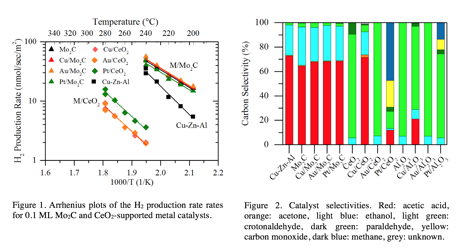
The AWS activities (Figure. 1) and product distributions (Figure. 2) were strong functions of the support. The observed AWS activities and activation energies suggest that the rate-limiting step, which is believed to be H2O dissociation, occurred on the support surface. Among all the catalysts studied, the Mo2C-supported catalysts possessed the highest AWS activities, with activities at least 5 times higher than those for the other materials. For the Mo2C-supported catalysts, the admetal did not significantly affect the activity. The Cu/CeO2 showed the highest AWS activity among the CeO2-supported materials. Like Mo2C, CeO2 is active for H2O dissociation. The high activity of the Cu/CeO2 catalyst clearly illustrates the importance of Cu particles for this material. In addition to the AWS reaction, the major side reactions were the Cannizzaro reaction, which produces ethanol and acetic acid, and aldol condensation, which forms crotonaldehyde. The Mo2C-supported catalysts and Cu/CeO2 were more than 60% selective to the AWS reaction. Our results suggest that the cooperation between the sites for H2O dissociation and aldehyde oxidation may have contributed to the high AWS activities and selectivities. In contrast, the other CeO2- and Al2O3-supported catalysts produced primarily crotonaldehyde via the aldol condensation reaction, which appeared to be catalyzed by weak acid sites. These and other results will be presented in the paper.
References
[1] Davda, R. R.; Shabaker, J. W.; Huber, G. W.; Cortright, R. D.; Dumesic, J. A. Appl. Catal. B Environ. 2005, 56, 171-186
[2] Zhang, Z.; Deng, K. ACS Catal. 2015, 5, 6529-6544
[3] Brewster, T. P.; Goldberg, J. M.; Tran, J. C.; Heinekey, D. M.; Goldberg, K. I. ACS Catal. 2016, 6, 6302-6305
[4] Schweitzer, N. M.; Schaidle, J. A. ; Ezekoye, O. K.; Pan, X. ; Linic, S.; Thompson, L. T. J. Am. Chem. Soc. 2011, 133, 2378-2381
See more of this Group/Topical: Catalysis and Reaction Engineering Division