
Background. Increasing concentrations of carbon dioxide in the atmosphere, although not toxic per se, are problematic due to their link to global warming. To fight climate change, several methods have been proposed. Carbon dioxide utilization through catalytic reduction to methanol is one of the most promising avenues to alleviate this problem. In this way, carbon dioxide can be captured directly at high-concentration sources (such as thermal power stations) and transformed into a useful chemical and an easy-to-handle energy source. Industrially, copper-zinc-alumina (CZA) catalysts are most commonly used because of their high conversions, selectivities towards methanol and resistance against deactivation. Although their operations is empirically understood well enough for engineering purposes, there is much debate about the exact mechanism and kinetics. Such knowledge is essential if one aims to systematically improve the catalysts.
We synthesised two catalysts (Cu/ZnO/alumina and Cu/MgO/alumina), experimentally tested them and performed ab initio multi-scale modelling, employing density functional theory (DFT), kinetic Monte Carlo (kMC), and micro-kinetic modelling (MK). Although no empirical assumptions were made in the process, results from theoretical modelling follow experiments nicely. Catalysts were synthesised in-house in such a way as to mimic the industrial catalysts as closely as possible but to avoid any spurious effects from impurities that are found in industrial catalysts (binders, stabilizers, intellectual property related compounds etc.).
Experimental. Experimentally, we aimed to discover the influence of MgO and ZnO on the characteristics of Cu-based catalysts. The Cu/M/Al catalysts (Cu:M: Al = 50:30:20 and M = Zn or Mg) were prepared by co-precipitation method at a constant pH = 8. Catalysts were characterized by BET, XRD, TPR, N2O-titration, CO2-TPD, XPS and micrographic techniques. Then, their catalytic activity for CO2 hydrogenation to methanol was evaluated. The catalytic activity was assessed in relation to the physicochemical properties of the catalysts together with the copper surface area, the reducibility of CuO and the catalyst basicity.
Ab initio calculations. DFT simulations were carried out in plane-wave formalism with exchange-correlation Perdew-Burke-Ernzerhof (PBE) functional within generalized gradient approximation (GGA). To take Cu-ZnO or Cu-MgO interface effect into account, which is the actual active site, into account, catalysts were modelled as follows. Cu sites were modelled as a Cu(111) surface. On top of the surface, a ZnO or MgO cluster, consisting of six atoms, was placed in the energetically most favourable orientation. The contact of ZnO or MgO clusters with Cu(111) was active site where the reaction took place.
A complex reaction pathway consisting of all possible intermediates and their interconversions was constructed. In total, 26 species and 33 reversible reaction steps were taken into account. To account for the hydrogen spill-over effect, which play a prominent role in catalyst performance, surface diffusion of hydrogen was explicitly included. Adsorption energy for each species was calculated, from which adsorption and desorption kinetics as functions of temperature and partial pressure were obtained from collision theory. For all elementary reaction steps, transition states were found and vibrational analysis was performed. This enabled us to use the transition state theory to obtain the first-principles-derived reaction rates as functions of temperature, which were used in kMC and MK modelling.
Modelling KMC. Kinetic Monte Carlo (kMC) simulations represent one of the pillars of multi-scale modelling approach, linking the atomistic-scale DFT computations with mesoscopic-scale kinetics. Recently, kMC has been gaining importance in the heterogeneous catalysis field to describe the performance (e.g. selectivity, conversion, surface kinetics) of a catalyst under operating conditions. Using DFT-obtained results of methanol synthesis reactions from carbon dioxide and hydrogen on two types of catalysts (metal-oxide alloys of Cu/Zn or Cu/Mg), we simulated the reaction pathway using kMC software package Zacros.
The methanol synthesis model consists of overall 19 lattice and 7 gas species, and 33 reversible reaction steps. For both catalysts, we simulated the reaction pathway at various temperatures (ranging from T = 480 K to T = 600 K) and pressures (ranging from P = 20 bar to P = 60 bar). We studied how selectivity, reaction steps frequencies, and lattice coverage change over time, temperature, and pressure.
We found that selectivities towards methanol are in general reasonably high at low temperatures but tumble with increasing temperature for all four catalysts (i.e. 80 % at T = 600 K for Cu/Mg catalyst). In line with other theoretical and experimental studies, we also observed an increase in selectivity with increasing pressure. By analysing the event frequency distribution, we studied the relative importance of certain reaction step for each of the two catalysts, confirming that the reaction pathway towards methanol production is slightly different for each of them and also dependent on the operating conditions. Similar conclusions were obtained also by our microkinetic modelling studies, as well as experiments.
Microkinetics. Using microkinetic modelling (MK), a CSTR reactor was simulated. The surface reaction rates were defined as:

ri is the rate of i-th reaction (in s-1), where ki and k-i are forward and backward constants, respectively. Θ denotes the surface coverage of species. Mass balances for surface species were defined as:
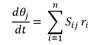
Where n is the number of reactions and Sij is the “stoichiometric coefficient”, which denotes how many times the species in question occurs in the reaction and whether it is produced or consumed. For the bulk species (gas phase concentrations), the mass balances were:

Cj is the concentration of the species in the bulk phase, Msites is the total concentration of catalysts sites in the reactor volume, ε is the void fraction of the catalyst bed, F is the total volumetric flow through the reactor, VR is the reactor volume and Cj,inlet is the inlet concentration of the bulk species.
Using the systematic approach described above, a system of 33 non-linear ordinary differential equations was obtained. Starting with an empty catalyst, the system was solved until a steady state was reached.
Results. Microkinetic modelling showed high selectivities towards methanol at low temperatures (between 95 and 100 %). Selectivities decreased with increasing temperature for both catalysts, although the magnitude of the change was somewhat smaller than in the experiment and kMC. As in kMC, Cu/Mg catalyst was observed to have a little higher selectivity than Cu/Zn, but the latter nevertheless performs better on account of great conversion, especially at lower temperatures. Above 650 K, the conversion for both catalysts is the same. As for pressure dependence, the conversions and selectivities increase with increasing pressure. This effect is more pronounced on Cu/Zn catalyst.
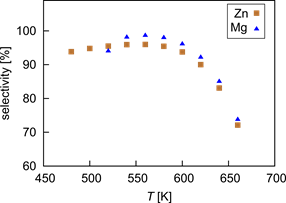
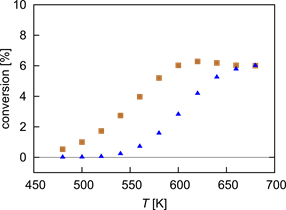
Figure 1: Temperature dependence of selectivity towards CH3OH and conversion of CO2 for the investigated catalysts from microkinetic modelling at p = 40 bar and GHSV = 6000 h−1.
Conclusion. We have synthesised Cu/Zn and Cu/Mg catalysts for catalytic hydrogenation of carbon dioxide into methanol. Experimental results showed high selectivities (above 90 %) at industrially relevant temperatures (200-250 °C) and pressure (20-40 bar) and good conversions. As the temperature increases, selectivity is lowered but the conversion is increased. The main side product is carbon monoxide, which is formed through reverse water-gas shift (RWGS) reaction because it is favoured at higher temperatures and pressures. Cu/Zn catalyst had much higher conversion, while Cu/Mg exhibited marginally better selectivity towards methanol. Results from kMC and MK modelling were in good agreement with these experimental results, proving that out model is sound and veracious for describing catalytic methanol synthesis.
DFT results prove that the reaction proceeds via formate pathway, i.e. through HCOO, H2COO, H2COOH, H2CO, H3CO to CH3OH. On Cu/Zn catalyst, formation of H2COO has the highest activation energy along the aforementioned reaction path and is probably the rate-determining step. On Cu/Mg, the rate-determining step is the same, but H2COOH is never formed as H2COO decomposes into H2COO directly. Insights from kMC reveal the temporal evolution of the lattice coverage and frequency of each reaction step. Lattice is first quickly saturated with hydrogen. As the reaction proceeds, other intermediates are gradually formed until the steady state is reached. Interestingly, H2COO hydrogenation into H2COOH is decisively the most frequent reaction step (the opposite of rate-determining step) on Cu/Zn , while on Cu/Mg RWGS pathway contributes non-negligibly.
Our results offer novel insights into the hydrogenation of carbon dioxide to methanol. Exact elucidation of the pathway, including energetics and kinetics of every reaction step, allows for calculation of catalyst performance across a wide range of operating conditions. This approach can be extended to other catalyst combinations, revealing promising catalysts in hope of improving the industrial grade CZA catalyst.
See more of this Group/Topical: Catalysis and Reaction Engineering Division