
Electrochemical Swing Process for Carbon Capture
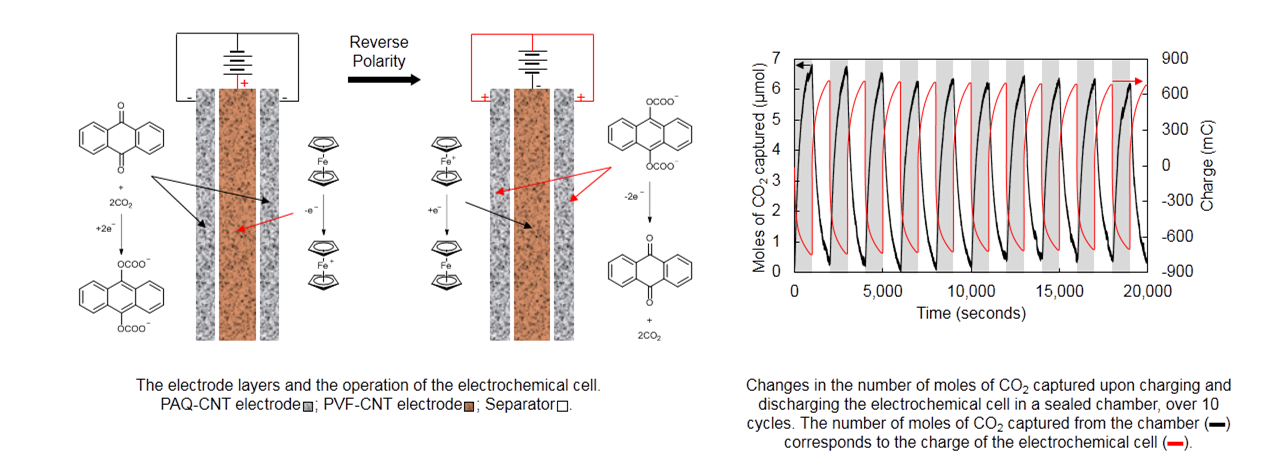
The capture of carbon dioxide (CO2) at low concentrations (<1%) is of interest for power generation and other industrial processes, as well as for ventilation of enclosed spaces. We report a solid-state Faradaic electrochemical cell that exploits the reductive addition of CO2 to quinones for CO2 capture. The behavior of the cell is modulated by the introduction of CO2 which changes the reduction of quinone from two one-electron reductions to one two-electron reduction. This results in a change in the potential window of the cell and alters its charge-discharge behavior. An electrochemical cell with a cathode, comprised of a polyanthraquinone-carbon nanotube composite, captures CO2 upon charging via the carboxylation of reduced quinones, and releases CO2 upon discharging. The novel cell architecture sandwiches a polyvinylferrocene anode, which serves as both an electron source and sink for the reduction and oxidation of quinones respectively, with two polyanthraquinone cathodes, maximizing the cathode surface area exposed to gas, allowing for ease of stacking of the cells in a device. The bench-scale prototype made demonstrates capture of CO2 from inlet streams of CO2 concentrations as low as 0.5% (5000 ppm) at a Faradaic efficiency of >90% and a work of 40-90 kJ per mole of CO2 captured. This makes it an efficiency improving addition to HVAC systems and cabin environmental control systems aboard aircraft and vehicles.
See more of this Group/Topical: Environmental Division