

Keywords:
(1) Chemical Reaction Engineering
(2) Thermodynamics
(3) Transport Phenomena
Abstract:
Our interest in the flame parameter Extinction Strain Rate (ESR) is motivated by recent work from the Ghoniem lab at MIT which has shown ESR to correlate strongly with turbulent flame structure and stability [1]. This is in turn important for predicting engine misfire, an important issue for natural gas engines. While ESR is a valuable parameter for describing flame behavior, it is unfortunately difficult to measure experimentally under many conditions of interest. Therefore, accurate and efficient computational methods become important to its use. However, current software for computing ESR has two important weaknesses. First, the step wise continuation solution method used to determine ESR doesn’t provide adequate sensitivity analysis necessary for refinement of chemical kinetic mechanisms. Current works reporting ESR sensitivity analysis have had to resort to brute force techniques and other partial measures [2]. Second, the methods often fail or take prohibitively long for larger detailed mechanisms, which are necessary for predicting polycyclic aromatic hydrocarbon (PAH) and soot formation as well as the oxidation of complex fuels like gasoline. Characteristic computation timings are shown in Figure 1, with these values neglecting multicomponent transport formulation as well as thermal diffusion, both of which increase accuracy at the cost of significant increases in computation time.
Our work seeks to address both of these issues, focusing first on sensitivity analysis. We present further analysis on how sensitivities might be obtained from current solver methods. This is done through examination of the underlying equations for the one dimensional, reacting, axisymmetric jet system used for computing ESR, as well as investigation of the phenomena governing extinction. With regard to the second problem, we’ve extensively investigated initial value problem formulation (IVP) as opposed to the complete discretization used by current ESR solvers. An IVP formulation would significantly improve large mechanism computations since it avoids the issue of each additional species in the chemical mechanism adding additional variables equal to the number of discretization points. We are also actively examining how improved sparsity solvers might be implemented to better handle the full discretization method if it cannot be avoided entirely.
Research funded by ExxonMobil as Founding Member of MIT Energy Initiative.
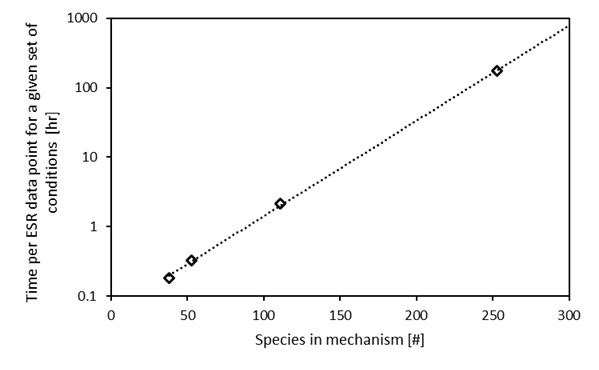
Figure 1: Correlation between run time for a single ESR data point in CHEMKINPro15151 and mechanism number of species. Calculations for Methane-Air twin flames with an equivalence ratio of 1 at ambient pressure, 1atm. Thermal diffusion and use of multicomponent transport handling are neglected, both of which are necessary for accurate results but require significant increases in computation time.
[1] Shanbhogue, S. J., Sanusi, Y. S., Taamallah, S., Habib, M. A., Mokheimer, E. M. A., & Ghoniem, A. F. (2016). Flame macrostructures, combustion instability and extinction strain scaling in swirl-stabilized premixed CH 4/H 2 combustion. Combustion and Flame, 163, 494-507.
[2] Dong, Y., Holley, A. T., Andac, M. G., Egolfopoulos, F. N., Davis, S. G., Middha, P., & Wang, H. (2005). Extinction of premixed H 2/air flames: chemical kinetics and molecular diffusion effects. Combustion and Flame, 142(4), 374-387.
See more of this Group/Topical: Catalysis and Reaction Engineering Division